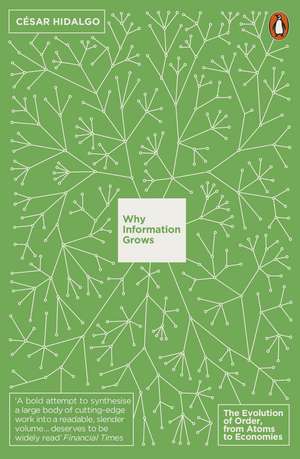
Why Information Grows
Autor Cesar Hidalgoen Limba Engleză Paperback – 7 apr 2016
What is economic growth? And why, historically, has it occurred in only a few places? Previous efforts to answer these questions have focused on institutions, geography, finances, and psychology. But MIT professor César Hidalgo argues that in order to fully grasp the nature of economic growth we need to transcend the social sciences and turn to the science of information, networks and complexity. The growth of economies, he explains, is deeply connected with the growth of order - or information.
At first glance, the universe seems hostile to order. Thermodynamics dictates that over time, order will disappear. But thermodynamics also has loopholes that promote the growth of information in pockets. Our cities are such pockets where information grows, but they are not all the same. For every Silicon Valley, Tokyo, and London, there are dozens of places with underdeveloped economies. Why does the US economy outstrip Brazil's, and Brazil's that of Chad? Why did the technology corridor along Boston's Route 128 languish while Silicon Valley blossomed? In each case, the key is how people, companies, and the networks they form process information - it is all about their knowledge, knowhow and imagination. As Hidalgo compellingly shows, economies are made of networks of people and society is a collective computer. The problem of economic development is in fact the problem of making these networks more powerful.
A radical new interpretation of global economics, Why Information Grows overturns traditional assumptions about the development of economies and the origins of wealth and takes a crucial step toward making economics less the dismal science and more the insightful one.
Preț: 63.60 lei
Preț vechi: 78.69 lei
-19%
Puncte Express: 95
Carte disponibilă
Livrare economică 12-18 noiembrie
Livrare express 27-31 octombrie pentru 33.74 lei
Livrare prin curier în România Termenul estimat este afișat lângă disponibilitate.
Transport gratuit de la 400.00 lei Plată online sau ramburs, în funcție de opțiunile comenzii.
Retur gratuit în 14 zile Comandă securizată și suport în română.
Specificații
ISBN-13: 9780141978024
ISBN-10: 0141978023
Pagini: 256
Dimensiuni: 128 x 199 x 20 mm
Greutate: 0.19 kg
Editura: Penguin Books
Locul publicării:London, United Kingdom
ISBN-10: 0141978023
Pagini: 256
Dimensiuni: 128 x 199 x 20 mm
Greutate: 0.19 kg
Editura: Penguin Books
Locul publicării:London, United Kingdom
V-ar putea interesa
-
 The Designer's Guide to VHDLPeter J. Ashenden-34%Preț: 375.93 lei572.56 lei
 -
 Deep SimplicityJohn GribbinPreț: 92.84 lei
 -
 -36%Preț: 347.01 lei544.93 lei
 -
 Every Thing Must Go: Metaphysics NaturalizedJames LadymanPreț: 363.24 lei
 -
 Evolution of Networks: From Biological Nets to the Internet and WWWS. N. Dorogovtsev-23%Preț: 432.72 lei558.75 lei
 -
 Elements of Information TheoryThomas M. Cover-20%Preț: 751.59 lei939.49 lei
 -
 Introduction to Systems TheoryNiklas LuhmannPreț: 169.40 lei
 -
 A Student's Guide to Coding and Information TheoryStefan M. MoserPreț: 260.73 lei
 -
 Introduction ModelicaFritzson-8%Preț: 452.76 lei492.13 lei
 -
 Optimal Estimation of Dynamic SystemsJohn L. Crassidis-18%Preț: 1494.88 lei1823.02 lei
 -
 Switching in Systems and ControlDaniel Liberzon-15%Preț: 584.73 lei687.91 lei
 -
 Introducing ChaosIwona AbramsPreț: 63.55 lei
 -
 Ekovitrin GlobalSeref OzataPreț: 165.02 lei
 -
 Artistic Narrative Of TechnologyMustafa Özilgen-23%Preț: 1244.96 lei1616.84 lei
Notă biografică
César Hidalgo leads the Macro Connections group at the MIT Media Lab. A trained statistical physicist and an expert on Networks and Complex Systems, he also has extensive experience in the field of economic development and has pioneered research on how big data impacts economic decision-making.
Recenzii
A bold attempt to synthesise a large body of cutting-edge work into a readable, slender volume... his thought-provoking book deserves to be widely read
Mr Hidalgo succeeds brilliantly in bringing his complex subject to life. His book is full of nuggets, from memorable phrases to interesting metaphors
[Hidalgo's] innovative thinking about what drives growth could help us to navigate the turbulence of the ever more interconnected global economy... He has identified a fertile seam
The concept of information is necessary to make sense of anything that is not a boring featureless mass, including life, mind, society, and value. Why Information Grows lucidly explains the foundations of this essential concept, while creatively applying it in exciting new ways. It is filled with interesting ideas, and a pleasure to read
Why Information Grows shows us how humans infuse information into matter, making it more valuable than gold. Hidalgo's work brilliantly spotlights the true alchemy of the twenty-first century and its impact from economic complexity to national competitiveness
Mr Hidalgo succeeds brilliantly in bringing his complex subject to life. His book is full of nuggets, from memorable phrases to interesting metaphors
[Hidalgo's] innovative thinking about what drives growth could help us to navigate the turbulence of the ever more interconnected global economy... He has identified a fertile seam
The concept of information is necessary to make sense of anything that is not a boring featureless mass, including life, mind, society, and value. Why Information Grows lucidly explains the foundations of this essential concept, while creatively applying it in exciting new ways. It is filled with interesting ideas, and a pleasure to read
Why Information Grows shows us how humans infuse information into matter, making it more valuable than gold. Hidalgo's work brilliantly spotlights the true alchemy of the twenty-first century and its impact from economic complexity to national competitiveness
Descriere
Descriere de la o altă ediție sau format:
What is economic growth? And why, historically, has it occurred in only a few places? Previous efforts to answer these questions have focused on institutions, geography, finances, and psychology. But according to MIT's antidisciplinarian César Hidalgo, understanding the nature of economic growth demands transcending the social sciences and including the natural sciences of information, networks, and complexity. To understand the growth of economies, Hidalgo argues, we first need to understand the growth of order.At first glance, the universe seems hostile to order. Thermodynamics dictates that over time, order,or information,disappears. Whispers vanish in the wind just like the beauty of swirling cigarette smoke collapses into disorderly clouds. But thermodynamics also has loopholes that promote the growth of information in pockets. Although cities are all pockets where information grows, they are not all the same. For every Silicon Valley, Tokyo, and Paris, there are dozens of places with economies that accomplish little more than pulling rocks out of the ground. So, why does the US economy outstrip Brazil's, and Brazil's that of Chad? Why did the technology corridor along Boston's Route 128 languish while Silicon Valley blossomed? In each case, the key is how people, firms, and the networks they form make use of information.Seen from Hidalgo's vantage, economies become distributed computers, made of networks of people, and the problem of economic development becomes the problem of making these computers more powerful. By uncovering the mechanisms that enable the growth of information in nature and society, Why Information Grows lays bare the origins of physical order and economic growth. Situated at the nexus of information theory, physics, sociology, and economics, this book propounds a new theory of how economies can do not just more things, but more interesting things.
What is economic growth? And why, historically, has it occurred in only a few places? Previous efforts to answer these questions have focused on institutions, geography, finances, and psychology. But according to MIT's antidisciplinarian César Hidalgo, understanding the nature of economic growth demands transcending the social sciences and including the natural sciences of information, networks, and complexity. To understand the growth of economies, Hidalgo argues, we first need to understand the growth of order.At first glance, the universe seems hostile to order. Thermodynamics dictates that over time, order,or information,disappears. Whispers vanish in the wind just like the beauty of swirling cigarette smoke collapses into disorderly clouds. But thermodynamics also has loopholes that promote the growth of information in pockets. Although cities are all pockets where information grows, they are not all the same. For every Silicon Valley, Tokyo, and Paris, there are dozens of places with economies that accomplish little more than pulling rocks out of the ground. So, why does the US economy outstrip Brazil's, and Brazil's that of Chad? Why did the technology corridor along Boston's Route 128 languish while Silicon Valley blossomed? In each case, the key is how people, firms, and the networks they form make use of information.Seen from Hidalgo's vantage, economies become distributed computers, made of networks of people, and the problem of economic development becomes the problem of making these computers more powerful. By uncovering the mechanisms that enable the growth of information in nature and society, Why Information Grows lays bare the origins of physical order and economic growth. Situated at the nexus of information theory, physics, sociology, and economics, this book propounds a new theory of how economies can do not just more things, but more interesting things.