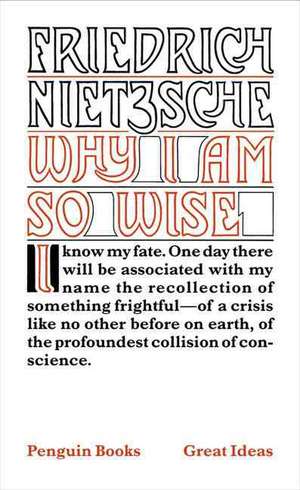
Why I Am So Wise
Autor Friedrich Nietzsche Traducere de R J Hollingdaleen Limba Engleză Paperback – 6 sep 2005
Nivel de studiu: referință pentru licență în filosofie și istoria ideilor. Volumul Why I am So Wise reprezintă o sinteză provocatoare a gândirii lui Friedrich Nietzsche, oferind cititorului acces direct la spiritul iconoclast al autorului prin selecții din ultimele sale lucrări finalizate. Reținem aici o structură bipartită: prima parte preia nucleul din autobiografia sa intelectuală, Ecce Homo, unde Nietzsche își analizează propria devenire și geniul, în timp ce a doua parte, extrasă din Amurgul idolilor, prezintă metoda sa de a „filosofa cu ciocanul”. Subliniem că acest volum nu este doar o culegere de aforisme, ci o demonstrație a stilului polemic și ironic care a redefinit moralitatea occidentală. Cititorii familiarizați cu A Nietzsche Reader vor aprecia Why I am So Wise pentru concentrarea sa asupra vocii subiective a autorului, oferind o perspectivă mai intimă și mai agresivă asupra misiunii sale filosofice decât antologiile tematice extinse. Spre deosebire de lucrările timpurii, precum Unpublished Fragments from the Period of Dawn, unde observăm o tatonare a conceptelor, acest volum din seria Penguin Great Ideas prezintă concluziile radicale ale unui gânditor care se consideră un „destin”. Progresia textului, de la auto-analiza din Ecce Homo până la atacul asupra erorilor metafizice din Amurgul idolilor, ghidează cititorul prin procesul de deconstrucție a valorilor creștine și a raționalismului socratic, piloni centrali în întreaga operă nietzscheană, de la Beyond Good and Evil la The Joyous Science.
Preț: 60.82 lei
Carte disponibilă
Livrare economică 29 octombrie-12 noiembrie
Specificații
ISBN-10: 0143036343
Pagini: 96
Dimensiuni: 113 x 180 x 10 mm
Greutate: 0.08 kg
Editura: Penguin Publishing Group
V-ar putea interesa
-
 On the Shortness of LifeLucius Annaeus Seneca-21%Preț: 43.93 lei55.67 lei
 -
 Great Ideas Confessions of a SinnerSaint Augustine-21%Preț: 44.13 lei55.79 lei
 -
 On FriendshipMichel De Montaigne-21%Preț: 44.27 lei55.87 lei
 -
 The Social ContractJean-Jacques Rousseau-20%Preț: 44.59 lei55.87 lei
 -
 On the Pleasure of HatingWilliam Hazlitt-20%Preț: 44.92 lei56.50 lei
 -
 The Communist ManifestoFriedrich Engels-21%Preț: 44.20 lei55.63 lei
 -
 Great Ideas On the Suffering of the WorldArthur Schopenhauer-30%Preț: 38.96 lei55.89 lei
 -
 On Art and LifeJohn Ruskin-21%Preț: 43.88 lei55.44 lei
 -
 On Natural SelectionCharles Darwin-22%Preț: 43.50 lei55.66 lei
 -
 Great Ideas Why I WriteGeorge Orwell-21%Preț: 44.02 lei55.76 lei
 -
 The First Ten BooksConfucius-21%Preț: 43.46 lei55.19 lei
 -
 The Art of WarSun Tzu-21%Preț: 43.88 lei55.66 lei
 -
 Fear and TremblingSøren Kierkegaard-20%Preț: 44.49 lei55.81 lei
 -
 On SuicideDavid Hume-21%Preț: 44.10 lei55.80 lei
 -
 Conspicuous ConsumptionThorstein Veblen-29%Preț: 40.29 lei56.48 lei
 -
 Books v. CigarettesGeorge OrwellPreț: 55.70 lei
 -
 The Fastidious AssassinsAlbert CamusPreț: 55.61 lei
 -
 The Sickness Unto DeathSøren Kierkegaard-20%Preț: 44.73 lei55.97 lei
 -
 Useful Work v. Useless ToilWilliam MorrisPreț: 55.56 lei
 -
 Days of ReadingMarcel ProustPreț: 55.61 lei
 -
 The Future of an IllusionSigmund FreudPreț: 55.43 lei
 -
 An Answer to the Question: 'What Is Enlightenment?'Immanuel Kant-21%Preț: 44.97 lei56.57 lei
 -
 Why Look at Animals?John BergerPreț: 55.69 lei
 -
 The Moral Essays (Operette Morali)LeopardiPreț: 273.75 lei
 -
 PassionsGiacomo LeopardiPreț: 502.71 lei
 -
 Dogs of God: Columbus, the Inquisition, and the Defeat of the MoorsJr. Reston, JamesPreț: 114.66 lei
 -
 Moral FablesGiacomo LeopardiPreț: 71.31 lei
De ce să citești această carte
Recomandăm acest volum oricărui student sau pasionat de filosofie care dorește să înțeleagă rădăcinile nihilismului modern și ale perspectivismului. Este o poartă de intrare ideală în universul lui Nietzsche, oferind esența radicalismului său într-un format compact. Cititorul câștigă o înțelegere clară a modului în care autorul a răsturnat ierarhiile morale tradiționale, pregătind terenul pentru existențialismul secolului XX.
Despre autor
Friedrich Nietzsche (1844–1900) a fost un filosof german, critic cultural și filolog, a cărui operă a exercitat o influență profundă asupra istoriei intelectuale moderne. Și-a început cariera ca filolog clasic, devenind cel mai tânăr profesor la Universitatea din Basel în 1869. Sănătatea precară l-a forțat să se retragă în 1879, perioadă în care a scris cele mai importante lucrări ale sale, caracterizate prin aforisme, ironie și o critică radicală a adevărului. Filosofia sa, axată pe „voința de putere”, moartea lui Dumnezeu și depășirea nihilismului prin afirmarea vieții, rămâne un punct de referință crucial pentru înțelegerea modernității.
Descriere scurtă
Now, Penguin brings you the works of the great thinkers, pioneers, radicals and visionaries whose ideas shook civilization, and helped make us who we are. Penguin's Great Ideas series features twelve groundbreaking works by some of history's most prodigious thinkers, and each volume is beautifully packaged with a unique type-drive design that highlights the bookmaker's art. Offering great literature in great packages at great prices, this series is ideal for those readers who want to explore and savor the Great Ideas that have shaped the world.
One of the most iconoclastic thinkers of all time, Friedrich Nietzsche continues to challenge the boundaries of conventional religion and morality with his subversive theories of the 'superman', the individual will, the death of God and the triumph of an all-powerful human life force.
Cuprins
How One Becomes What One Is
Foreword
Why I am so Wise
Why I am So Clever
Why I Write Such Good Books
Why I am a Destiny
2. Twilight of the Idols
or How to Philosophize with a Hammer
Maxims and Arrows
The Four Great Errors
The Hammer Speaks
Notă biografică
R. J. Hollingdale has translated eleven of Nietzsche’s books and published two books about him. He has also translated works by, among others, Schopenhauer, Goethe, E. T. A. Hoffmann, Lichtenberg and Theodor Fontane, many of these for the Penguin Classics. He is Honorary President of the British Nietzsche Society, and was for the Australian academic year 1991 Visiting Fellow at Trinity College, Melbourne.
Extras
Descriere
One of the most iconoclastic thinkers of all time, Friedrich Nietzsche continues to challenge the boundaries of conventional religion and morality with his subversive theories of the 'superman', the individual will, the death of God and the triumph of an all-powerful human life force.