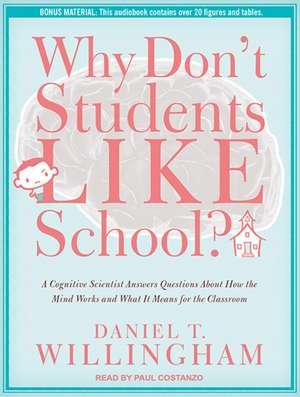
Why Don't Students Like School?: A Cognitive Scientist Answers Questions about How the Mind Works and What It Means for the Classroom
Paul Costanzo Autor Daniel T. Willinghamen Limba Engleză CD-Audio – 31 aug 2011
Notăm cu interes o lacună persistentă în literatura pedagogică: prăpastia dintre descoperirile fundamentale ale neuroștiinței și aplicarea lor concretă la catedră. Deși studiile despre creier au avansat considerabil, profesorii primesc rareori instrumente pentru a naviga între cerințele testărilor standardizate și mecanismele cognitive reale ale elevilor. Why Don't Students Like School? vine să completeze exact acest gol, oferind explicații riguroase despre motivul pentru care studenții rețin tot ce văd la televizor, dar uită conceptele predate la curs.
Găsim în această lucrare o abordare care demitizează „stilurile de învățare” și pune accent pe structura narativă și rutină ca piloni ai memoriei. Comparabil cu Visible Learning and the Science of How We Learn de John Hattie în rigurozitatea datelor, volumul lui Daniel T. Willingham este însă actualizat pentru a răspunde provocărilor moderne ale curriculumului, fiind mai degrabă un ghid de implementare decât o meta-analiză statistică. Dacă Hattie se concentrează pe rezultate, Willingham explică procesele biologice din spatele acestor rezultate.
Spre deosebire de alte contribuții ale sale, unde autorul analizează psihologia cognitivă pură, acest titlu reprezintă puntea sa cea mai pragmatică către educație. Credem că relevanța acestui volum rezidă în capacitatea sa de a explica de ce mintea umană nu este concepută nativ pentru a gândi, ci pentru a evita efortul cognitiv, oferind soluții pentru a face învățarea să pară naturală. Formatul audio, narat de Paul Costanzo, facilitează integrarea acestor principii în rutina zilnică a cadrelor didactice, transformând teoria academică în sfaturi testate la clasă.
Preț: 178.75 lei
Indisponibil temporar
Specificații
ISBN-10: 1452604193
Dimensiuni: 163 x 140 x 29 mm
Greutate: 0.19 kg
Ediția:Completă
Editura: Tantor Audio
V-ar putea interesa
-
 Preț: 339.38 lei
 -
 Transmission Line Modeling TLMChristopou-9%Preț: 1069.14 lei1174.88 lei
 -
 Help Seeking in Academic Settings: Goals, Groups, and ContextsStuart A. Karabenick-18%Preț: 1124.23 lei1371.02 lei
 -
 -18%Preț: 1123.20 lei1369.75 lei
 -
 Preț: 296.17 lei
 -
 Cognition: The Thinking AnimalDaniel T. Willingham-11%Preț: 580.69 lei652.46 lei
 -
 Raising Kids Who ReadDaniel T. WillinghamPreț: 135.20 lei
 -
 -28%Preț: 463.70 lei642.16 lei
 -
 -24%Preț: 222.03 lei293.86 lei
 -
 -24%Preț: 222.59 lei294.21 lei
 -
 -25%Preț: 178.04 lei238.22 lei
 -
 STAYING CONNECTEDRachel SalibaPreț: 204.40 lei
 -
 Teach for Climate JusticeTom RoderickPreț: 263.36 lei
 -
 The British Dyslexia Association - Teaching Dyslexic Students: Theory and PracticeBritish Dyslexia Association-24%Preț: 245.99 lei325.16 lei
 -
 Elstree 175Hugo VickersPreț: 276.30 lei
 -
 Outsmart Your BrainDaniel T WillinghamPreț: 169.12 lei
 -
 Schwerpunktthema Abitur Englisch - Sekundarstufe IIPeter BaasnerPreț: 277.71 lei
 -
 Preț: 375.08 lei
 -
 Befreiungsschlag. Der Weg aus der GewaltCornelia WitzmannPreț: 83.41 lei
 -
 Preț: 196.01 lei
De ce să citești această carte
Recomandăm această carte oricărui profesor, mentor sau părinte care dorește să înțeleagă arhitectura cognitivă a învățării. Cititorul câștigă o perspectivă bazată pe dovezi asupra modului în care se formează memoria și, mai ales, învață de ce faptele sunt esențiale pentru gândirea critică. Este un instrument indispensabil pentru a transforma predarea dintr-o intuiție într-o știință aplicată, optimizând retenția informației în rândul elevilor.
Despre autor
Daniel T. Willingham este un psiholog cognitiv renumit, specializat în aplicarea cercetărilor despre creier în domeniul educației. Este cunoscut pentru rubrica sa influentă „Ask the Cognitive Scientist” din American Educator, unde răspunde întrebărilor practice ale profesorilor. Această ediție audio este narată de Paul Costanzo, un profesionist format la Juilliard, care aduce peste 25 de ani de experiență în voice acting și o nuanțare specifică narațiunilor de non-ficțiune academică, fiind premiat de revista AudioFile pentru calitatea interpretării sale.