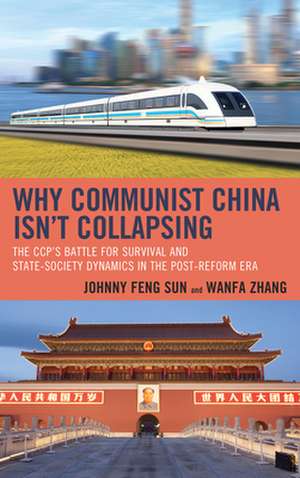
Why Communist China isn’t Collapsing: The CCP’s Battle for Survival and State-Society Dynamics in the Post-Reform Era
Autor Feng Sun, Wanfa Zhangen Limba Engleză Hardback – 5 noi 2019
More importantly, the book conducts a deep analysis of the reasons that this authoritarian regime could act responsively and progressively. The CCP possesses strong vigilance and adaptability assets which have helped it survive various crises over the past decades. This book scrutinizes the Chinese cultural environment as well as the political perception and economic interests of major social actors presumed to be forces with potential power to topple the regime. Both the state-dependency resulting from a late developer context and the elements of collectivism and "rule by virtue" in traditional Chinese culture play critical roles in shaping public attitudes toward the CCP regime.
Preț: 667.61 lei
Preț vechi: 814.15 lei
-18%
Puncte Express: 1001
Carte tipărită la comandă
Livrare economică 01-15 iunie
Specificații
ISBN-13: 9781498567152
ISBN-10: 1498567150
Pagini: 284
Dimensiuni: 161 x 233 x 26 mm
Greutate: 0.59 kg
Editura: Bloomsbury Publishing
Colecția Lexington Books
Locul publicării:New York, United States
ISBN-10: 1498567150
Pagini: 284
Dimensiuni: 161 x 233 x 26 mm
Greutate: 0.59 kg
Editura: Bloomsbury Publishing
Colecția Lexington Books
Locul publicării:New York, United States
Cuprins
Chapter 1: Introduction
Chapter 2:"Comcapitalism"-The CCP's Legitimacy Battle on the Political and Economic Front
Chapter 3: "Comfucianism"-The CCP's Fight on the Ideological and Cultural Front
Chapter 4: "Blocking, Dredging, and Channeling"-The CCP's Struggle on the Social Front
Chapter 5: Stability at Risk? Party Elites and Factionalism
Chapter 6: Unexpected Allies-Coopted Capitalists and The Middle Class
Chapter 7: The Marginalized Social Class-Workers and Peasants
Chapter 8: The Calculated Strategies of Hard Power and Soft Tread
Chapter 9: International Political Crisis and the CCP's New Opportunities
Chapter 10: Conclusion
Chapter 2:"Comcapitalism"-The CCP's Legitimacy Battle on the Political and Economic Front
Chapter 3: "Comfucianism"-The CCP's Fight on the Ideological and Cultural Front
Chapter 4: "Blocking, Dredging, and Channeling"-The CCP's Struggle on the Social Front
Chapter 5: Stability at Risk? Party Elites and Factionalism
Chapter 6: Unexpected Allies-Coopted Capitalists and The Middle Class
Chapter 7: The Marginalized Social Class-Workers and Peasants
Chapter 8: The Calculated Strategies of Hard Power and Soft Tread
Chapter 9: International Political Crisis and the CCP's New Opportunities
Chapter 10: Conclusion
Recenzii
This work by Feng Sun and Wanfa Zhang seeks to provide the reader with an overview of the various factors contributing to the political survival of the Chinese party-state. The book is an interesting work to reflect upon and provides an introduction into the various debates and concepts surrounding the CPC's rule over China.
Challenging Western scholars and journalists who foresee China's collapse, Sun (Troy Univ.) and Zhang (Florida Institute of Technology) propose that communist leadership has devised a resilient, flexible system through what they call "Comcapitalism," a blend of capitalism and socialism, and "Comfucianism," a graft of traditional values on to Party rule. Coercion remains, but officials "channel mass discontent into constructive activities" that address local issues. Clever, but is it a stable, long-term solution? The authors present empirical data showing that most Chinese are content and patriotic, and they refute the Western modernization theory that economic growth forms a middle class and thus leads to democracy. That scenario, they write, does not fit Chinese history and culture. Sun and Zhang deem factionalism, corruption, and labor and peasant unrest under control. This book was published a little too early to include Xi Jinping's tightening and reemphasis on state-owned enterprises and difficulties with debt, Xinjiang, and Hong Kong. Middle-way communist experiments (e.g., those of Tito and Gorbachev) alternated between loose and tight, never finding stability. This is now possibly China's pattern. The authors' offer a testable proposition: if the Beijing regime endures without systemic upheaval, they will have been proven right. . . Summing Up: Recommended. Upper-division undergraduates through faculty.
"Why has the Chinese Communist Party not collapsed? The answer is simple: because it has gained the trust of the people. Why has it gained the trust of the people? The answer is complex and this book sheds much light; it is a must-read for anyone who wants to understand contemporary Chinese politics."
"Why Communist China Isn't Collapsing attempts to explain the survival of the Chinese Communist regime. The authors argue that its legitimacy has a solid foundation in terms of Chinese political theory and political culture. As China now faces a deteriorating domestic and international environment, their thesis deserves careful consideration by those concerned with its future."
"This book is a timely overview of the factors behind China's remarkable economic success and rise to power that challenges conventional wisdom predicting either the collapse or democratization of China. While drawing on, and often dismissing the relevance of the western academic literature and theories, Sun and Zhang present a detailed insiders' view of state-society relations that is largely sympathetic to the leadership role of the Chinese Communist Party as a responsive authoritarian regime."
Challenging Western scholars and journalists who foresee China's collapse, Sun (Troy Univ.) and Zhang (Florida Institute of Technology) propose that communist leadership has devised a resilient, flexible system through what they call "Comcapitalism," a blend of capitalism and socialism, and "Comfucianism," a graft of traditional values on to Party rule. Coercion remains, but officials "channel mass discontent into constructive activities" that address local issues. Clever, but is it a stable, long-term solution? The authors present empirical data showing that most Chinese are content and patriotic, and they refute the Western modernization theory that economic growth forms a middle class and thus leads to democracy. That scenario, they write, does not fit Chinese history and culture. Sun and Zhang deem factionalism, corruption, and labor and peasant unrest under control. This book was published a little too early to include Xi Jinping's tightening and reemphasis on state-owned enterprises and difficulties with debt, Xinjiang, and Hong Kong. Middle-way communist experiments (e.g., those of Tito and Gorbachev) alternated between loose and tight, never finding stability. This is now possibly China's pattern. The authors' offer a testable proposition: if the Beijing regime endures without systemic upheaval, they will have been proven right. . . Summing Up: Recommended. Upper-division undergraduates through faculty.
"Why has the Chinese Communist Party not collapsed? The answer is simple: because it has gained the trust of the people. Why has it gained the trust of the people? The answer is complex and this book sheds much light; it is a must-read for anyone who wants to understand contemporary Chinese politics."
"Why Communist China Isn't Collapsing attempts to explain the survival of the Chinese Communist regime. The authors argue that its legitimacy has a solid foundation in terms of Chinese political theory and political culture. As China now faces a deteriorating domestic and international environment, their thesis deserves careful consideration by those concerned with its future."
"This book is a timely overview of the factors behind China's remarkable economic success and rise to power that challenges conventional wisdom predicting either the collapse or democratization of China. While drawing on, and often dismissing the relevance of the western academic literature and theories, Sun and Zhang present a detailed insiders' view of state-society relations that is largely sympathetic to the leadership role of the Chinese Communist Party as a responsive authoritarian regime."