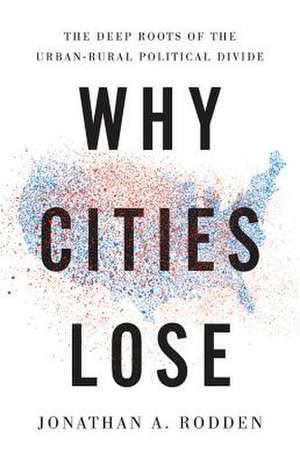
Why Cities Lose
Autor Jonathan A Roddenen Limba Engleză Hardback – 4 iun 2019
Why is it so much easier for the Democratic Party to win the national popular vote than to build and maintain a majority in Congress? Why can Democrats sweep statewide offices in places like Pennsylvania and Michigan yet fail to take control of the same states' legislatures? Many place exclusive blame on partisan gerrymandering and voter suppression. But as political scientist Jonathan A. Rodden demonstrates in Why Cities Lose, the Left's electoral challenges have deeper roots in economic and political geography.
In the late nineteenth century, support for the Left began to cluster in cities among the industrial working class. Today, left-wing parties have become coalitions of diverse urban interest groups, from racial minorities to the creative class. These parties win big in urban districts but struggle to capture the suburban and rural seats necessary for legislative majorities. A bold new interpretation of today's urban-rural political conflict, Why Cities Lose also points to electoral reforms that could address the Left's under-representation while reducing urban-rural polarization.
Preț: 124.06 lei
Preț vechi: 222.64 lei
-44% Nou
Puncte Express: 186
Preț estimativ în valută:
21.95€ • 25.74$ • 19.28£
21.95€ • 25.74$ • 19.28£
Carte disponibilă
Livrare economică 22 ianuarie-05 februarie
Preluare comenzi: 021 569.72.76
Specificații
ISBN-13: 9781541644274
ISBN-10: 1541644271
Pagini: 336
Dimensiuni: 164 x 244 x 33 mm
Greutate: 0.52 kg
Editura: BASIC BOOKS
ISBN-10: 1541644271
Pagini: 336
Dimensiuni: 164 x 244 x 33 mm
Greutate: 0.52 kg
Editura: BASIC BOOKS
Notă biografică
Jonathan A. Rodden is professor of political science and a senior fellow at the Hoover Institution at Stanford University, and founder and director of the Stanford Spatial Social Science Lab. The author of the prizewinning Hamilton's Paradox, he lives in Stanford, California.
Recenzii
"The biggest problem facing America today is political polarization: Democrats command the superstar cities and tech hubs that drive the knowledge economy, while Republicans have a stronghold in suburban places and rural areas. In this important book, Jonathan A. Rodden draws on a trove of data spanning the twentieth century to show us in painstaking detail why cities continue to lose out to rural and suburban interests, and what challenges this poses for our democracy."—Richard Florida, author of The Rise of the Creative Class and The New Urban Crisis
"This important book, which should reset our understanding of polarization in America and around the world, will comfort neither those on the left who see themselves as the vanguard of a victorious electoral future, nor those on the right who believe that voters are fundamentally conservative."—Andrew Gelman, author of Red State, Blue State, Rich State, Poor State
"This important book, which should reset our understanding of polarization in America and around the world, will comfort neither those on the left who see themselves as the vanguard of a victorious electoral future, nor those on the right who believe that voters are fundamentally conservative."—Andrew Gelman, author of Red State, Blue State, Rich State, Poor State