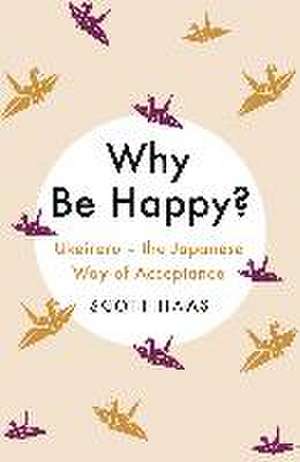
Why Be Happy?: The Japanese Way of Acceptance
Autor Scott Haasen Limba Engleză Paperback – 2 mar 2023
Psychologist Scott Haas spends much of his time in Japan, and with this book he provides a host of delightful examples of the way he has been made welcome, accepted and happy in this distant country, as well as many thought provoking and practical lessons which you can apply.
WHY BE HAPPY? will help make your world a happier place by discovering a place of contentment and peace amid the chaos of modern life.
Preț: 56.32 lei
Preț vechi: 77.32 lei
-27%
Puncte Express: 84
Carte disponibilă
Livrare economică 09-23 noiembrie
Livrare express 24-30 octombrie pentru 39.55 lei
Livrare prin curier în România Termenul estimat este afișat lângă disponibilitate.
Transport gratuit de la 400.00 lei Plată online sau ramburs, în funcție de opțiunile comenzii.
Retur gratuit în 14 zile Comandă securizată și suport în română.
Specificații
ISBN-13: 9781529338799
ISBN-10: 1529338794
Pagini: 256
Dimensiuni: 128 x 194 x 20 mm
Greutate: 0.19 kg
Editura: John Murray Press
Colecția John Murray One
Locul publicării:London, United Kingdom
ISBN-10: 1529338794
Pagini: 256
Dimensiuni: 128 x 194 x 20 mm
Greutate: 0.19 kg
Editura: John Murray Press
Colecția John Murray One
Locul publicării:London, United Kingdom
Recenzii
"Respect, flexibility, and the inspiration to articulate core values are the key elements to understanding different cultures. With these three approaches, Why Be Happy? describes quite eloquently the values that Japanese people want to hand to the next generation."
Scott Haas describes dualism of life in Japan perfectly. He allows the reader to view the culture through his experiences as the Japanese simultaneously strive for perfection or imperfection, depending on whether you view it (the culture) from a western or Japanese standpoint. I highly recommend Why Be Happy? to anybody who's interested in learning about Japan. Omedetoo gozaimasu!
Why be Happy? is a fascinating, suggestive contemplation, filtered through experiences in Japan, of the happiness perplex in America. Haas perceives the basic elements of contentment in Japan as acceptance and empathy and asks if these aren't more satisfyingly found in the connections between people than in the isolated (American) individual.
Scott Haas has written a valuable book that is enormously helpful for integrating our Western approach with Japanese practices for stress reduction. Both anecdotal and grounded in research, the book is extremely pragmatic. By focusing on Japanese methods to reduce stress, he then suggests that the subsequent calm can enable people to better address the systemic and institutional causes of their stress.
Scott Haas understands that Japanese cuisine reflects culture and history; he takes us behind the scenes and shows how the food is a sure way to appreciate Japan.
Scott Haas's insightful and engrossing exploration into the Japanese way of acceptance is a road map to a more meaningful life. This wonderful book excites with food for thought that is sumptuous, savory, and nuanced.
Scott Haas asks a very philosophical question, and he is really interesting and deep. Every time you open a page, you'll be amazed.
Scott Haas describes dualism of life in Japan perfectly. He allows the reader to view the culture through his experiences as the Japanese simultaneously strive for perfection or imperfection, depending on whether you view it (the culture) from a western or Japanese standpoint. I highly recommend Why Be Happy? to anybody who's interested in learning about Japan. Omedetoo gozaimasu!
Why be Happy? is a fascinating, suggestive contemplation, filtered through experiences in Japan, of the happiness perplex in America. Haas perceives the basic elements of contentment in Japan as acceptance and empathy and asks if these aren't more satisfyingly found in the connections between people than in the isolated (American) individual.
Scott Haas has written a valuable book that is enormously helpful for integrating our Western approach with Japanese practices for stress reduction. Both anecdotal and grounded in research, the book is extremely pragmatic. By focusing on Japanese methods to reduce stress, he then suggests that the subsequent calm can enable people to better address the systemic and institutional causes of their stress.
Scott Haas understands that Japanese cuisine reflects culture and history; he takes us behind the scenes and shows how the food is a sure way to appreciate Japan.
Scott Haas's insightful and engrossing exploration into the Japanese way of acceptance is a road map to a more meaningful life. This wonderful book excites with food for thought that is sumptuous, savory, and nuanced.
Scott Haas asks a very philosophical question, and he is really interesting and deep. Every time you open a page, you'll be amazed.
Notă biografică
Scott Haas is a writer and clinical psychologist and the author of four books. The winner of a James Beard award for his on-air broadcasts on NPR's Here and Now, he holds a Ph.D. from the University of Detroit and he did his doctoral internship at Massachusetts Mental Health Center, a Harvard Medical School teaching hospital. He works in Japan three to four times each year. He is based in Cambridge, MA.