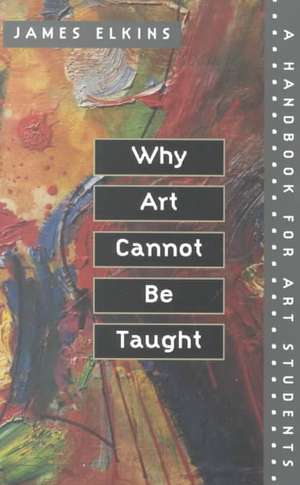
Why Art Cannot Be Taught: A Handbook for Art Students
Autor James Elkinsen Limba Engleză Paperback – 17 mai 2001
Ne-a atras atenția modul în care Why Art Cannot Be Taught abordează educația artistică printr-o lentilă interdisciplinară, împletind pedagogia cu istoria instituțională și analiza sociologică a interacțiunilor din atelier. James Elkins nu propune o metodologie nouă, ci investighează natura paradoxală a încercării de a preda ceea ce mulți consideră a fi „nepredabil”. Considerăm că forța acestui volum rezidă în onestitatea cu care disecă dinamica dintre profesori și studenți, evidențiind discrepanțele dintre obiectivele declarate și realitatea practicii la clasă.
Structura volumului se concentrează pe momentele critice ale educației artistice, în special pe sesiunile de critică (critiques), pe care autorul le folosește ca un studiu de caz pentru a demasca asumpțiile neexaminate și jargonul adesea confuz. Spre deosebire de alte manuale tehnice, James Elkins explorează aici „izolarea intelectuală” a facultăților de profil și modul în care istoria școlii de artă moderne influențează direct curriculumul actual. Merită menționat că autorul nu evită subiectele inconfortabile, precum tensiunile latente din cursurile de desen după model sau inutilitatea impunerii vechilor maeștri ca standarde absolute pentru studenții contemporani.
Ca alternativă la A Philosophy of the Art School de Michael Newall pentru cursurile de pedagogia artei, lucrarea lui Elkins are avantajul de a fi ancorată în experiența directă, oferind un ghid de „supraviețuire” practic pentru studenți, în timp ce Newall se concentrează mai mult pe modelele filosofice abstracte. În contextul operei sale, Why Art Cannot Be Taught completează viziunea din Stories of Art, unde autorul critica structura manualelor tradiționale de istoria artei, și rafinează observațiile despre materialitatea și lupta procesului creativ descrise în What Painting Is. Este o continuare firească a efortului său de a aduce rigoare teoretică într-un domeniu guvernat adesea de intuiție și ambiguitate.
Librarul mai recomandă

Preț: 197.84 lei
Carte disponibilă
Livrare economică 09-23 noiembrie
Livrare express 24-30 octombrie pentru 28.67 lei
Specificații
ISBN-10: 0252069501
Pagini: 224
Ilustrații: Illustrations
Dimensiuni: 146 x 235 x 18 mm
Greutate: 0.4 kg
Ediția:New.
Editura: University of Illinois Press
Colecția University of Illinois Press
Locul publicării:United States
V-ar putea interesa
-
 Education in the ArtsChristine Sinclair-10%Preț: 589.59 lei655.10 lei
 -
 The Forms and Fictions of Victorian Art InstructionKimberly J. Stern-32%Preț: 586.16 lei860.97 lei
 -
 Lessons for Young ArtistsDavid GentlemanPreț: 141.74 lei
 -
 Art SchoolSteven Henry MadoffPreț: 368.30 lei
 -
 101 Things to Learn in Art SchoolKit WhitePreț: 91.23 lei
 -
 The Dehumanization of Art and Other Essays on Art, Culture, and LiteratureJosé Ortega Y. GassetPreț: 90.47 lei
 -
 Preț: 269.14 lei
 -
 Preț: 269.96 lei
 -
 Preț: 123.93 lei
 -
 Reclaiming the Artistry of TeachingProfessor Gert Biesta-17%Preț: 193.14 lei233.64 lei
 -
 -24%Preț: 94.94 lei125.31 lei
 -
 Beginning Drawing AtelierJuliette Aristides-16%Preț: 118.91 lei140.87 lei
 -
 Preț: 229.24 lei
 -
 Preț: 231.15 lei
 -
 Let's Talk about CritiqueElissa ArmstrongPreț: 291.44 lei
 -
 Inspiring Writing in Art and DesignPat FrancisPreț: 233.68 lei
 -
 Why We Make ArtRichard HickmanPreț: 207.50 lei
 -
 The Art and Design Teacher's HandbookSusie Hodge-52%Preț: 110.72 lei229.18 lei
 -
 Preț: 437.48 lei
 -
 Preț: 109.90 lei
De ce să citești această carte
Recomandăm această carte studenților și profesorilor de la facultățile de arte care doresc să înțeleagă mecanismele reale din spatele procesului de predare. Cititorul câștigă o perspectivă critică asupra modului în care funcționează criticile de atelier și învață să identifice asumpțiile care blochează adesea progresul artistic. Este un instrument esențial pentru a naviga sistemul academic fără a pierde din vedere esența creativității personale.
Despre autor
James Elkins este profesor titular la departamentul de Istoria, Teoria și Critica Artei din cadrul School of the Art Institute of Chicago. Cu o carieră dedicată explorării limitelor reprezentării vizuale, Elkins a coordonat serii importante precum „Art and Globalization” și „What Is an Image?”. Opera sa se distinge printr-o abordare analitică ce refuză clișeele istoriografiei tradiționale, preferând să investigheze experiența tactilă a picturii sau structurile fundamentale ale educației vizuale. Expertiza sa vastă transformă acest ghid într-o analiză pertinentă a instituțiilor de învățământ artistic contemporan.
Descriere scurtă
"Art can be taught, but it seems as if it can't be since so few students become outstanding artists."
"Art cannot be taught, but it can be fostered or helped along."
"Art cannot be taught or even nourished, but it is possible to teach right up to the beginnings of art so that students are ready to make art the moment they graduate."
"Great art cannot be taught, but more run-of-the-mill art can be."
Elkins traces the development (or invention) of the modern art school and considers how issues such as the question of core curriculum and the intellectual isolation of art schools affect the teaching and learning of art. He also addresses the phenomenon of art critiques as a microcosm for teaching art as a whole and dissects real-life critiques, highlighting presuppositions and dynamics that make them confusing and suggesting ways to make them more helpful.
Elkins's no-nonsense approach clears away the assumptions about art instruction that are not borne out by classroom practice. For example, he notes that despite much talk about instilling visual acuity and teaching technique, in practice neither teachers nor students behave as if those were their principal goals. He addresses the absurdity of pretending that sexual issues are absent from life-drawing classes and questions the practice of holding up great masters and masterpieces as models for students capable of producing only mediocre art. He also discusses types of art--including art that takes time to complete and art that isn't serious--that cannot be learned in studio art classes.
Why Art Cannot Be Taught is a response to Elkins's observation that "we know very little about what we do" in the art classroom. His incisive commentary illuminates the experience of learning art for those involved in it, while opening an intriguing window for those outside the discipline.