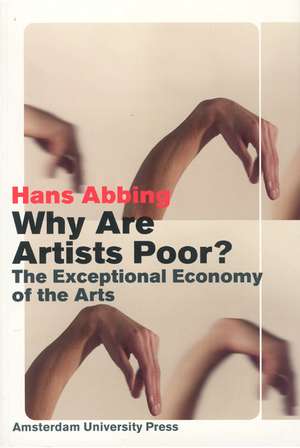
Why Are Artists Poor?
Autor Hans Abbingen Limba Engleză Paperback – 18 dec 2007
Most artists earn very little. Nevertheless, there is no shortage of aspiring young artists. Do they give to the arts willingly or unknowingly? Governments and other institutions also give to the arts, to raise the low incomes. But their support is ineffective: subsidies only increase the artists' poverty.
The economy of the arts is exceptional. Although the arts operate successfully in the marketplace, their natural affinity is with gift-giving, rather than with commercial exchange. People believe that artists are selflessly dedicated to art, that price does not reflect quality, and that the arts are free. But is it true?
This unconventional multidisciplinary analysis explains the exceptional economy of the arts. Insightful illustrations from the practice of a visual artist support the analysis.
The economy of the arts is exceptional. Although the arts operate successfully in the marketplace, their natural affinity is with gift-giving, rather than with commercial exchange. People believe that artists are selflessly dedicated to art, that price does not reflect quality, and that the arts are free. But is it true?
This unconventional multidisciplinary analysis explains the exceptional economy of the arts. Insightful illustrations from the practice of a visual artist support the analysis.
Preț: 510.28 lei
Preț vechi: 600.33 lei
-15%
Puncte Express: 765
Preț estimativ în valută:
90.22€ • 106.40$ • 78.63£
90.22€ • 106.40$ • 78.63£
Carte tipărită la comandă
Livrare economică 11-25 aprilie
Specificații
ISBN-13: 9789053565650
ISBN-10: 9053565655
Pagini: 372
Dimensiuni: 156 x 234 x 20 mm
Greutate: 0.57 kg
Ediția:1
Editura: Routledge
Locul publicării:Netherlands
ISBN-10: 9053565655
Pagini: 372
Dimensiuni: 156 x 234 x 20 mm
Greutate: 0.57 kg
Ediția:1
Editura: Routledge
Locul publicării:Netherlands
V-ar putea interesa
-
 -13%Preț: 167.71 lei193.35 lei
 -
 Economic GeographyWilliam P. Anderson-8%Preț: 567.17 lei616.48 lei
 -
 The Servant EconomyJeff FauxPreț: 149.31 lei
 -
 Preț: 117.28 lei
 -
 Preț: 199.91 lei
 -
 Decent Capitalism: A Blueprint for Reforming our EconomiesSebastian DullienPreț: 198.80 lei
 -
 The New Depression: The Breakdown of the Paper Money EconomyRichard DuncanPreț: 202.71 lei
 -
 Predictable SurprisesMax H. BazermanPreț: 128.47 lei
 -
 Strategy MapsRobert S. KaplanPreț: 256.41 lei
 -
 Preț: 181.63 lei
 -
 Strategic Environmental Assessment in ActionRiki Therivel-15%Preț: 410.16 lei482.54 lei
 -
 -13%Preț: 62.44 lei72.17 lei
Notă biografică
Hans Abbing is a painter, a photographer and an economist. As an economist he lectures at the Faculty of History and Arts at the Erasmus University in Rotterdam.
Cuprins
Preface
1. Sacred Art
2. The Denial of the Economy
3. Economic Value Versus Aesthetic Value
4. The Selflessly Devoted Artist
5. Money for the Artist
6. Structural Poverty
7. The Cost Disease
8. The Power and the Duty to Give
9. The Government Serves Art
10. Art Serves the Government
11. Informal Barriers Structure the Arts
12. Conclusion: a Cruel Economy
Epilogue: the Future Economy of the Arts
Notes
Literature
Index of Names
Index of Subjects
1. Sacred Art
2. The Denial of the Economy
3. Economic Value Versus Aesthetic Value
4. The Selflessly Devoted Artist
5. Money for the Artist
6. Structural Poverty
7. The Cost Disease
8. The Power and the Duty to Give
9. The Government Serves Art
10. Art Serves the Government
11. Informal Barriers Structure the Arts
12. Conclusion: a Cruel Economy
Epilogue: the Future Economy of the Arts
Notes
Literature
Index of Names
Index of Subjects