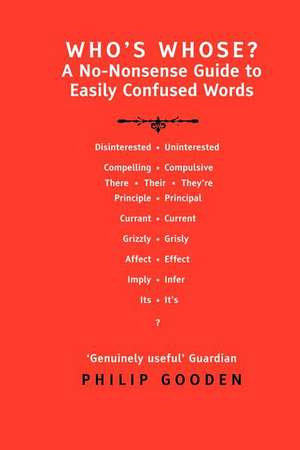
Who's Whose?: A no-nonsense guide to easily confused words
Autor Mr Philip Gooden Editat de R. Livesyen Limba Engleză Hardback – 28 noi 2005
Have you ever been fazed by the spelling of phased, or fretted over the difference between anxiety and angst, stationery and stationary? If so, you are not alone: the English language is a minefield, full of words that look and sound alike but mean different things in different places.
"Who's Whose? is an entertaining and essential A to Z guide to the most commonly confused words in English today, with real examples of good and bad usage to make differences crystal clear. In addition to documenting these verbal confusions, it offers a sympathetic guide to the seriousness of each gaffe (the Embarassment rating), an explanation of why it happens, and some handy hints on how to avoid it in future. With "Who's Whose in your corner, you'll never again mistake a principle for a principal.
Preț: 193.20 lei
Carte tipărită la comandă
Livrare economică 18 noiembrie-02 decembrie
Specificații
ISBN-10: 0713676426
Pagini: 484
Dimensiuni: 156 x 234 x 25 mm
Greutate: 0.68 kg
Ediția:Text mare
Editura: Bloomsbury Publishing
Colecția A&C Black Academic and Professional
Locul publicării:London, United Kingdom
V-ar putea interesa
-
 The Bible BookNick PagePreț: 137.35 lei
 -
 -42%Preț: 81.78 lei141.99 lei
 -
 The Masorah of Biblia Hebraica StuttgartensiaPage H. KelleyPreț: 227.16 lei
 -
 -27%Preț: 66.40 lei91.45 lei
 -
 -23%Preț: 684.00 lei888.32 lei
 -
 Savage TextThatcherPreț: 367.41 lei
 -
 Idiomantics: The Weird World of Popular PhrasesMr Philip Gooden-39%Preț: 69.94 lei113.84 lei
 -
 The Brown-Driver-Briggs Hebrew and English LexiconFrancis BrownPreț: 293.68 lei
Descriere
Notă biografică
Philip Gooden read English at Magdalen College, Oxford, and then taught at secondary school level for many years. In 2001 he became a full-time writer. Philip writes books on the English language as well as historical crime novels and mysteries. He was chairman of the Crime Writers' Association in 2007-8 and is part of the writing collective, The Medieval Murderers. He has also written the popular Who's Whose?: A No-Nonsense Guide to Easily-Confused Words, published by Bloomsbury.
Philip Gooden read English at Magdalen College, Oxford, and then taught at secondary level for many years. In 2001 he became a full-time writer. He is the author of the Nick Revill series, a sequence of historical mysteries based in Elizabethan London and set around Shakespeare's Globe theatre. Titles so far published are Sleep of Death, Death of Kings, The Pale Companion (shortlisted for the Ellis Peters Historical Dagger award in 2002), Alms for Oblivion, Mask of Night and An Honourable Murderer. A contributor to various short story anthologies, Philip Gooden also works as an editor, most recently on the Mammoth Book of Literary Anecdotes and a new edition of Arthur Conan Doyle's The Lost World for Penguin Classics. He has also written the popular Who's Whose?: A No-Nonsense Guide to Easily-Confused Words, published by Bloomsbury. He lives in Bath where he is currently working on the first in a new series of historical novels.
Recenzii
'A jolly little book...A useful handbook to the booby traps that lie in wait for us all, including such old favourites as imply/infer, uninterested/ disinterested, discreet/ discrete, fazed/phased and so on.'
'For those muddled about standard English... If you ever effect instead of affect, or think bears are grisly and bones beneath the patio are grizzly, this masterly and compelling, rather than masterful and compulsive, volume is for you.'
'A guide containing much good sense...uncertain users of the English language in general would best profit from the whole book.'