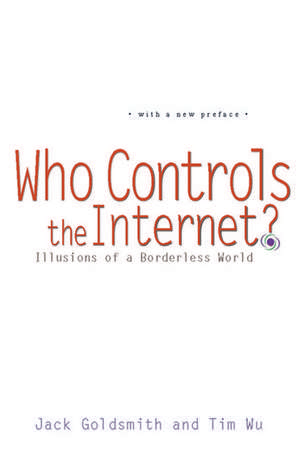
Who Controls the Internet?: Illusions of a Borderless World
Autor Jack Goldsmith, Tim Wuen Limba Engleză Paperback – 17 iul 2008
Preț: 97.18 lei
Preț vechi: 120.20 lei
-19%
Puncte Express: 146
Carte tipărită la comandă
Livrare economică 27 noiembrie-08 decembrie
Livrare prin curier în România Termenul estimat este afișat lângă disponibilitate.
Transport gratuit de la 400.00 lei Plată online sau ramburs, în funcție de opțiunile comenzii.
Retur gratuit în 14 zile Comandă securizată și suport în română.
Specificații
ISBN-13: 9780195340648
ISBN-10: 0195340647
Pagini: 240
Ilustrații: halftones
Dimensiuni: 158 x 233 x 16 mm
Greutate: 0.34 kg
Editura: Oxford University Press
Colecția OUP USA
Locul publicării:New York, United States
ISBN-10: 0195340647
Pagini: 240
Ilustrații: halftones
Dimensiuni: 158 x 233 x 16 mm
Greutate: 0.34 kg
Editura: Oxford University Press
Colecția OUP USA
Locul publicării:New York, United States
V-ar putea interesa
-
 Collins Grammar for IELTSFiona AishPreț: 69.30 lei
 -
 The Net DelusionEvgeny MorozovPreț: 136.00 lei
 -
 -33%Preț: 649.92 lei964.42 lei
 -
 -13%Preț: 180.49 lei207.11 lei
 -
 Writing and Drafting in Legal PracticePaul Rylance-11%Preț: 384.16 lei432.87 lei
 -
 Declaring Independence in CyberspaceMilton L. Mueller-20%Preț: 307.09 lei383.86 lei
 -
 Preț: 238.64 lei
 -
 The Master SwitchTim WuPreț: 137.44 lei
 -
 FlashForwardRobert J. Sawyer-26%Preț: 58.41 lei79.13 lei
 -
 The Tech CoupMarietje SchaakePreț: 97.91 lei
 -
 Hack to the FutureEmily Crose-20%Preț: 169.61 lei212.01 lei
 -
 -28%Preț: 51.18 lei70.81 lei
 -
 Internet Policies & Issues: Volume 8B G Kutais-35%Preț: 1269.46 lei1964.74 lei
 -
 A History of the Internet and the Digital FutureJohnny Ryan-20%Preț: 133.58 lei166.97 lei
 -
 The Internet ConCory DoctorowPreț: 84.06 lei
 -
 Taking Back Control?Wolfgang StreeckPreț: 206.82 lei
 -
 Law and the InternetProfessor Lilian Edwards-30%Preț: 461.12 lei662.03 lei
 -
 The Age of ExtractionTim WuPreț: 107.56 lei
 -
 -27%Preț: 67.48 lei92.11 lei
Recenzii
A timely look at the ways that governments make themselves felt in cyberspace. Goldsmith and Wu cover a range of controversies, from domain-name disputes to online poker and porn to political censorship. Their judgments are well worth attending.
In the 1990s the Internet was greeted as the New New Thing: It would erase national borders, give rise to communal societies that invented their own rules, undermine the power of governments. In this splendidly argued book, Jack Goldsmith and Tim Wu explain why these early assumptions were mostly wrong: The Internet turns out to illustrate the enduring importance of Old Old Things, such as law and national power and business logic. By turns provocative and colorful, this is an essential read for anyone who cares about the relationship between technology and globalization.
In the 1990s the Internet was greeted as the New New Thing: It would erase national borders, give rise to communal societies that invented their own rules, undermine the power of governments. In this splendidly argued book, Jack Goldsmith and Tim Wu explain why these early assumptions were mostly wrong: The Internet turns out to illustrate the enduring importance of Old Old Things, such as law and national power and business logic. By turns provocative and colorful, this is an essential read for anyone who cares about the relationship between technology and globalization.