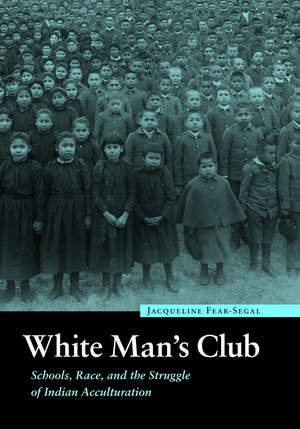
White Man's Club: Schools, Race, and the Struggle of Indian Acculturation: Indigenous Education
Autor Jacqueline Fear-Segalen Limba Engleză Hardback – noi 2007
Tens of thousands of Indian children filed through the gates of government schools to be trained as United States citizens. Part of a late-nineteenth-century campaign to eradicate Native cultures and communities, these institutions became arenas where whites debated the terms of Indian citizenship, but also where Native peoples resisted the power of white schooling and claimed new skills to protect and redefine tribal and Indian identities.
In White Man’s Club, schools for Native children are examined within the broad framework of race relations in the United States for the first time. Jacqueline Fear-Segal analyzes multiple schools and their differing agendas and engages with the conflicting white discourses of race that underlay their pedagogies. She argues that federal schools established to Americanize Native children did not achieve their purpose; instead they progressively racialized American Indians. A far-reaching and bold account of the larger issues at stake, White Man’s Club challenges previous studies for overemphasizing the reformers’ overtly optimistic assessment of the Indians’ capacity for assimilation and contends that a covertly racial agenda characterized this educational venture from the start. Asking the reader to consider the legacy of nineteenth-century acculturation policies, White Man’s Club incorporates the life stories and voices of Native students and traces the schools’ powerful impact into the twenty-first century.
Fear-Segal draws upon a rich array of source material. Traditional archival research is interwoven with analysis of maps, drawings, photographs, the built environment, and supplemented by oral and family histories. Creative use of new theoretical and interpretive perspectives brings fresh insights to the subject matter.




Preț: 210.20 lei
Puncte Express: 315
Preț estimativ în valută:
37.21€ • 43.29$ • 32.27£
37.21€ • 43.29$ • 32.27£
Carte indisponibilă temporar
Doresc să fiu notificat când acest titlu va fi disponibil:
Se trimite...
Preluare comenzi: 021 569.72.76
Specificații
ISBN-13: 9780803220249
ISBN-10: 0803220243
Pagini: 422
Ilustrații: 20 photographs, index
Dimensiuni: 152 x 229 x 15 mm
Greutate: 0.75 kg
Editura: Nebraska
Colecția University of Nebraska Press
Seria Indigenous Education
Locul publicării:United States
ISBN-10: 0803220243
Pagini: 422
Ilustrații: 20 photographs, index
Dimensiuni: 152 x 229 x 15 mm
Greutate: 0.75 kg
Editura: Nebraska
Colecția University of Nebraska Press
Seria Indigenous Education
Locul publicării:United States
V-ar putea interesa
-
 ComanchesT R Fehrenbach-19%Preț: 83.89 lei104.07 lei
 -
 Columbia River BasketryMary Dodds SchlickPreț: 223.07 lei
 -
 Preț: 219.98 lei
 -
 Keewaydinoquay, Stories from My YouthKeewaydinoquayPreț: 116.46 lei
 -
 The CheyenneJohn H. MoorePreț: 414.86 lei
 -
 Indian OrphanagesMarilyn Irvin HoltPreț: 288.57 lei
 -
 Preț: 227.77 lei
 -
 -21%Preț: 351.41 lei445.07 lei
 -
 Around the Sacred FireJ. TreatPreț: 383.59 lei
 -
 Ojibwa: People of Forests and PrairiesMICHAEL JOHNSONPreț: 290.43 lei
 -
 The EncounterPetru PopescuPreț: 90.17 lei
Notă biografică
Jacqueline Fear-Segal is a senior lecturer in American history at the University of East Anglia, Norwich, England, and the author of articles in the Journal of American Studies, American Studies International, and Critical Engagement.
Cuprins
List of Illustrations 000
Acknowledgments 000
Introduction 000
Prologue: Prisoners Made Pupils 000
1.The Development of an Indian Educational System
1. White Theories: Can the Indian be Educated? 000
2. Native Views: "A New Road for All the Indians" 000
3. Mission Schools in the West: Precursors of a System 000
2. Hampton Normal and Agricultural Institute
4. Samuel Chapman Armstrong: Educator of Backward Races 000
5. Thomas Wildcat Alford: Shawnee Educated in Two Worlds 000
3. Carlisle Indian Industrial School
6. Richard Henry Pratt: National Universalist 000
7. Carlisle Campus: Landscape of Race and Erasure 000
8. Man-on-the-Bandstand: Surveillance, Concealment, and Resistance 000
9. Indian School Cemetery: Telling Remains 000
4. Modes of Cultural Survival
10. Kesetta: Memory and Recovery 000
11. Susie Rayos Marmon: Storytelling and Teaching 000
Epilogue: Cultural Survival as Performance, Powwow 2000 000
Notes 000
Bibliography 000
Index 000
Acknowledgments 000
Introduction 000
Prologue: Prisoners Made Pupils 000
1.The Development of an Indian Educational System
1. White Theories: Can the Indian be Educated? 000
2. Native Views: "A New Road for All the Indians" 000
3. Mission Schools in the West: Precursors of a System 000
2. Hampton Normal and Agricultural Institute
4. Samuel Chapman Armstrong: Educator of Backward Races 000
5. Thomas Wildcat Alford: Shawnee Educated in Two Worlds 000
3. Carlisle Indian Industrial School
6. Richard Henry Pratt: National Universalist 000
7. Carlisle Campus: Landscape of Race and Erasure 000
8. Man-on-the-Bandstand: Surveillance, Concealment, and Resistance 000
9. Indian School Cemetery: Telling Remains 000
4. Modes of Cultural Survival
10. Kesetta: Memory and Recovery 000
11. Susie Rayos Marmon: Storytelling and Teaching 000
Epilogue: Cultural Survival as Performance, Powwow 2000 000
Notes 000
Bibliography 000
Index 000
Recenzii
"A rich and rewarding book."—Michael C. Coleman, Great Plains Quarterly
"Fear-Segal imaginatively examines the ominous racialization of American Indians in the nineteenth and twentieth centuries through a focus on the covertly racial agenda of boarding school policy. . . . White Man's Club's sophisticated but readable style will engross any reader."—Sally McBeth, Western Historical Quarterly
"With the publication of Jacqueline Fear-Segal's White Man’s Club, the historiography of Indian residential schooling has reached a new level of sophistication."—John Milloy, Journal of American History
“Perhaps only once in a decade does a book come along that truly sets the standard for the rest of the field. White Man’s Club is such a book. Beautifully written and superbly argued, it is replete with fresh insights and analysis of a subject that remains one of the most enduring and meaningful and often painful in the history of American Indian and white relations. Students of the Indian boarding school movement will be especially interested in the insights provided by Fear-Segal, particularly those that address how the dominant nineteenth century views of race played a major role in the creation and functioning of off-reservation boarding schools.”—Journal of the West
"White Man's Club is a well-constructed and well-researched book that originally uses primary sources to unveil the convert agenda of race subjugation and control in the government schooling system and its impact on students' lives."—Marinella Lentis, Wicazo Sa
"By including Native voices, Fear-Segal's study reminds us that the Native experience in America is not an academic exercise but involves people's cherished memories and present realities."—Ruth Spack, American Historical Review