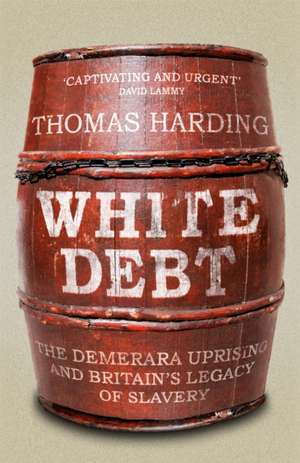
White Debt
Autor Thomas Hardingen Limba Engleză Hardback – 6 ian 2022
Recomandăm White Debt studenților la istorie, cercetătorilor post-colonialismului și publicului larg interesat de modul în care trecutul imperial modelează prezentul. Acest volum nu este doar o cronică istorică, ci un demers de asumare a responsabilității, în care Thomas Harding investighează implicarea propriei familii în sistemul sclavagist din Demerara (Guyana de astăzi). Găsim aici o analiză minuțioasă a revoltei din 1823, cea mai mare din Imperiul Britanic, un eveniment care a accelerat procesul de abolire, dar care a rămas adesea în umbra altor relatări istorice.
Descoperim o structură narativă ingenioasă, care evită generalizările prin urmărirea a patru destine divergente: un bărbat înrobit, un misionar, un colonist și un proprietar de sclavi. Această metodă oferă o perspectivă polifonică asupra cruzimii sistemului și a curajului celor care i s-au opus. Cititorii familiarizați cu Blood Legacy Reckoning with a Family's Story of Slavery de Alex Renton vor aprecia modul similar, dar mai focalizat pe un singur eveniment major, în care Harding împletește cercetarea arhivală cu introspecția etică. Dacă lucrarea lui Renton oferă o privire de ansamblu asupra moștenirii sclaviei, White Debt oferă o examinare microscopică a unui punct de cotitură istoric.
În contextul operei sale, White Debt continuă direcția începută în Legacy, unde Thomas Harding a explorat istoria Marii Britanii prin prisma unei familii și a unei companii de succes. Aici, însă, tonul devine mai critic, mutând accentul de la succesul antreprenorial la costul uman ascuns al bogăției imperiale. Cartea reușește să transforme datele istorice într-o interogație vitală despre reparații și memorie colectivă.
Preț: 138.65 lei
Carte disponibilă
Livrare economică 15-29 iulie
Livrare express 01-07 iulie pentru 33.86 lei
Specificații
ISBN-10: 147462104X
Pagini: 320
Dimensiuni: 165 x 241 x 35 mm
Greutate: 0.54 kg
Editura: Orion Publishing Group
De ce să citești această carte
Această carte este esențială pentru oricine dorește să înțeleagă rădăcinile profunde ale inegalității moderne. Cititorul câștigă o perspectivă documentată asupra mecanismelor sclaviei britanice și a modului în care rezistența sclavilor a forțat schimbări politice la Londra. Este o lectură necesară pentru a înțelege dezbaterea actuală despre reparații și despre modul în care familiile și instituțiile europene se pot raporta onest la un trecut marcat de exploatare.
Despre autor
Thomas Harding este un autor de succes, ale cărui lucrări au fost traduse în peste șaisprezece limbi și au fost recompensate cu premii prestigioase, precum JQ-Wingate Prize pentru non-ficțiune și CWA Golden Dagger. Recunoscut pentru capacitatea sa de a transforma cercetarea istorică în narațiuni captivante, Harding este și o voce importantă în activismul video internațional, predând cursuri despre potențialul noilor media în mâinile cetățenilor implicați. Interesul său constant pentru istoria socială și biografie se reflectă în volume precum 'Hanns and Rudolf' sau 'The House by the Lake', White Debt fiind punctul culminant al investigațiilor sale despre responsabilitatea istorică.
Notă biografică
Descriere
Recenzii
A deep dive into colonialism and enslavement, with personal legacies that continue to resonate today - a deeply affecting and forensically elegant book for our times
This well-researched history of the 1823 slave uprising in Demerara is a page-turner . . . Harding lays out what happened with novelistic (but still assiduously researched) flair
Authentic, bold and poignant, WHITE DEBT is a captivating tale of resistance and an urgent antidote to our collective amnesia
The Demerara episode graphically reveals the hidden cruelties of colonialism, not to mention British myopia towards the atrocities. Harding tells the story with impressive drama and detail
WHITE DEBT is an important step in our routinely dysfunctional national conversation about the Atlantic slave trade
[A] vital read
Excellent . . . Harding is a thoughtful and honest writer . . . an exemplary piece of history writing
An important and timely book told with great sympathy, honesty and an original approach. His family is always present, in the background, but he does not shy away from criticism and asking big questions which many in this country must try and answer
Some write about the past. Thomas Harding, our most human historian, has, once again, brought it alive . . . in all its tragedy, glory, complexity
Puts Harding alongside other recent revisers of Britain's imperial history . . . provides a valuable introduction to the various strands of this debate
Honest, compelling and certainly timely, WHITE DEBT lays bare the nature of a crime against an entire race of people, for which there was no punishment. As Thomas Harding has done, all readers should consider; what is my part in the wider story of the British slave trade and how do I make amends where necessary?
Gripping . . . Novelistic in its narrative energy, its jeopardy and its tensions, WHITE DEBT is a rich story so well told
I was much moved by WHITE DEBT. I am so glad Thomas Harding wrote it. He tells the story of Britain's appalling role in slavery with great sensitivity and leads the reader to the only possible conclusion, that there is a debt and it must be paid
WHITE DEBT is a timely, pioneering, game changer. Its compelling narrative and thought-provoking reflections enable us to (re)visit plantation slavery with fresh eyes. It invites the reader to reflect on a core period of British history that has for too long been ignored or dismissed as bearing no relationship to present-day inequities that exist between White and Black people. This book is compulsory reading for anyone interested in understanding the case for reparations and will delight readers who are tired of portrayals of enslaved Africans as marginal to the history of abolitionism. WHITE DEBT is a courageous tour de force
A major study of the 1823 slave uprising in British Guyana, revealing the utter brutality of the slaveowners and the courage as well as the organisational genius of the African leaders of the uprising. That Harding inserts himself in the narrative, seeking to make amends for his forebears' involvement in slave-produced commodities, makes his book all the more compelling, since it creates a dialogue between the living and the dead