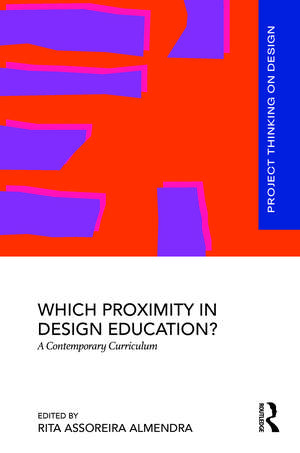
Which Proximity in Design Education?: A Contemporary Curriculum: Project Thinking on Design
Editat de Rita Assoreira Almendraen Limba Engleză Hardback – 30 ian 2025
Which Proximity in Design Education? frames a wide range of approaches in design studios on undergraduate, graduate, and postgraduate levels and their capacity to render meaningful and novel attitudes and actions beyond the classroom. The urgent call for resilience in the way we lead our lives has brought our global boundaries and social tensions to the forefront of the conversation, and there is a generation of students fully aware of our collective responsibility in this decisive decade. As such, educators need to rapidly adapt to new tools and ways of teaching design, whilst also being challenged on how to educate the designer for the pressing tasks of the near future. It presents optimistic solutions for how education can support renovated mindsets and efforts towards common goals.
This book contains distinct visions of the world and its problems relating to proximity in design education. As such, the chapters present diversified solutions to these issues, which will be of interest to teachers and researchers working in design education.



Preț: 1116.20 lei
Preț vechi: 1361.23 lei
-18%
Puncte Express: 1674
Carte tipărită la comandă
Livrare economică 23 noiembrie-07 decembrie
Livrare prin curier în România Termenul estimat este afișat lângă disponibilitate.
Transport gratuit pentru acest produs Plată online sau ramburs, în funcție de opțiunile comenzii.
Retur gratuit în 14 zile Comandă securizată și suport în română.
Specificații
ISBN-13: 9781032835549
ISBN-10: 1032835540
Pagini: 280
Ilustrații: 102
Dimensiuni: 156 x 234 mm
Greutate: 0.56 kg
Ediția:1
Editura: Taylor & Francis
Colecția Routledge
Seria Project Thinking on Design
Locul publicării:Oxford, United Kingdom
ISBN-10: 1032835540
Pagini: 280
Ilustrații: 102
Dimensiuni: 156 x 234 mm
Greutate: 0.56 kg
Ediția:1
Editura: Taylor & Francis
Colecția Routledge
Seria Project Thinking on Design
Locul publicării:Oxford, United Kingdom
V-ar putea interesa
-
 Preț: 388.03 lei
 -
 Design and Ethics: Reflections on PracticeEmma FeltonPreț: 387.51 lei
 -
 Preț: 269.14 lei
 -
 Preț: 346.25 lei
 -
 Design for Education: Spaces and Tools for LearningAna Rute CostaPreț: 381.56 lei
 -
 Preț: 203.67 lei
 -
 Preț: 380.33 lei
 -
 Preț: 382.35 lei
 -
 Preț: 496.90 lei
 -
 Collaboration in Design Education: Case Studies & Teaching MethodologiesMarty Maxwell Lane-22%Preț: 217.17 lei277.31 lei
 -
 -10%Preț: 161.35 lei179.49 lei
 -
 -21%Preț: 186.46 lei236.46 lei
 -
 Reflective Teaching in Higher EducationCamille Kandiko Howson-14%Preț: 273.08 lei317.28 lei
 -
 Teaching DesignMeredith DavisPreț: 132.32 lei
 -
 Contemporary Design Education in AustraliaLisa ScharounPreț: 470.65 lei
 -
 -18%Preț: 356.71 lei434.22 lei
 -
 -18%Preț: 355.01 lei433.21 lei
 -
 -11%Preț: 466.00 lei523.60 lei
 -
 Design History ReaderKristen Coogan-23%Preț: 173.69 lei225.09 lei
Public țintă
Academic, Postgraduate, and Undergraduate AdvancedCuprins
Part 1 Design Proximity(ies) in Design Education
1. Draw(in)Proximity: A Drawing-Based Strategy for Knowledge Transfer
2. The New Fado of the Students: Proximity between Utopia and Architecture Education
3. Design Educators: Collective Agents of Change
4. The Synergies Initiative: Enhancing Interdisciplinarity through Problem-based Learning in Design Education
5. Portuguese Educational Practices: A Journey through European Trends in Graduation, Quality Assurance, and Design History: The Influences and Consequences in the Teaching of Design to Develop a Relevant and Contemporary Curriculum
6. Liquid Proximity: Engaging and Alternative Ways of Interacting with Design Students
7. Proximity of Conjectures to Design Pedagogy
Part 2 Design Approaches in Academic Context
8. Food Design Education: Design for Food or Food for Design? Different Approaches to Designing a Change for Our Food Systems
9. Design Activism: A Humanitarian Approach in an Academic Context
10. Textile Design: A Transdisciplinary Approach in Higher Education in Portugal
11. Urban Design Project-Based Teaching: The UQAM Praxis III Lab Approach
12. Investigating the Means Utilized by the Supporting Staff in Design Studio Courses: An Interview Study
13. Assessments in the Design Studio: Self-Reflecting on MDD (AUAS) Methods
14. Teaching Design in the Google Age: Redesigning the Assignment
15. Design Thinking and the Proximity Argument — The Case Study of Engineering Students at a Portuguese University
Part 3 Teaching-Learning Processes
16. Teaching-Learning Design through the Contingency of COVID-19
17. Tall Tales: Reflecting on the Role of Dialogue in Design Studio Learning
18. Portuguese Design Education on Materials – An Overview
19. Supporting the Understanding of Complex Concepts through Play Situations
20. A Pilot Study for Introducing Designing Materials in Design Education
21. Exploring Student Perceptions of Product-Service Systems
1. Draw(in)Proximity: A Drawing-Based Strategy for Knowledge Transfer
2. The New Fado of the Students: Proximity between Utopia and Architecture Education
3. Design Educators: Collective Agents of Change
4. The Synergies Initiative: Enhancing Interdisciplinarity through Problem-based Learning in Design Education
5. Portuguese Educational Practices: A Journey through European Trends in Graduation, Quality Assurance, and Design History: The Influences and Consequences in the Teaching of Design to Develop a Relevant and Contemporary Curriculum
6. Liquid Proximity: Engaging and Alternative Ways of Interacting with Design Students
7. Proximity of Conjectures to Design Pedagogy
Part 2 Design Approaches in Academic Context
8. Food Design Education: Design for Food or Food for Design? Different Approaches to Designing a Change for Our Food Systems
9. Design Activism: A Humanitarian Approach in an Academic Context
10. Textile Design: A Transdisciplinary Approach in Higher Education in Portugal
11. Urban Design Project-Based Teaching: The UQAM Praxis III Lab Approach
12. Investigating the Means Utilized by the Supporting Staff in Design Studio Courses: An Interview Study
13. Assessments in the Design Studio: Self-Reflecting on MDD (AUAS) Methods
14. Teaching Design in the Google Age: Redesigning the Assignment
15. Design Thinking and the Proximity Argument — The Case Study of Engineering Students at a Portuguese University
Part 3 Teaching-Learning Processes
16. Teaching-Learning Design through the Contingency of COVID-19
17. Tall Tales: Reflecting on the Role of Dialogue in Design Studio Learning
18. Portuguese Design Education on Materials – An Overview
19. Supporting the Understanding of Complex Concepts through Play Situations
20. A Pilot Study for Introducing Designing Materials in Design Education
21. Exploring Student Perceptions of Product-Service Systems
Notă biografică
Rita Assoreira Almendra is a Full Professor at the Lisbon School of Architecture (FA-ULisboa) where she is Head of the Design Department and coordinates both the Design Doctoral Program and the nucleus of Design at CIAUD research centre. She holds a PhD in Design (2010) from FA-ULisboa, and a Master's in Design Management (2004) and an MBA with marketing specialization (2002), both from the Catholic University of Lisbon. Rita has worked for more than 20 years as a design researcher and educator, with numerous publications and master's and doctoral supervisions in this field. She is the founder and coordinator of the Research & Education in Design research group [redes.fa.ulisboa.pt], and was responsible for two editions of the International Conference on Research and Education in Design.
Descriere
This book explores various pedagogical viewpoints and dialectical positions within the field of design education and the concept of proximity it has established with industries and manufacturing.