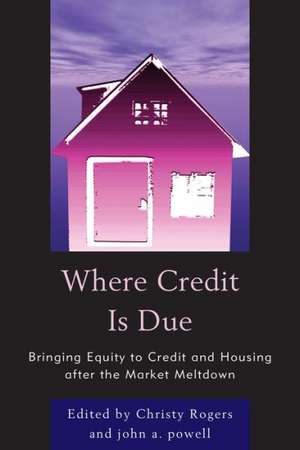
Where Credit is Due: Bringing Equity to Credit and Housing After the Market Meltdown: University Press of America
Autor John Powell, Christy Rogers Contribuţii de Vanessa Carter, Gail Christopher, Rick Cohen, Jeffrey D. Dillman, Gary Dymski, Deyanira Del Rio, Ira Goldstein, Henry Korman, Jillian Olinger, Rhonda Ortiz, Manuel Pastor, Christopher L. Peterson, John A. Powell, Thomas H. Stanton, Hannah Thomas, Dan Urevick-Ackelsberg, Mark A. Willisen Limba Engleză Paperback – 21 noi 2013
Din seria University Press of America
- 35%
 Preț: 376.42 lei
 - 27%
 Preț: 255.50 lei
 - 33%
 Preț: 388.94 lei
 - 27%
 Preț: 277.28 lei
 - 29%
 Preț: 343.67 lei
 - 33%
 Preț: 356.32 lei
 - 28%
 Preț: 238.63 lei
 - 27%
 Preț: 352.54 lei
 - 27%
 Preț: 276.97 lei
 - 33%
 Preț: 485.31 lei
 - 27%
 Preț: 252.84 lei
 - 27%
 Preț: 273.68 lei
 - 39%
 Preț: 527.38 lei
 - 26%
 Preț: 279.74 lei
 - 23%
 Preț: 314.30 lei
 - 27%
 Preț: 252.91 lei
 - 36%
 Preț: 369.19 lei
 - 28%
 Preț: 251.94 lei
 - 34%
 Preț: 443.80 lei
 - 26%
 Preț: 286.36 lei
 - 34%
 Preț: 351.50 lei
 - 35%
 Preț: 374.40 lei
 - 33%
 Preț: 491.96 lei
 - 27%
 Preț: 266.67 lei
 - 33%
 Preț: 481.51 lei
 - 27%
 Preț: 253.44 lei
 - 27%
 Preț: 273.68 lei
 - 34%
 Preț: 348.03 lei
 - 26%
 Preț: 285.87 lei
 - 29%
 Preț: 345.60 lei
 - 27%
 Preț: 256.41 lei
 - 27%
 Preț: 258.17 lei
 - 23%
 Preț: 322.16 lei
 - 34%
 Preț: 506.57 lei
 - 32%
 Preț: 390.38 lei
 - 25%
 Preț: 306.96 lei
 - 33%
 Preț: 390.66 lei
 - 34%
 Preț: 442.53 lei
 - 32%
 Preț: 363.17 lei
 - 27%
 Preț: 276.77 lei
 - 34%
 Preț: 536.65 lei
 - 27%
 Preț: 255.93 lei
 - 25%
 Preț: 364.66 lei
 - 32%
 Preț: 458.54 lei
 - 34%
 Preț: 474.70 lei
 - 37%
 Preț: 730.79 lei
 - 26%
 Preț: 357.73 lei
 - 39%
 Preț: 531.33 lei
 - 23%
 Preț: 322.03 lei
Preț: 326.75 lei
Preț vechi: 419.35 lei
-22%
Puncte Express: 490
Carte tipărită la comandă
Livrare economică 20 noiembrie-04 decembrie
Livrare prin curier în România Termenul estimat este afișat lângă disponibilitate.
Transport gratuit de la 400.00 lei Plată online sau ramburs, în funcție de opțiunile comenzii.
Retur gratuit în 14 zile Comandă securizată și suport în română.
Specificații
ISBN-13: 9780761856061
ISBN-10: 0761856064
Pagini: 402
Dimensiuni: 154 x 226 x 25 mm
Greutate: 0.57 kg
Editura: Bloomsbury Publishing
Colecția University Press of America
Seria University Press of America
Locul publicării:New York, United States
ISBN-10: 0761856064
Pagini: 402
Dimensiuni: 154 x 226 x 25 mm
Greutate: 0.57 kg
Editura: Bloomsbury Publishing
Colecția University Press of America
Seria University Press of America
Locul publicării:New York, United States
V-ar putea interesa
-
 -23%Preț: 959.88 lei1246.76 lei
 -
 Credit Rating Agencies on the Watch List: Analysis of European RegulationRaquel García Alcubilla-31%Preț: 948.64 lei1378.94 lei
 -
 Small Firm Ownership and Credit Constraints in IndiaRajesh Raj S. N.-18%Preț: 1395.15 lei1701.40 lei
 -
 International Macroeconomics for Business and Political LeadersJohn MarthinsenPreț: 223.95 lei
 -
 -18%Preț: 945.05 lei1152.50 lei
 -
 Real Estate Concepts: A HandbookErnie Jowsey-15%Preț: 441.26 lei519.12 lei
 -
 The Rating Agencies and Their Credit RatingsHerwig Langohr-8%Preț: 608.29 lei661.18 lei
 -
 Credit Risk Modeling using Excel and VBAGunter Löeffler-8%Preț: 684.55 lei744.08 lei
 -
 A History of Credit and Power in the Western WorldScott B. MacDonaldPreț: 485.23 lei
 -
 Making Remittances WorkEmiko TodorokiPreț: 279.89 lei
 -
 Healers of RadesCarol BlackhurstPreț: 90.42 lei
 -
 -26%Preț: 671.77 lei912.33 lei
 -
 The Survival of the FitterJohn PowellPreț: 177.02 lei
Cuprins
Chapter 1 Introduction
Chapter 2 Chapter 1: Overview
Chapter 3 Chapter 2: Understanding the Subprime Crisis: Institutional Evolution and Theoretical Views
Chapter 4 Chapter 3: Subprime Lending, Foreclosure and Race: An Introduction to the Role of Securitization in Residential Mortgage Finance
Chapter 5 Chapter 4: A Structural Racism Lens on Subprime Foreclosures and Vacant Properties
Chapter 6 Chapter 5: Subprime Lending, Mortgage Foreclosure and Race: How Far Have We Come and How Far Have We to Go?
Chapter 7 Chapter 6: Subprime Lending in the City of Cleveland and Cuyahoga County
Chapter 8 Chapter 7: Bending Toward Justice: An Empirical Study of Foreclosures in One Neighborhood Three Years After Impact and a Proposed Framework for a Better Community
Chapter 9 Chapter 8: The Foreclosure Crisis and Fair Credit Access for in Immigrant Communities
Chapter 10 Chapter 9: An Ethnographic View of Impact: Asset Stripping for People of Color
Chapter 11 Chapter 10: Affirmatively Furthering Fair Housing: A Critical Component of the Neighborhood Stabilization Program
Chapter 12 Chapter 11: Frannie, Freddie, and the Future of Fair Housing
Chapter 13 Chapter 12: Fannie Mae and Freddie Mac: How Can We Improve Their Support of the Mortgage Market?
Chapter 14 Chapter 13: Furthering Fair Housing, the Housing Finance System, and the Government Sponsored Enterprises
Chapter 15 Chapter 14: Give Credit Where Credit is Due: Overhauling the CRA
Chapter 16 Chapter 15: Breaking the Bank / (Re)Making the Bank: America's Financial Crisis and the Implications for Sustainable Advocacy for Fair Credit and Fair Banking
Chapter 17 Chapter 16: The Housing and Credit Crisis Revisited: Looking Back and Moving Forward
Chapter 2 Chapter 1: Overview
Chapter 3 Chapter 2: Understanding the Subprime Crisis: Institutional Evolution and Theoretical Views
Chapter 4 Chapter 3: Subprime Lending, Foreclosure and Race: An Introduction to the Role of Securitization in Residential Mortgage Finance
Chapter 5 Chapter 4: A Structural Racism Lens on Subprime Foreclosures and Vacant Properties
Chapter 6 Chapter 5: Subprime Lending, Mortgage Foreclosure and Race: How Far Have We Come and How Far Have We to Go?
Chapter 7 Chapter 6: Subprime Lending in the City of Cleveland and Cuyahoga County
Chapter 8 Chapter 7: Bending Toward Justice: An Empirical Study of Foreclosures in One Neighborhood Three Years After Impact and a Proposed Framework for a Better Community
Chapter 9 Chapter 8: The Foreclosure Crisis and Fair Credit Access for in Immigrant Communities
Chapter 10 Chapter 9: An Ethnographic View of Impact: Asset Stripping for People of Color
Chapter 11 Chapter 10: Affirmatively Furthering Fair Housing: A Critical Component of the Neighborhood Stabilization Program
Chapter 12 Chapter 11: Frannie, Freddie, and the Future of Fair Housing
Chapter 13 Chapter 12: Fannie Mae and Freddie Mac: How Can We Improve Their Support of the Mortgage Market?
Chapter 14 Chapter 13: Furthering Fair Housing, the Housing Finance System, and the Government Sponsored Enterprises
Chapter 15 Chapter 14: Give Credit Where Credit is Due: Overhauling the CRA
Chapter 16 Chapter 15: Breaking the Bank / (Re)Making the Bank: America's Financial Crisis and the Implications for Sustainable Advocacy for Fair Credit and Fair Banking
Chapter 17 Chapter 16: The Housing and Credit Crisis Revisited: Looking Back and Moving Forward
Recenzii
There is, perhaps, no more powerful illustration of contemporary structural racism than the exponential growth of unfair and unequal credit and lending practices that served as kindling for what became the fire-the subprime mortgage crisis.This book is a seminal contribution because it.has the potential to help move readers and policy makers beyond denial of the multifaceted, racially-based drivers of financial practices, policies, and our economy.
...An understanding of this issue is essential to preparing our country to complete in the 21st century global economy as people of color become the majority.
...An understanding of this issue is essential to preparing our country to complete in the 21st century global economy as people of color become the majority.