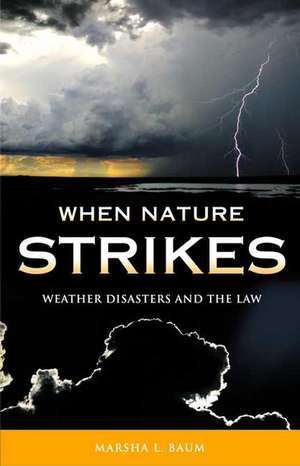
When Nature Strikes: Weather Disasters and the Law
Autor Marsha L. Baumen Limba Engleză Hardback – 30 iun 2007
For example, weather can be the means to commit a crime or the factor that turns an event from a terrible accident into a criminal act. Weather can be a defense against liability in both civil and criminal cases. People seek relief in court from the harm caused by weather events, whether a slip on the ice or the horrible devastation wrought by a deadly hurricane. Courts and the criminal justice system can be affected by weather events that prevent physical access to the courthouse or that destroy evidence. Through laws passed by Congress, U.S. weather services have evolved from simply weather recording into weather forecasting and warning systems. Federal patent law offers monopolies over inventions to encourage inventors to develop new devices that increase human safety in extreme weather or to improve methods such as cloud seeding or wind energy.
Preț: 297.14 lei
Preț vechi: 378.88 lei
-22%
Puncte Express: 446
Carte tipărită la comandă
Livrare economică 07-21 decembrie
Livrare prin curier în România Termenul estimat este afișat lângă disponibilitate.
Transport gratuit de la 400.00 lei Plată online sau ramburs, în funcție de opțiunile comenzii.
Retur gratuit în 14 zile Comandă securizată și suport în română.
Specificații
ISBN-13: 9780275221294
ISBN-10: 0275221296
Pagini: 248
Dimensiuni: 156 x 235 x 25 mm
Greutate: 0.55 kg
Editura: Bloomsbury Publishing
Colecția Praeger
Locul publicării:New York, United States
ISBN-10: 0275221296
Pagini: 248
Dimensiuni: 156 x 235 x 25 mm
Greutate: 0.55 kg
Editura: Bloomsbury Publishing
Colecția Praeger
Locul publicării:New York, United States
V-ar putea interesa
-
 Dead AidDambisa Moyo-19%Preț: 63.70 lei78.35 lei
 -
 -18%Preț: 82.36 lei100.49 lei
 -
 -16%Preț: 100.14 lei118.83 lei
 -
 -24%Preț: 381.11 lei500.41 lei
 -
 -30%Preț: 798.23 lei1142.42 lei
 -
 -27%Preț: 68.17 lei93.16 lei
 -
 Humanitarian InterventionThomas G WeissPreț: 133.97 lei
 -
 Hope in HellDan BortolottiPreț: 130.72 lei
 -
 -25%Preț: 196.16 lei261.23 lei
 -
 -17%Preț: 215.11 lei259.93 lei
 -
 An Imperfect OfferingJames Orbinski-19%Preț: 98.55 lei121.72 lei
 -
 Carbonnier, G: Humanitarian EconomicsGilles Carbonnier-23%Preț: 229.64 lei297.67 lei
 -
 Engineering in EmergenciesJan DavisPreț: 416.92 lei
Recenzii
Baum takes a novel approach to the topic of weather by analyzing its frequent intersections with the law. Weather affects countless court cases, legislation, and administrative law. Three particular areas of legal concern are addressed: the history and role of the US government in forecasting and issuing warnings; scientific attempts at weather control, including patents law; and liability and criminal culpability for weather-related harm. Particularly useful is a glossary of weather terms, a table of weather-related cases, and a list of federal statutes and proposed legislation. Baum explores varying questions, such as the liability of forecasters for inaccurate weather reports and the legal debate over blame for the catastrophic damage caused by Hurricane Katrina. She contends the legal system often addresses weather-related issues the same way, even though substantial evidence indicates these approaches fail. Baum argues that the government needs to develop better strategies to cope with disasters, mitigating the harm that these events cause. This is a much-needed work, considering the growing impact of weather-related disasters. Extensive notes; selected bibliography. Highly recommended. General readers; academic audiences, upper-division undergraduate and up; professionals.
Baum examines a topic that is without any other treatment..[t]he book will be useful to scholars and instructors in the general areas of law and disasters and may also be useful for instructors looking for supplementary readings on civil liability and sovereign immunity that have a weather or disaster dimension.
Baum notes that legal issues in the future will encompass global warming law, weaponization of the weather, and medical malpractice lawsuits for failure to consider weather-sensitivity disorders. This fascinating look at the social consequences of severe weather is accompanied by a glossary of terms from acid rain to winter weather advisories.
Baum (U. of New Mexico Law School, Albuquerque) presents the first book to explore various areas in which law and weather meet and affect each other. The text addresses law related to weather in the U.S. in the context of specific cases, legislation, and administrative legal action, through a sampling of cases and a select few weather events representing the 200 years of U.S. history. Baum focuses on three main areas: the history and role of the government in weather reporting, forecasting, and warning systems; human attempts to affect the weather and governmental regulation of those efforts; and liability for harm resulting from weather-related incidents that affect individuals. For meteorologists, weather historians, attorneys, and interested general readers.
Baum examines a topic that is without any other treatment..[t]he book will be useful to scholars and instructors in the general areas of law and disasters and may also be useful for instructors looking for supplementary readings on civil liability and sovereign immunity that have a weather or disaster dimension.
Baum notes that legal issues in the future will encompass global warming law, weaponization of the weather, and medical malpractice lawsuits for failure to consider weather-sensitivity disorders. This fascinating look at the social consequences of severe weather is accompanied by a glossary of terms from acid rain to winter weather advisories.
Baum (U. of New Mexico Law School, Albuquerque) presents the first book to explore various areas in which law and weather meet and affect each other. The text addresses law related to weather in the U.S. in the context of specific cases, legislation, and administrative legal action, through a sampling of cases and a select few weather events representing the 200 years of U.S. history. Baum focuses on three main areas: the history and role of the government in weather reporting, forecasting, and warning systems; human attempts to affect the weather and governmental regulation of those efforts; and liability for harm resulting from weather-related incidents that affect individuals. For meteorologists, weather historians, attorneys, and interested general readers.