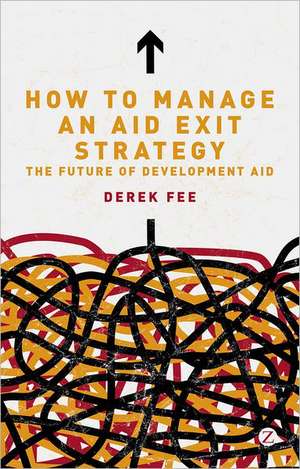
How to Manage an Aid Exit Strategy: The Future of Development Aid
Autor Derek Feeen Limba Engleză Paperback – 12 iul 2012
David Fee provides a refreshing, insightful and comprehensive analysis of how an exit may actually be possible - drawing on real experience and as such supplying a simple summary of recommended policy steps. The author thoroughly reviews aid for trade, regional integration and microfinance and a host of other solutions that have been proposed - arguing that an exit strategy for both donors and the least developed countries will have to consider the optimal combination of these specific initiatives to best satisfy the necessity of development and at the same time solve the problems of conventional aid.
Preț: 184.79 lei
Preț vechi: 249.14 lei
-26%
Puncte Express: 277
Carte disponibilă
Livrare economică 21 mai-04 iunie
Specificații
ISBN-13: 9781780320298
ISBN-10: 1780320299
Pagini: 272
Dimensiuni: 136 x 214 x 16 mm
Greutate: 0.34 kg
Ediția:New.
Editura: Bloomsbury Publishing
Colecția Zed Books
Locul publicării:London, United Kingdom
ISBN-10: 1780320299
Pagini: 272
Dimensiuni: 136 x 214 x 16 mm
Greutate: 0.34 kg
Ediția:New.
Editura: Bloomsbury Publishing
Colecția Zed Books
Locul publicării:London, United Kingdom
V-ar putea interesa
-
 -20%Preț: 73.67 lei92.40 lei
 -
 Toxic Aid: Economic Collapse and Recovery in TanzaniaSebastian Edwards-34%Preț: 512.88 lei772.34 lei
 -
 -17%Preț: 90.84 lei109.85 lei
 -
 -33%Preț: 772.78 lei1160.78 lei
 -
 -28%Preț: 63.94 lei88.71 lei
 -
 Humanitarian InterventionThomas G WeissPreț: 127.62 lei
 -
 -18%Preț: 202.63 lei247.90 lei
 -
 An Imperfect OfferingJames Orbinski-21%Preț: 92.09 lei115.95 lei
 -
 Carbonnier, G: Humanitarian EconomicsGilles Carbonnier-23%Preț: 229.64 lei297.67 lei
 -
 Engineering in EmergenciesJan DavisPreț: 392.62 lei
 -
 Aid, NGOs and the Realities of Women's LivesTina WallacePreț: 222.87 lei
Cuprins
Preface
1. The State of Aid
2. A Short History of Development Aid
3. The Development Aid Business
4. Domestic Resource Mobilization
5. Trade Liberalization
6. The BRICS
7. Regional Integration
8. Microfinance
9. Remittances
10. Non-Governmental Organizations and Philanthropic Foundations
11. Towards an Aid Exit Strategy
Notes
Bibliography
1. The State of Aid
2. A Short History of Development Aid
3. The Development Aid Business
4. Domestic Resource Mobilization
5. Trade Liberalization
6. The BRICS
7. Regional Integration
8. Microfinance
9. Remittances
10. Non-Governmental Organizations and Philanthropic Foundations
11. Towards an Aid Exit Strategy
Notes
Bibliography
Recenzii
To develop successful strategies and tactics for the future one has to know the present situation and that is not possible without knowing the past. To that end this book is a great help. It provides a thorough contribution to a debate that should not be limited to the in crowd of experts. Development cooperation is paid for by all taxpayers, who should all have a genuine interest in getting value for money. The same would, of course, be true for those at the receiving end of the aid.
I congratulate Derek Fee on his high-quality and extremely detailed book that has not only the merit to be an update on development aid but also asks pertinent questions on the future of our relations with developing countries. He does this with tact and success, based on his long experience of Africa. Derek Fee is one of those men, visionaries, open to dialogue, reforms and changes. I congratulate him on this most valuable book, which finds its place among all the lovers of Africa.
Derek Fee's book is a must-read for development practitioners and policy makers who are seeking a new paradigm to the conventional aid model, one that can work for the poor and that will lay the basis for aid dependent countries to exit from aid . A marvellously insightful book on the politics and economics of the relationship between the aid recipient countries and donors of all colours.
I congratulate Derek Fee on his high-quality and extremely detailed book that has not only the merit to be an update on development aid but also asks pertinent questions on the future of our relations with developing countries. He does this with tact and success, based on his long experience of Africa. Derek Fee is one of those men, visionaries, open to dialogue, reforms and changes. I congratulate him on this most valuable book, which finds its place among all the lovers of Africa.
Derek Fee's book is a must-read for development practitioners and policy makers who are seeking a new paradigm to the conventional aid model, one that can work for the poor and that will lay the basis for aid dependent countries to exit from aid . A marvellously insightful book on the politics and economics of the relationship between the aid recipient countries and donors of all colours.