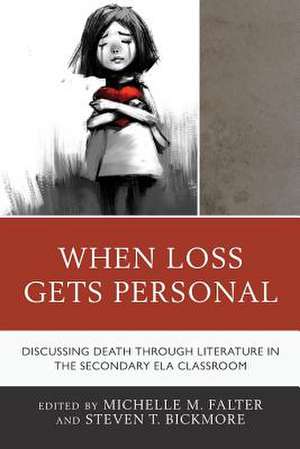
When Loss Gets Personal: Discussing Death through Literature in the Secondary ELA Classroom
Editat de Michelle M. Falter, Steven T. Bickmoreen Limba Engleză Paperback – 23 noi 2018
Each chapter in this book focuses on 1-2 texts and provides practical activities that ask students to engage with the loss through writing assignments, projects, activities, and discussion prompts in order to build empathy, understanding, and develop critically-minded and engaged students. When Loss Gets Personal will be of interest to English language arts teachers, teacher educators, librarians, and scholars who wish to explore with their students the complex emotions that revolve around discussing deaths that occur in literature.
Preț: 269.64 lei
Preț vechi: 352.18 lei
-23%
Puncte Express: 404
Carte tipărită la comandă
Livrare economică 28 noiembrie-12 decembrie
Livrare prin curier în România Termenul estimat este afișat lângă disponibilitate.
Transport gratuit de la 400.00 lei Plată online sau ramburs, în funcție de opțiunile comenzii.
Retur gratuit în 14 zile Comandă securizată și suport în română.
Specificații
ISBN-13: 9781475843811
ISBN-10: 147584381X
Pagini: 184
Ilustrații: 4 b/w illustrations; 5 b/w photos; 6 tables; 26 textboxes
Dimensiuni: 155 x 231 x 12 mm
Greutate: 0.3 kg
Editura: Bloomsbury Publishing
Colecția Rowman & Littlefield
Locul publicării:New York, United States
ISBN-10: 147584381X
Pagini: 184
Ilustrații: 4 b/w illustrations; 5 b/w photos; 6 tables; 26 textboxes
Dimensiuni: 155 x 231 x 12 mm
Greutate: 0.3 kg
Editura: Bloomsbury Publishing
Colecția Rowman & Littlefield
Locul publicării:New York, United States
Cuprins
Foreword
Author TBA
Acknowledgements
Introduction
Michelle M. Falter
Part I: Suicide
Chapter 1- Death and the Digital: Student Voices and Small Stories as Supplemental Texts to Thirteen Reasons Why
Emily C. Plummer
Chapter 2- Young Adults "Step Out" of Thirteen Reasons Why and Impulse: Moving from Personal Connection to Analysis
Alison Heron-Hruby, Mallory Aronhalt, Madison Beam, Hollibeth Francis, Danielle Jones, Haleigh Wells, and Brandie Trent
Chapter 3- Pursuing Mystery in A Tale for the Time Being: A Pedagogical Framework for Reading about Suicide with High School Students
Mark A. Sulzer
Part II: Terminal Illness
Chapter 4- Accepting the Deadline and Forging Ahead: Literature through the Lens of Palliative Care in a High School English Classroom
Christian Z. Goering and Ginger Goering
Chapter 5- Keeping it Real: Teaching Death Be Not Proud and This Star Won't Go Out as Adolescent Narratives of Loss
Michelle M. Falter
Chapter 6- The Healing Power of Stories: Reading and Re-Reading A Monster Calls
Jon Ostenson
Part III- Accidents
Chapter 7- The Thing about Grieving: Intellectual and Emotional Work in Ali Benjamin's The Thing about Jellyfish
Mary Harrell and Sharon Kane
Chapter 8- "Grieving Like a Normal Person": Examining Responses to Grief in Nina LaCour's We Are Okay
Jenna Spiering and Kate Kedley
Chapter 9- Envisioning Alternate Realities of Loss: Using Imagination to Bridge Classroom Conversations about Grief through Peter Pan and The Wendy Project
Nina R. Schoonover and Ashley A. Atkinson
Chapter 10- Addressing Trauma and Death with Young Adolescents through Tears of a Tiger
Melissa A. Baker, Laronda Brown, and Marisa A. Vicere
Chapter 11- Dealing with Death through Dialogue: Existentialism & Looking for Alaska
Katie Rybakova
Part IV: Familial Death
Chapter 12- The Intersectionality of Music and Mortality using Jason Reynold's The Boy in the Black Suit
Latasha McKinney and Rebecca Maldonado
Chapter 13- Loss and the Perfection Crucible in The Bell Jar and The Catcher in the RyeAntonia Alberga-Parisi and Brittany PopeChapter 14- "My Mother is a Fish": Exploring Grief through As I Lay Dying
Chea Parton
About the Editors
About the Contributors
Index
Author TBA
Acknowledgements
Introduction
Michelle M. Falter
Part I: Suicide
Chapter 1- Death and the Digital: Student Voices and Small Stories as Supplemental Texts to Thirteen Reasons Why
Emily C. Plummer
Chapter 2- Young Adults "Step Out" of Thirteen Reasons Why and Impulse: Moving from Personal Connection to Analysis
Alison Heron-Hruby, Mallory Aronhalt, Madison Beam, Hollibeth Francis, Danielle Jones, Haleigh Wells, and Brandie Trent
Chapter 3- Pursuing Mystery in A Tale for the Time Being: A Pedagogical Framework for Reading about Suicide with High School Students
Mark A. Sulzer
Part II: Terminal Illness
Chapter 4- Accepting the Deadline and Forging Ahead: Literature through the Lens of Palliative Care in a High School English Classroom
Christian Z. Goering and Ginger Goering
Chapter 5- Keeping it Real: Teaching Death Be Not Proud and This Star Won't Go Out as Adolescent Narratives of Loss
Michelle M. Falter
Chapter 6- The Healing Power of Stories: Reading and Re-Reading A Monster Calls
Jon Ostenson
Part III- Accidents
Chapter 7- The Thing about Grieving: Intellectual and Emotional Work in Ali Benjamin's The Thing about Jellyfish
Mary Harrell and Sharon Kane
Chapter 8- "Grieving Like a Normal Person": Examining Responses to Grief in Nina LaCour's We Are Okay
Jenna Spiering and Kate Kedley
Chapter 9- Envisioning Alternate Realities of Loss: Using Imagination to Bridge Classroom Conversations about Grief through Peter Pan and The Wendy Project
Nina R. Schoonover and Ashley A. Atkinson
Chapter 10- Addressing Trauma and Death with Young Adolescents through Tears of a Tiger
Melissa A. Baker, Laronda Brown, and Marisa A. Vicere
Chapter 11- Dealing with Death through Dialogue: Existentialism & Looking for Alaska
Katie Rybakova
Part IV: Familial Death
Chapter 12- The Intersectionality of Music and Mortality using Jason Reynold's The Boy in the Black Suit
Latasha McKinney and Rebecca Maldonado
Chapter 13- Loss and the Perfection Crucible in The Bell Jar and The Catcher in the RyeAntonia Alberga-Parisi and Brittany PopeChapter 14- "My Mother is a Fish": Exploring Grief through As I Lay Dying
Chea Parton
About the Editors
About the Contributors
Index
Recenzii
This important collection of essays addresses the reality of the experience of death as an inevitable part of life and literature through rich, concrete, engaging classroom activities responding to a wide range of young adult and canonical novels. Contributors draw on their teaching experiences to describe specific methods along with extensive resources for fostering students' discussions, writing, and artwork/media about characters' experiences of grief, loss,
depression, and mental illness associated with death and suicide.
This book will speak to and guide teachers and teacher educators who strive to be courageous in teaching literature to young people. Falter, Bickmore, and their contributors explore critical, cutting-edge approaches to teaching literature - approaches that humanize students by taking seriously their experiences with and questions about death, loss, and grief. This volume considers how suicide, terminal illness, accidents, and deaths of family members are depicted in both canonical and young adult literature. And, it offers strategies for creating interpretive spaces that foster deep engagement with these texts and the inquiries they evoke.
This text is an informative and indispensable guide for educators in creating classroom spaces that allow for the exploration of death and dying. Drawing from highly engaging young adult and commonly taught literature, these authors offer instructional methods that introduce, teach, and challenge students to consider a book's emotional core. Through the use of these strategies and approaches, the creation of classroom climates where students can feel comfortable exploring and discussing death and dying can be achieved.
Whether readers are teachers of English at the secondary or college level, or work in teacher preparation programs, they will discover that When Loss Gets Personal: Discussing Death through Literature in the Secondary ELA Classroom offers a multitude ofpractical strategies to help students reflect on personal and cultural beliefs related to grief, loss, and death. What I find energizing about this edited collection from Michelle Falter and Steven Bickmore is the variety of genres and forms of literature examined (e.g., verse novels, graphic novels, memoirs, mystery, and bildungsroman) and the diverse theoretical perspectives employed by each of the chapter's authors (e.g., reader-response theory, existentialism, cultural theory, and humanistic theory). This book fills a gap in the field of English Language Arts and gives instructors a valuable set of questions, assignments, and techniques that will make hosting authentic discussions of difficult topics such as suicide, terminal illness, death, and grief more manageable and meaningful.
depression, and mental illness associated with death and suicide.
This book will speak to and guide teachers and teacher educators who strive to be courageous in teaching literature to young people. Falter, Bickmore, and their contributors explore critical, cutting-edge approaches to teaching literature - approaches that humanize students by taking seriously their experiences with and questions about death, loss, and grief. This volume considers how suicide, terminal illness, accidents, and deaths of family members are depicted in both canonical and young adult literature. And, it offers strategies for creating interpretive spaces that foster deep engagement with these texts and the inquiries they evoke.
This text is an informative and indispensable guide for educators in creating classroom spaces that allow for the exploration of death and dying. Drawing from highly engaging young adult and commonly taught literature, these authors offer instructional methods that introduce, teach, and challenge students to consider a book's emotional core. Through the use of these strategies and approaches, the creation of classroom climates where students can feel comfortable exploring and discussing death and dying can be achieved.
Whether readers are teachers of English at the secondary or college level, or work in teacher preparation programs, they will discover that When Loss Gets Personal: Discussing Death through Literature in the Secondary ELA Classroom offers a multitude ofpractical strategies to help students reflect on personal and cultural beliefs related to grief, loss, and death. What I find energizing about this edited collection from Michelle Falter and Steven Bickmore is the variety of genres and forms of literature examined (e.g., verse novels, graphic novels, memoirs, mystery, and bildungsroman) and the diverse theoretical perspectives employed by each of the chapter's authors (e.g., reader-response theory, existentialism, cultural theory, and humanistic theory). This book fills a gap in the field of English Language Arts and gives instructors a valuable set of questions, assignments, and techniques that will make hosting authentic discussions of difficult topics such as suicide, terminal illness, death, and grief more manageable and meaningful.