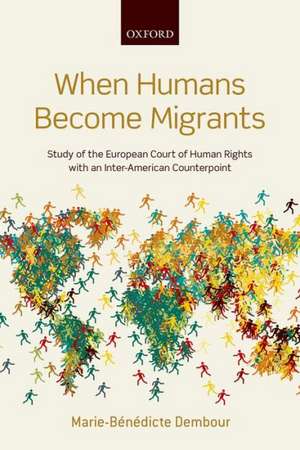
When Humans Become Migrants: Study of the European Court of Human Rights with an Inter-American Counterpoint
Autor Marie-Bénédicte Dembouren Limba Engleză Hardback – 26 mar 2015
Preț: 876.67 lei
Preț vechi: 1272.08 lei
-31%
Puncte Express: 1315
Carte tipărită la comandă
Livrare economică 19-25 noiembrie
Livrare prin curier în România Termenul estimat este afișat lângă disponibilitate.
Transport gratuit pentru acest produs Plată online sau ramburs, în funcție de opțiunile comenzii.
Retur gratuit în 14 zile Comandă securizată și suport în română.
Specificații
ISBN-13: 9780199667833
ISBN-10: 0199667837
Pagini: 578
Dimensiuni: 163 x 236 x 38 mm
Greutate: 1 kg
Editura: OUP OXFORD
Colecția OUP Oxford
Locul publicării:Oxford, United Kingdom
ISBN-10: 0199667837
Pagini: 578
Dimensiuni: 163 x 236 x 38 mm
Greutate: 1 kg
Editura: OUP OXFORD
Colecția OUP Oxford
Locul publicării:Oxford, United Kingdom
V-ar putea interesa
-
 -31%Preț: 752.31 lei1083.37 lei
 -
 -30%Preț: 808.05 lei1154.69 lei
 -
 Us and Them?: The Dangerous Politics of Immigration ControlBridget Anderson-19%Preț: 365.71 lei453.98 lei
 -
 Blackstone's Guide to the Asylum and Immigration Act 2004Doughty Street Chambers-29%Preț: 483.08 lei676.71 lei
 -
 -31%Preț: 597.62 lei864.66 lei
 -
 Immigration Outside the LawHiroshi Motomura-23%Preț: 281.27 lei364.29 lei
 -
 We Wanted Workers: Unraveling the Immigration NarrativeGeorge J. BorjasPreț: 172.25 lei
 -
 -18%Preț: 1255.87 lei1531.54 lei
 -
 Paths to International JusticeMarie-Bénédicte DembourPreț: 388.64 lei
 -
 Culture and RightsMarie-Benedicte DembourPreț: 400.06 lei
 -
 The Health of NewcomersPatricia IllingworthPreț: 398.08 lei
 -
 Care, Migration and Human Rights: Law and PracticeSiobhán Mullally-15%Preț: 430.89 lei506.93 lei
 -
 -15%Preț: 520.78 lei612.68 lei
 -
 Justice and Authority in Immigration LawColin Grey-25%Preț: 175.66 lei235.26 lei
 -
 Recalling the Belgian CongoMarie-Bénédicte Dembour-23%Preț: 755.47 lei981.13 lei
 -
 -27%Preț: 889.22 lei1210.81 lei
 -
 -27%Preț: 999.47 lei1362.39 lei
 -
 -27%Preț: 887.26 lei1209.50 lei
 -
 -27%Preț: 1023.68 lei1395.88 lei
 -
 U.S. Asylum System: Trends in Claims, Fraud Risks & Prevention ControlsEugene James Martin-27%Preț: 724.70 lei988.39 lei
Recenzii
When Humans Become Migrants is a magisterial endeavour which will become a standard work of reference for those working in the fields of migrants rights and the case law of the ECtHR. [T]he clear, intuitive way in which the book, and each individual chapter, is structured, and the verve and clarity with which it is written lend it a discipline-transcending accessibility, which should ensure it the wide readership it merits.
With a title as hard hitting as When Humans Become Migrants one would hope the content of the book would be equally as striking, and thankfully it is. Through it, legal anthropologist Marie-Bénédicte Dembour challenges our thinking about the position and humanity of migrants, even before opening the book ... Dembours conceptual approach - contrasting the treatment of migrants in the European Court of Human Rights (ECtHR) with that of the Inter-American Court of Human Rights (IACHR) - provides a unique, highly relevant, and timely contribution to the field of human rights law and migration studies.
This book is highly recommendable for students, academics, and practitioners working on migration and human rights. It is an excellent and crucial addition to the literature and the first book where both regional courts are carefully examined on the issue of migrant protection. This makes the publication a lasting contribution for years to come and a central landmark in the scholarly research on the subject.
Dembour's analysis is wide-ranging, covering historical and current developments in a range of areas of concern to migrants and their representatives. It is a work of sympathetic imagination which holds fast to its ideals even when writing against the mainstream.
Dembour offers not only a perspicacious analysis and prudent suggestions, but also raises significant questions such as how the interests of migrants on one hand and of states on the other could be balanced without a bias for either or another, or how to regard the other as one of our own, create an open and inclusive attitude and set it as an institutional imperative.
In her characteristically original, distinctive and insightful way, Dembour invites us to abandon preconceived ideas and to think differently. This is the role judges need legal scholars to perform if academic commentaries are to nourish judicial decision-making. An intelligent, lucid and courageous book that takes the debate into new territory.
With a title as hard hitting as When Humans Become Migrants one would hope the content of the book would be equally as striking, and thankfully it is. Through it, legal anthropologist Marie-Bénédicte Dembour challenges our thinking about the position and humanity of migrants, even before opening the book ... Dembours conceptual approach - contrasting the treatment of migrants in the European Court of Human Rights (ECtHR) with that of the Inter-American Court of Human Rights (IACHR) - provides a unique, highly relevant, and timely contribution to the field of human rights law and migration studies.
This book is highly recommendable for students, academics, and practitioners working on migration and human rights. It is an excellent and crucial addition to the literature and the first book where both regional courts are carefully examined on the issue of migrant protection. This makes the publication a lasting contribution for years to come and a central landmark in the scholarly research on the subject.
Dembour's analysis is wide-ranging, covering historical and current developments in a range of areas of concern to migrants and their representatives. It is a work of sympathetic imagination which holds fast to its ideals even when writing against the mainstream.
Dembour offers not only a perspicacious analysis and prudent suggestions, but also raises significant questions such as how the interests of migrants on one hand and of states on the other could be balanced without a bias for either or another, or how to regard the other as one of our own, create an open and inclusive attitude and set it as an institutional imperative.
In her characteristically original, distinctive and insightful way, Dembour invites us to abandon preconceived ideas and to think differently. This is the role judges need legal scholars to perform if academic commentaries are to nourish judicial decision-making. An intelligent, lucid and courageous book that takes the debate into new territory.
Notă biografică
Marie-Bénédicte Dembour is Professor of Law and Anthropology at the University of Brighton She has also taught at the European University Institute, the Vrije Universiteit Brussels, and the University of Oxford. She has authored and edited numerous previous titles.
Cuprins
- 1: Introduction
- Part I: FOUNDATIONS
- 2: The alien in the social imagination of the founding texts
- 3: Rejecting the legacy of empire: Postcolonial dereliction (East African Asians case)
- 4: Dislocating families: The Strasbourg reversal (Abdulaziz, Cabales and Balkandali)
- 5: Not so threatening foreighers: Nationality as a central human rights issue (Advisory opinion 4/84)
- Part II: CONSOLIDATION
- 6: Shattering Lives: The normalisation of deportation (After Berrehab)
- 7: The sleeping beauty awakens late: An absolute prohibition with many buts (Around Soering)
- 8: Social protection: All are equal but some are more equal than others (After Gaygusuz)
- 9: The Voice of the Inter-American Court: Equality as Jus Cogens (Advisory Opinions 16/99 and 18/03)
- 10: Reparations are a Big Issue: Taking Human Rights One Step Further (Yean and Bosico)
- Part III: PROSPECTS
- 11: Migrants, not criminals: Inter-American determination v. European hesitations (Vélez Loor )
- 12: Domestic asylum procedures aside: Scrutinising Strasbourgs 'Scrutiny' (M.S.S.)
- 13: The Darkest Case Law: Condoning Rightlessness (Bonger et alia)
- 14: On the Road to Substantive Equality: Due Process and Non-discrimination at San José (Nadege Dorzema and Pacheco Tineo) - by Lourdes Peroni
- 15: Conclusion: The Way Forward