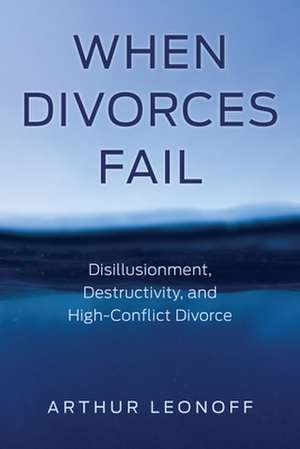
When Divorces Fail: Disillusionment, Destructivity, and High-Conflict Divorce
Autor Arthur Leonoffen Limba Engleză Paperback – 15 sep 2021
Preț: 256.51 lei
Preț vechi: 334.82 lei
-23%
Puncte Express: 385
Carte tipărită la comandă
Livrare economică 17 noiembrie-01 decembrie
Livrare prin curier în România Termenul estimat este afișat lângă disponibilitate.
Transport gratuit de la 400.00 lei Plată online sau ramburs, în funcție de opțiunile comenzii.
Retur gratuit în 14 zile Comandă securizată și suport în română.
Specificații
ISBN-13: 9781538153727
ISBN-10: 1538153726
Pagini: 232
Ilustrații: 1 table
Dimensiuni: 154 x 232 x 15 mm
Greutate: 0.35 kg
Editura: Bloomsbury Publishing
Colecția Rowman & Littlefield
Locul publicării:New York, United States
ISBN-10: 1538153726
Pagini: 232
Ilustrații: 1 table
Dimensiuni: 154 x 232 x 15 mm
Greutate: 0.35 kg
Editura: Bloomsbury Publishing
Colecția Rowman & Littlefield
Locul publicării:New York, United States
V-ar putea interesa
-
 Hasby Finds His VoiceLauren Braude GarrettPreț: 124.01 lei
 -
 Preț: 96.48 lei
 -
 Children and DivorceCraig HawleyPreț: 66.58 lei
 -
 The Essentials of Parental Alienation SyndromeJ. Michael Bone Ph. D.Preț: 128.14 lei
 -
 SplitopiaWendy ParisPreț: 120.35 lei
 -
 Child Custody Evaluation & Mediation PreparationDr Miguel AlvarezPreț: 119.74 lei
 -
 A Separate PieceMS Robyn SpencerPreț: 36.71 lei
 -
 Give Us This Day Our Daily Meds (Bread)Deanna RickePreț: 82.70 lei
 -
 A House Without a CoveringEssie DayPreț: 154.49 lei
 -
 TWISTED BOAZJohn M. McVeyPreț: 174.40 lei
 -
 Mindful Co-ParentingPsy D. Jeremy S. GaiesPreț: 93.91 lei
 -
 Ring ExchangePam EvansPreț: 83.29 lei
 -
 Recovering from DivorceMary Jo ThorsonPreț: 63.45 lei
 -
 Yes You CanDavid EllsworthPreț: 53.02 lei
 -
 Coping with Divorce for the Single DaddyNick ThomasPreț: 80.83 lei
 -
 Heartbreak CureAlexander JanzerPreț: 39.29 lei
 -
 How to Cure a Sexless MarriageMarguerite De LyonPreț: 39.29 lei
 -
 Successful Stages in ReunificationSteffanie Brooks-Aguilar M. S.Preț: 79.17 lei
 -
 No Contact RuleRhonda WyattPreț: 67.37 lei
 -
 Las Penas del Joven Werther (Spanish Edition)Johann Wolfgang GoethePreț: 61.25 lei
 -
 -5%Preț: 321.80 lei338.74 lei
 -
 The King's ChroniclesBlackard, MarkPreț: 87.45 lei
Cuprins
Acknowledgments
Author's Note
Introduction
1 High Conflict: An Ethical Dilemma
2 The Nature of Destructiveness
3 Divorce: A Crisis of Disillusionment
4 Disillusionment Therapy
5 Love in the Age of Divorce
6 Those Who Cannot Love: Destructive Personalities
7 In Pursuit of an Ethical Divorce: What This Means for High Conflict
8 Confronting the Nihilism of High Conflict
9 Traumatic Conflict Disorder
10 Implications for Legal, Judicial, and Mental Health Services
11 Tabling High Conflict: On the Path to Ethics
Index
About the Author
Author's Note
Introduction
1 High Conflict: An Ethical Dilemma
2 The Nature of Destructiveness
3 Divorce: A Crisis of Disillusionment
4 Disillusionment Therapy
5 Love in the Age of Divorce
6 Those Who Cannot Love: Destructive Personalities
7 In Pursuit of an Ethical Divorce: What This Means for High Conflict
8 Confronting the Nihilism of High Conflict
9 Traumatic Conflict Disorder
10 Implications for Legal, Judicial, and Mental Health Services
11 Tabling High Conflict: On the Path to Ethics
Index
About the Author
Recenzii
Arthur Leonoff writes about when divorces fail in a discerning, compassionate manner that reflects his extensive forensic experience, his psychoanalytic and socially engaged mind, and his fearless devotion to addressing a relational problem that features destructivity and an absence of empathy and ethics. Through clinical stories that bring the disturbing experience of high-conflict divorce alive, he provides the reader with psychological understanding and pragmatic approaches to intervention. He offers mental health professionals and family law specialists, as well as the general public an understandable and constructive deep dive into a very complex matter.
In his third book, When Divorces Fail: Disillusionment, Destructivity, and High-Conflict Divorce, Dr. Leonoff offers deep insight into the genesis of severe high conflict divorce and its transgenerational impact. Illustrating his theory with case summaries that will resonate strongly with every mental health and legal professional who works with this challenging population, Dr. Leonoff explains the unexplained. This book is an absolute must-read for every family court judge, family lawyer, mediator, arbitrator, and parenting coordinator who has experienced the astonishment, dismay, frustration, and sense of failure working with high conflict individuals. Readers will appreciate why some of the legal structures we currently use to support and manage high conflict parties, including some family dispute resolution processes and case management systems, are ineffective in containing the destructive behaviour we so often witness in these divorces. In the end, Dr. Leonoff shares his compelling ideas about where we might go from here.
Leonoff draws on a wealth of experience in working with high conflict separating couples to explore the trauma and complexities of these most challenging cases. He relates the disillusionment and destructive behavior of parents to their own childhoods, and to the devastation it causes for their children. This book provides important insights and practical advice for family justice and mental health professionals.
This book is rich with observations, psychoanalytic and otherwise, about the extremity of high-conflict divorce. It also provides an understanding for treating all couples in crisis.
In his third book, When Divorces Fail: Disillusionment, Destructivity, and High-Conflict Divorce, Dr. Leonoff offers deep insight into the genesis of severe high conflict divorce and its transgenerational impact. Illustrating his theory with case summaries that will resonate strongly with every mental health and legal professional who works with this challenging population, Dr. Leonoff explains the unexplained. This book is an absolute must-read for every family court judge, family lawyer, mediator, arbitrator, and parenting coordinator who has experienced the astonishment, dismay, frustration, and sense of failure working with high conflict individuals. Readers will appreciate why some of the legal structures we currently use to support and manage high conflict parties, including some family dispute resolution processes and case management systems, are ineffective in containing the destructive behaviour we so often witness in these divorces. In the end, Dr. Leonoff shares his compelling ideas about where we might go from here.
Leonoff draws on a wealth of experience in working with high conflict separating couples to explore the trauma and complexities of these most challenging cases. He relates the disillusionment and destructive behavior of parents to their own childhoods, and to the devastation it causes for their children. This book provides important insights and practical advice for family justice and mental health professionals.
This book is rich with observations, psychoanalytic and otherwise, about the extremity of high-conflict divorce. It also provides an understanding for treating all couples in crisis.