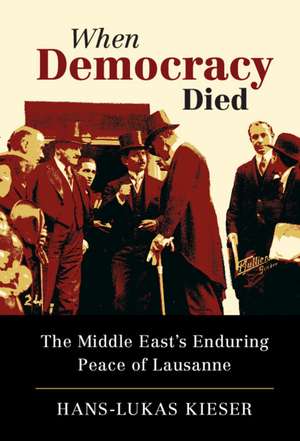
When Democracy Died
Autor Hans-Lukas Kieseren Limba Engleză Hardback – 27 apr 2023
Preț: 307.19 lei
Puncte Express: 461
Carte tipărită la comandă
Livrare economică 30 noiembrie-14 decembrie
Livrare express 23-29 octombrie pentru 178.26 lei
Livrare prin curier în România Termenul estimat este afișat lângă disponibilitate.
Transport gratuit de la 400.00 lei Plată online sau ramburs, în funcție de opțiunile comenzii.
Retur gratuit în 14 zile Comandă securizată și suport în română.
Specificații
ISBN-13: 9781316516423
ISBN-10: 1316516423
Pagini: 342
Dimensiuni: 156 x 237 x 24 mm
Greutate: 0.65 kg
Editura: Cambridge University Press
Locul publicării:Cambridge, United Kingdom
ISBN-10: 1316516423
Pagini: 342
Dimensiuni: 156 x 237 x 24 mm
Greutate: 0.65 kg
Editura: Cambridge University Press
Locul publicării:Cambridge, United Kingdom
Cuprins
Introduction. The historic near east peace of Lausanne; 1. A century's pivotal 'peace'; 2. Against the Paris-Geneva peace: Bolsheviks, Turkists, Islamists; 3. A protracted conference: redefining Turkey, western realpolitik.
Recenzii
'Rather than viewing the Treaty of Lausanne from the perspective of the victorious founders of the Turkish Republic, this critical study examines the Treaty from that of its losers. Kieser convincingly argues that the Treaty legalized and rewarded ethnic cleansing; sounded the death-knell for democratic self-determination; and ushered in extreme nationalist, authoritarian rule in Turkey.' Marc Baer, London School of Economics
'This study gives an original interpretation of the Lausanne Treaty. It allows us to understand the emergence of the two new regimes of the post-Great War period: fascism in Italy and Kemalism in Turkey, which, together with the Bolshevik Soviet Union, considered themselves to be the pillars of an antidemocratic age to come.' Hamit Bozarslan, EHESS, School for Advanced Studies in the Social Sciences, Paris
'Kieser offers an important corrective to histories of modern Turkey. He shows that 'colonialism' is not the only process to blame for the Middle East's anti-democratic tradition, and that Europe owes some of its interwar fascism and ultranationalism to the Lausanne Conference. The Lausanne Treaty, the book shows, reads like a manual on how to get away with genocide. Germany was watching.' Lerna Ekmekcioglu, Massachusetts Institute of Technology
'In this brilliant study, Kieser shows how the Lausanne Treaty proved both a crucial endpoint of the Paris system and the basis for the rise of authoritarianism. Carefully researched and cogently argued, it finetunes understandings of fascism by revealing the family resemblances between Turkey and other regimes that sought to eliminate minorities.' Michelle Tusan, University of Nevada, Las Vegas
'This study gives an original interpretation of the Lausanne Treaty. It allows us to understand the emergence of the two new regimes of the post-Great War period: fascism in Italy and Kemalism in Turkey, which, together with the Bolshevik Soviet Union, considered themselves to be the pillars of an antidemocratic age to come.' Hamit Bozarslan, EHESS, School for Advanced Studies in the Social Sciences, Paris
'Kieser offers an important corrective to histories of modern Turkey. He shows that 'colonialism' is not the only process to blame for the Middle East's anti-democratic tradition, and that Europe owes some of its interwar fascism and ultranationalism to the Lausanne Conference. The Lausanne Treaty, the book shows, reads like a manual on how to get away with genocide. Germany was watching.' Lerna Ekmekcioglu, Massachusetts Institute of Technology
'In this brilliant study, Kieser shows how the Lausanne Treaty proved both a crucial endpoint of the Paris system and the basis for the rise of authoritarianism. Carefully researched and cogently argued, it finetunes understandings of fascism by revealing the family resemblances between Turkey and other regimes that sought to eliminate minorities.' Michelle Tusan, University of Nevada, Las Vegas
Descriere
Offers a history of the Treaty of Lausanne, outlining the decade of war that preceded it and its enduring impact in the Middle East and beyond.