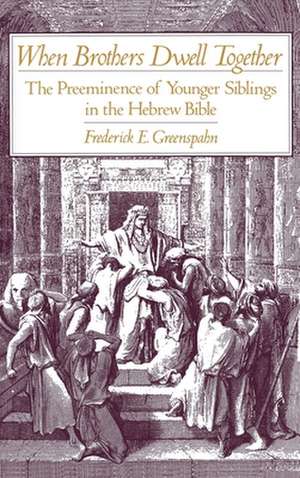
When Brothers Dwell Together: The Preeminance of Younger Siblings in the Hebrew Bible
Autor Frederick E. Greenspahnen Limba Engleză Hardback – 19 mai 1994
Preț: 780.70 lei
Preț vechi: 1118.18 lei
-30%
Puncte Express: 1171
Carte tipărită la comandă
Livrare economică 10-15 decembrie
Livrare prin curier în România Termenul estimat este afișat lângă disponibilitate.
Transport gratuit pentru acest produs Plată online sau ramburs, în funcție de opțiunile comenzii.
Retur gratuit în 14 zile Comandă securizată și suport în română.
Specificații
ISBN-13: 9780195082531
ISBN-10: 0195082532
Pagini: 208
Dimensiuni: 161 x 244 x 19 mm
Greutate: 0.44 kg
Editura: Oxford University Press
Colecția OUP USA
Locul publicării:New York, United States
ISBN-10: 0195082532
Pagini: 208
Dimensiuni: 161 x 244 x 19 mm
Greutate: 0.44 kg
Editura: Oxford University Press
Colecția OUP USA
Locul publicării:New York, United States
V-ar putea interesa
-
 The TalmudNorman Solomon-17%Preț: 116.26 lei139.63 lei
 -
 -20%Preț: 148.87 lei185.54 lei
 -
 The Buddha and his Dhamma: A Critical EditionAakash Singh Rathore-20%Preț: 359.27 lei447.98 lei
 -
 The Hindus: An Alternative HistoryWendy Doniger-11%Preț: 189.30 lei212.04 lei
 -
 Debating the Dasam GranthRobin Rinehart-30%Preț: 764.29 lei1094.53 lei
 -
 The Dead Sea Scrolls and the Origins of the BibleEugene C. UlrichPreț: 212.35 lei
 -
 The Middle Length Discourses of the BuddhaBodhi Bhikkhu-18%Preț: 479.56 lei581.81 lei
 -
 Understanding the Qur'an TodayMahmoud HusseinPreț: 76.01 lei
 -
 Companion to the Qur anAndrew RippinPreț: 415.88 lei
 -
 The Mosaic of IslamSuleiman MouradPreț: 120.52 lei
 -
 Reading the Qur'anZiauddin Sardar-15%Preț: 89.85 lei106.12 lei
 -
 The Bhagavad GitaGeoffrey ParrinderPreț: 64.70 lei
Recenzii
The book is lucidly written and provides a fresh and thought-provoking approach to an often neglected area of Old Testament research ... the book contains many stimulating insights and interesting observations.
He is to be congratulated from the outset for this methodological thoroughness and clarity. Masterfully following several avenues of inquiry and drawing out at every turn the fullest implications, he has provided a model of literacy, theological, and historical-critical interpretation. His discussion is remarkable also for its lucidity and for the thorough treatment of scholarly opinion.
He is to be congratulated from the outset for this methodological thoroughness and clarity. Masterfully following several avenues of inquiry and drawing out at every turn the fullest implications, he has provided a model of literacy, theological, and historical-critical interpretation. His discussion is remarkable also for its lucidity and for the thorough treatment of scholarly opinion.