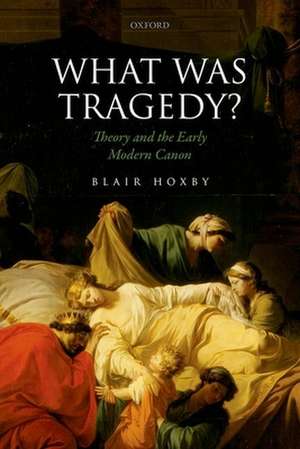
What Was Tragedy?: Theory and the Early Modern Canon
Autor Blair Hoxbyen Limba Engleză Hardback – oct 2015
Preț: 808.46 lei
Preț vechi: 1171.65 lei
-31%
Puncte Express: 1213
Carte tipărită la comandă
Livrare economică 03-09 decembrie
Livrare prin curier în România Termenul estimat este afișat lângă disponibilitate.
Transport gratuit pentru acest produs Plată online sau ramburs, în funcție de opțiunile comenzii.
Retur gratuit în 14 zile Comandă securizată și suport în română.
Specificații
ISBN-13: 9780198749165
ISBN-10: 0198749163
Pagini: 378
Ilustrații: Numerous black-and-white halftones
Dimensiuni: 171 x 236 x 29 mm
Greutate: 0.74 kg
Editura: OUP OXFORD
Colecția OUP Oxford
Locul publicării:Oxford, United Kingdom
ISBN-10: 0198749163
Pagini: 378
Ilustrații: Numerous black-and-white halftones
Dimensiuni: 171 x 236 x 29 mm
Greutate: 0.74 kg
Editura: OUP OXFORD
Colecția OUP Oxford
Locul publicării:Oxford, United Kingdom
V-ar putea interesa
-
 -20%Preț: 364.44 lei453.32 lei
 -
 -32%Preț: 800.48 lei1179.13 lei
 -
 -28%Preț: 368.03 lei511.55 lei
 -
 Religio Medici, Hydriotaphia and The Garden of CyrusThomas Browne-29%Preț: 349.52 lei489.85 lei
 -
 Writing the Nation in Reformation England, 1530-1580Cathy Shrank-19%Preț: 373.10 lei463.30 lei
 -
 The Literary Culture of the Reformation: Grammar and GraceBrian Cummings-28%Preț: 455.56 lei633.98 lei
 -
 Paradise Lost and the Romantic ReaderLucy Newlyn-28%Preț: 353.98 lei492.46 lei
 -
 -33%Preț: 2211.04 lei3289.56 lei
 -
 -33%Preț: 2100.19 lei3123.65 lei
 -
 -28%Preț: 376.77 lei522.10 lei
 -
 Arabian Nights' EntertainmentsRobert L. Mack-16%Preț: 100.54 lei119.18 lei
 -
 Mock-Epic Poetry from Pope to HeineRitchie Robertson-31%Preț: 576.89 lei830.38 lei
 -
 Shakespeare in PartsSimon Palfrey-12%Preț: 294.63 lei336.14 lei
 -
 -27%Preț: 350.93 lei477.76 lei
 -
 -31%Preț: 899.02 lei1308.09 lei
 -
 -22%Preț: 386.10 lei493.33 lei
 -
 Young Milton: The Emerging Author, 1620-1642Edward Jones-31%Preț: 949.79 lei1379.65 lei
 -
 Preț: 268.72 lei
 -
 Preț: 301.91 lei
 -
 The Substance of CervantesJohn G. WeigerPreț: 319.11 lei
 -
 GrillparzerW. E. YatesPreț: 299.96 lei
 -
 Preț: 425.07 lei
 -
 Preț: 376.62 lei
 -
 William Cowper of the Inner Temple, Esq.Ryskamp CharlesPreț: 303.20 lei
 -
 Goethe's BoyhoodJohann Wolfgang von GoethePreț: 200.89 lei
 -
 Preț: 245.24 lei
 -
 Thomas WyattThomas WyattPreț: 69.12 lei
 -
 Tis Pity She's A Whore: A critical guideProfessor Lisa Hopkins-14%Preț: 239.26 lei277.83 lei
 -
 Preț: 64.09 lei
Recenzii
What Was Tragedy? reflects recent interest in reception studies, as some of its chapters diligently consider the performance history and success of a variety of theatrical texts, some now forgotten (as is the case of Stefonio's Crispus), some relegated to a secondary position within the corpus of extremely canonical authors (as is the case of Shakespeare's Antony and Cleopatra).
Ranging from classical theory and drama to Renaissance English, Italian, and French drama (principally Racine), German romantic philosophy, and modern literary criticism, Blair Hoxby argues brilliantly and compellingly what we can now deduce was a different meaning drama held in the sixteenth and seventeenth centuries.
This is an important book, and Hoxby's call to attend to and describe what was actually performed as tragedy in the period restores vitality and variation to the canon. Ultimately, he affords us a much clearer view of the masterwork over which the period labored.
One of this year's greatest scholarly achievements ... Combining literary and intellectual history, philosophy, and formal analysis, Hoxby recovers a largely lost early modern poetics of tragedy ... What Was Tragedy? has many implications not just for how we understand tragedy in our period, but also for how we conceive of early modern selfhood, how we understand the history of emotions, and how we go about the business of literary periodization. It's a major piece of scholarship.
Hoxby exhibits a powerful disciplinary, linguistic, and chronological reach, and asks fundamental questions about secular and sacred drama, the Renaissance and the Enlightenment, and early modern and post-Romantic thought. For its combination of imaginative, omnivorous research and an argument that has already caused excited discussion here at RSA, the committee found this an extraordinary piece of work.
Hoxby (Stanford Univ.) has written an intriguing work that attempts to establish what the genre of tragedy meant before idealists such as Schelling, Schlegel, and Hegel created the definition now accepted.
Hoxby makes a very compelling case for attending more carefully to works that might answer to the name of tragedy produced in Europe between 1515 and 1795 ... Hoxbys book is a superb achievement, and treats us to nuanced and sensitive readings
In this densely learned book, Blair Hoxby sets himself the worthy and formidable task of scraping away the mores of German Idealists so that early modern tragedy might be read on its own terms ... it will be a valuable reference for years to come.
The sweep of the book is its greatest recommendation in many respects. Hoxby's deep knowledge of music and music history, world philosophy, and theatre practice provide a worthwhile and perhaps even indispensable addition to the body of work on the nature of tragedy. For the music and theatre scholar, Hoxby's work in answering his past-tense question should prove invaluable for those seeking to answer the same question in the here and now.
Ranging from classical theory and drama to Renaissance English, Italian, and French drama (principally Racine), German romantic philosophy, and modern literary criticism, Blair Hoxby argues brilliantly and compellingly what we can now deduce was a different meaning drama held in the sixteenth and seventeenth centuries.
This is an important book, and Hoxby's call to attend to and describe what was actually performed as tragedy in the period restores vitality and variation to the canon. Ultimately, he affords us a much clearer view of the masterwork over which the period labored.
One of this year's greatest scholarly achievements ... Combining literary and intellectual history, philosophy, and formal analysis, Hoxby recovers a largely lost early modern poetics of tragedy ... What Was Tragedy? has many implications not just for how we understand tragedy in our period, but also for how we conceive of early modern selfhood, how we understand the history of emotions, and how we go about the business of literary periodization. It's a major piece of scholarship.
Hoxby exhibits a powerful disciplinary, linguistic, and chronological reach, and asks fundamental questions about secular and sacred drama, the Renaissance and the Enlightenment, and early modern and post-Romantic thought. For its combination of imaginative, omnivorous research and an argument that has already caused excited discussion here at RSA, the committee found this an extraordinary piece of work.
Hoxby (Stanford Univ.) has written an intriguing work that attempts to establish what the genre of tragedy meant before idealists such as Schelling, Schlegel, and Hegel created the definition now accepted.
Hoxby makes a very compelling case for attending more carefully to works that might answer to the name of tragedy produced in Europe between 1515 and 1795 ... Hoxbys book is a superb achievement, and treats us to nuanced and sensitive readings
In this densely learned book, Blair Hoxby sets himself the worthy and formidable task of scraping away the mores of German Idealists so that early modern tragedy might be read on its own terms ... it will be a valuable reference for years to come.
The sweep of the book is its greatest recommendation in many respects. Hoxby's deep knowledge of music and music history, world philosophy, and theatre practice provide a worthwhile and perhaps even indispensable addition to the body of work on the nature of tragedy. For the music and theatre scholar, Hoxby's work in answering his past-tense question should prove invaluable for those seeking to answer the same question in the here and now.
Notă biografică
Blair Hoxby is an Associate Professor of English at Stanford University. After graduating with an A. B. from Harvard University, he studied at Oxford University as a Rhodes Scholar. He then earned his Ph.D. from Yale University. Before coming to Stanford, he was an Associate Professor of English at Yale and an Associate Professor of History and Literature at Harvard. He is the author of Mammon's Music: Literature and Economics in the Age of Milton and numerous articles on Milton, literary and cultural responses to nascent capitalism, early modern theater, and theories of tragedy.