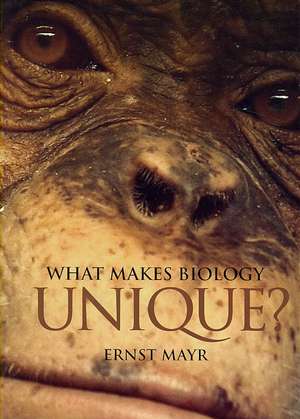
What Makes Biology Unique?: Considerations on the Autonomy of a Scientific Discipline
Autor Ernst Mayren Limba Engleză Paperback – 15 apr 2007
Structura volumului What Makes Biology Unique? este concepută ca o serie de eseuri tematice care fundamentează metodologia biologiei ca știință autonomă. Remarcăm efortul autorului de a delimita biologia de rigoarea pur reductionistă a științelor fizice, argumentând că viața necesită un set propriu de concepte filosofice și epistemologice. Subliniem analiza magistrală a lui Ernst Mayr asupra moștenirii lui Darwin: acesta nu a propus o singură teorie, ci cinci procese distincte, fiecare cu propria traiectorie istorică. Considerăm că această distincție este crucială pentru clarificarea controverselor care persistă în mediul academic din cauza confundării selecției naturale cu descendența comună sau cu speciația.
În contextul operei sale, volumul reprezintă o rafinare a ideilor din Animal Species and Evolution, trecând de la descrierea mecanismelor biologice la o analiză meta-teoretică a disciplinei. Dacă în lucrările anterioare se concentra pe taxonomie și ornitologie, aici Ernst Mayr își asumă rolul de filosof al științei. Comparabil cu The Structure of Biological Science de Alexander Rosenberg în rigurozitate, volumul lui Mayr este însă actualizat pentru a sublinia caracterul istoric și contingent al proceselor biologice, spre deosebire de legile universale ale fizicii. Tonul este unul de o precizie academică remarcabilă, oferind o perspectivă matură asupra modului în care s-a format gândirea biologică modernă. Ediția de față, publicată de Cambridge University Press, servește drept o sinteză finală a carierei unui cercetător care a modelat biologia secolului trecut.
Preț: 270.26 lei
Carte tipărită la comandă
Livrare economică 03-17 iunie
Specificații
ISBN-10: 0521700345
Pagini: 248
Ilustrații: 1 table
Dimensiuni: 154 x 228 x 15 mm
Greutate: 0.34 kg
Editura: Cambridge University Press
Colecția Cambridge University Press
Locul publicării:New York, United States
V-ar putea interesa
-
 Preț: 444.90 lei
 -
 DarwinWilliam BrownPreț: 187.02 lei
 -
 Darwinian HeresiesAbigail LustigPreț: 289.47 lei
 -
 Evolution and BeliefRobert J. AsherPreț: 219.15 lei
 -
 The Cambridge Companion to DarwinJonathan HodgePreț: 325.27 lei
 -
 The Cambridge Illustrated Glossary of Botanical TermsMichael HickeyPreț: 445.88 lei
 -
 What Evolution Is: From Theory to FactErnst Mayr-27%Preț: 65.77 lei89.82 lei
 -
 Soul Dust: The Magic of ConsciousnessNicholas Humphrey-27%Preț: 64.95 lei89.33 lei
 -
 The Correspondence of Charles Darwin: Volume 19, 1871Charles Darwin-23%Preț: 905.06 lei1175.40 lei
 -
 Adaptive SpeciationUlf DieckmannPreț: 456.01 lei
De ce să citești această carte
Această carte este esențială pentru cercetători și studenți care doresc să înțeleagă biologia dincolo de datele empirice. Cititorul câștigă o perspectivă clară asupra modului în care teoria evoluționistă este structurată, învățând să distingă între diferitele sale componente. Este un argument solid pentru statutul independent al biologiei, oferind instrumente intelectuale necesare oricui dorește să navigheze dezbaterile contemporane despre viață și evoluție.
Despre autor
Ernst Mayr (1904–2005) a fost profesor emerit la Universitatea Harvard și director al Muzeului de Zoologie Comparată. Supranumit „Darwin al secolului XX”, a fost o figură centrală în dezvoltarea sintezei evoluționiste moderne. De-a lungul carierei sale vaste ca ornitolog, taxonomist și istoric al științei, a redefinit conceptul de specie și a contribuit fundamental la înțelegerea biodiversității. Opera sa vastă, care include titluri fundamentale precum Animal Species and Evolution, l-a consacrat drept unul dintre cei mai influenți biologi din istorie, primind numeroase distincții pentru integrarea biologiei cu filosofia și istoria.
Descriere scurtă
Cuprins
Recenzii
'Ernst Mayr has long had a deep and well-informed interest in the philosophy of biology in relation to broad questions in the philosophy of science. This is an invaluable, thought-provoking, and engaging summary of his ideas, a crowning achievement!' Mary Jane West-Eberhard, Smithsonian Tropical Research Institute, author of Developmental Plasticity and Evolution (Hawkins Award, 2003)
'His essays reflect the recent literature as much as can be expected, given their broad scope, but their greatest virtue is their historical and conceptual depth. Not only has Mayr been a major force for much of the history of evolutionary theory, but he is also a philosopher and a scholar of the old school who believes in tracing ideas to their roots.' David Sloan Wilson, American Scientist
'… an excellent firsthand overview of his philosophy of biology… I admire his clear and elegant writing as well as his insights into biology and philosophy… I am convinced that What Makes Biology Unique? will be loved by those who are curious about biology … I only regret not having this excellent little book in my pocket during my first research in the tropics.' Matthias Glaubrecht, Science Magazine
'As with all of Ernst Mayr's writings, the prose is crisp, clear and interesting … it is a good place to start - both for thinking about biology as a science and as an introduction to the ideas and perceptions of one of the great scientists of the 20th century.' BioEssays
'… this excellent book will help many molecular biologists understand the underlying structure of mainstream evolution much better.' European Molecular Biology Organization
'… a valuable summary of the thoughts of one of the best known evolutionary biologists.' Ibis