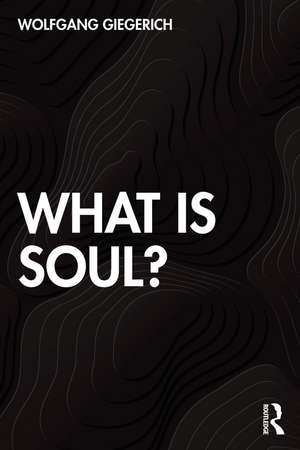
What is Soul?
Autor Wolfgang Giegerichen Limba Engleză Paperback – 9 ian 2020
Rooted in the metaphysics of bygone times, the notion of soul in our Western tradition is packed with associations and meanings that are incompatible with the anthropological and naturalistic thinking that prevails in modernity. Whereas treatises of old conceived of the soul as an infinite, immaterial substance which was the ground of man's hope for eternal salvation, modern psychology has for the most part discarded the concept in favor of more tangible touchstones such as the emotions, desires, and attachments which characterize man as a finite, bodily-existing positive fact. An exception to this trend has been the analytical psychology of C. G. Jung. Against the positivistic spirit of his times, Jung insisted upon a "'psychology with soul, ' that is, a psychology based upon the hypothesis of an autonomous mind." In this volume, Wolfgang Giegerich once again takes up the Jungian commitment to a psychology with soul. Agreeing with Jung that the soul concept is indispensable for a truly psychological psychology, he supplements and re-orients the Jungian approach to both this concept and the phenomenology of the soul by means of a whole series of nuanced discussions that are as rigorous as they are thoroughgoing. The result is nothing short of a tour de force. Tarrying with the negative, Giegerich's particular contribution resides in his showing the movement against the soul to be the soul's own doing. In animus moments of itself, consciousness in the form of philosophy and Enlightenment reason turned upon itself as religion and metaphysics. Far from abolishing the soul, however, these incisive negations were themselves negated. As if dancing upon its own demise, the soul came home to itself, not as an invisible metaphysical substance, but more invisibly still as the logically negative evaporation of that substance into the form of subject, or even better said, into psychology.
Preț: 350.52 lei
Carte tipărită la comandă
Livrare economică 07-21 decembrie
Specificații
ISBN-10: 0367477181
Pagini: 364
Dimensiuni: 152 x 229 x 20 mm
Greutate: 0.44 kg
Ediția:1
Editura: Taylor & Francis
Colecția Routledge
Locul publicării:Oxford, United Kingdom
V-ar putea interesa
-
 -29%Preț: 276.48 lei387.82 lei
 -
 The Mystery of Human Relationship: Alchemy and the Transformation of the SelfNathan Schwartz-SalantPreț: 381.65 lei
 -
 The Wisdom of the SerpentJoseph Lewis HendersonPreț: 411.43 lei
 -
 The Symbolic QuestEdward C. WhitmontPreț: 315.17 lei
 -
 The Far Side of MadnessJohn BeebePreț: 162.40 lei
 -
 Lectures on Jung's TypologyJames HillmanPreț: 148.58 lei
 -
 Moore, R: Magician and the AnalystRobert LPh.D. MoorePreț: 187.58 lei
 -
 CreativityPaul BrutschePreț: 204.80 lei
 -
 Sea GlassGilda FrantzPreț: 210.17 lei
 -
 Painting Therapy: On the Basis of C.G. Jung's Analytical PsychologyProfessor Ingrid RiedelPreț: 290.81 lei
Public țintă
Postgraduate, Professional, and Professional Practice & DevelopmentCuprins
Notă biografică
Recenzii
Descriere
Rooted in the metaphysics of bygone times, the notion of soul in our Western tradition is packed with associations and meanings that are incompatible with the anthropological and naturalistic thinking that prevails in modernity. Whereas treatises of old conceived of the soul as an infinite, immaterial substance which was the ground of man's hope for eternal salvation, modern psychology has for the most part discarded the concept in favor of more tangible touchstones such as the emotions, desires, and attachments which characterize man as a finite, bodily-existing positive fact. An exception to this trend has been the analytical psychology of C. G. Jung. Against the positivistic spirit of his times, Jung insisted upon a "'psychology with soul, ' that is, a psychology based upon the hypothesis of an autonomous mind." In this volume, Wolfgang Giegerich once again takes up the Jungian commitment to a psychology with soul. Agreeing with Jung that the soul concept is indispensable for a truly psychological psychology, he supplements and re-orients the Jungian approach to both this concept and the phenomenology of the soul by means of a whole series of nuanced discussions that are as rigorous as they are thoroughgoing. The result is nothing short of a tour de force. Tarrying with the negative, Giegerich's particular contribution resides in his showing the movement against the soul to be the soul's own doing. In animus moments of itself, consciousness in the form of philosophy and Enlightenment reason turned upon itself as religion and metaphysics. Far from abolishing the soul, however, these incisive negations were themselves negated. As if dancing upon its own demise, the soul came home to itself, not as an invisible metaphysical substance, but more invisibly still as the logically negative evaporation of that substance into the form of subject, or even better said, into psychology.