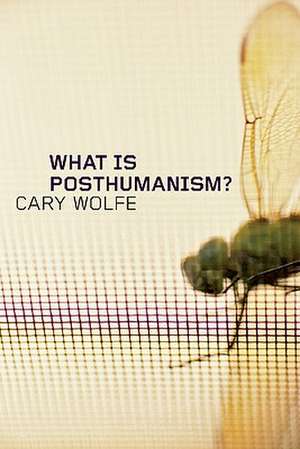
What Is Posthumanism?: Posthumanities, cartea 8
Autor Cary Wolfeen Limba Engleză Paperback – 31 dec 2009
Evoluția gândirii contemporane a marcat o deplasare critică de la viziunea antropocentrică spre o înțelegere a umanului ca parte a unui continuum biologic și tehnologic. În What Is Posthumanism?, remarcăm efortul lui Cary Wolfe de a teoretiza această tranziție nu ca pe o depășire a limitelor biologice prin tehnologie, ci ca pe o reevaluare a relației noastre cu non-umanul. Lucrarea extinde cadrul propus de The Bloomsbury Handbook of Posthumanism cu date noi din perspectiva teoriei sistemelor și a deconstrucției, oferind o rigoare filozofică ce lipsește adesea din abordările pur speculative. Descoperim aici o structură bicefală: prima parte sondează fundamentele etice și disciplinare, trecând prin bioetică și științe cognitive, în timp ce a doua parte testează aceste teorii pe obiecte culturale concrete. Analizele sale asupra arhitecturii Diller+Scofidio sau a muzicii lui Brian Eno demonstrează că postumanismul nu este doar o teorie abstractă, ci o sensibilitate ce transformă estetica. Poziționată în continuarea preocupărilor din Animal Rites și Zoontologies, această carte rafinează critica umanismului clasic, insistând pe complexitatea corporalității și a protezelor noastre existențiale. Subliniem claritatea cu care Wolfe separă postumanismul critic de transumanismul utopic, oferind un instrumentar teoretic esențial pentru orice cercetător din sfera științelor umaniste care dorește să înțeleagă locul omului într-o lume marcată de interdependențe trans-specii și sisteme digitale.
Din seria Posthumanities
-
 Preț: 138.44 lei
 -
 Preț: 184.17 lei
 -
 Preț: 204.43 lei
 -
 Preț: 228.02 lei
 -
 Preț: 214.10 lei
 -
 Preț: 184.30 lei
 -
 Preț: 174.31 lei
 -
 Preț: 138.45 lei
 -
 Preț: 172.29 lei
 -
 Preț: 203.70 lei
 -
 Preț: 182.47 lei
 -
 Preț: 116.35 lei
 -
 Preț: 186.84 lei
 -
 Preț: 176.87 lei
 -
 Preț: 151.60 lei
 -
 Preț: 115.26 lei
 -
 Preț: 202.58 lei
 -
 Preț: 168.17 lei
 -
 Preț: 189.90 lei
 -
 Preț: 200.91 lei
 -
 Preț: 186.84 lei
 -
 Preț: 183.97 lei
 -
 Preț: 345.91 lei
 -
 Preț: 124.65 lei
 -
 Preț: 213.41 lei
 -
 Preț: 151.57 lei
 -
 Preț: 184.39 lei
 - 20%
 Preț: 133.76 lei
 -
 Preț: 263.56 lei
 -
 Preț: 185.37 lei
 -
 Preț: 211.27 lei
 -
 Preț: 216.54 lei
 -
 Preț: 210.97 lei
 -
 Preț: 182.13 lei
 -
 Preț: 214.29 lei
 -
 Preț: 195.23 lei
 -
 Preț: 211.30 lei
 -
 Preț: 210.50 lei
 -
 Preț: 222.80 lei
 -
 Preț: 204.04 lei
 -
 Preț: 178.70 lei
 -
 Preț: 146.40 lei
 -
 Preț: 210.54 lei
 -
 Preț: 197.05 lei
 -
 Preț: 175.12 lei
 -
 Preț: 224.15 lei
 -
 Preț: 186.81 lei
Preț: 144.16 lei
Carte disponibilă
Livrare economică 17 noiembrie-01 decembrie
Livrare express 31 octombrie-06 noiembrie pentru 64.98 lei
Specificații
ISBN-10: 0816666156
Pagini: 400
Ilustrații: 15
Dimensiuni: 140 x 216 x 28 mm
Greutate: 0.45 kg
Ediția:1
Editura: University of Minnesota Press
Colecția Univ Of Minnesota Press
Seria Posthumanities
De ce să citești această carte
O lectură fundamentală pentru cei interesați de filozofia contemporană și teoria culturală. Cary Wolfe oferă o clarificare conceptuală necesară, separând postumanismul de promisiunile tehnologice ale transumanismului. Cititorul va câștiga o perspectivă interdisciplinară solidă, învățând cum să aplice concepte filozofice complexe în analiza artei, filmului și arhitecturii, totul într-un format academic riguros publicat de University of Minnesota Press.
Despre autor
Cary Wolfe este profesor și deține catedra Bruce și Elizabeth Dunlevie în cadrul Departamentului de Engleză de la Rice University. Este recunoscut ca una dintre figurile fondatoare ale studiilor despre animale și ale teoriei postumaniste. Opera sa, care include titluri precum Animal Rites și Zoontologies, explorează limitele etice și filozofice dintre uman și animal, integrând perspective din deconstrucție și teoria sistemelor pentru a redefini umanismul în secolul XXI.
Descriere scurtă
Exploring how both critical thought along with cultural practice have reacted to this radical repositioning, Cary Wolfe-one of the founding figures in the field of animal studies and posthumanist theory-ranges across bioethics, cognitive science, animal ethics, gender, and disability to develop a theoretical and philosophical approach responsive to our changing understanding of ourselves and our world. Then, in performing posthumanist readings of such diverse works as Temple Grandin's writings, Wallace Stevens's poetry, Lars von Trier's Dancer in the Dark, the architecture of Diller+Scofidio, and David Byrne and Brian Eno's My Life in the Bush of Ghosts, he shows how this philosophical sensibility can transform art and culture.
For Wolfe, a vibrant, rigorous posthumanism is vital for addressing questions of ethics and justice, language and trans-species communication, social systems and their inclusions and exclusions, and the intellectual aspirations of interdisciplinarity. In What Is Posthumanism? he carefully distinguishes posthumanism from transhumanism (the biotechnological enhancement of human beings) and narrow definitions of the posthuman as the hoped-for transcendence of materiality. In doing so, Wolfe reveals that it is humanism, not the human in all its embodied and prosthetic complexity, that is left behind in posthumanist thought.
Notă biografică
Cuprins
Part One: Theories, Disciplines, Ethics
1. Meaning and Event, or, Systems Theory and "The Reconstruction of Deconstruction"
2. Language and Subjectivity: Cognitive Science, Deconstruction, and The Animal
3. Flesh and Finitude: Bioethics and the Philosophy of The Living
4. "Animal Studies," Disciplinarity, and the (Post)Humanities
5. Learning from Temple Grandin: Animal Studies, Disability Studies, and Who Comes After the Subject
Part Two: Media, Culture, Practices
6. From Dead Meat to Glow-in-the-Dark Bunnies: The Animal Question in Contemporary Art
7. When You Can't Believe Your Eyes (Or Voice): Dancer in The Dark
8. Lose the Building: Form and System in Contemporary Architecture
9. Emerson's Romanticism, Cavell's Skepticism, Luhmann's Modernity
10. The Idea of Observation at Key West: Systems Theory, Poetry, and Form Beyond Formalism
11. The Digital, the Analog, and the Spectral: Echographies from My Life in the Bush of Ghosts
Notes
Publication History
Index