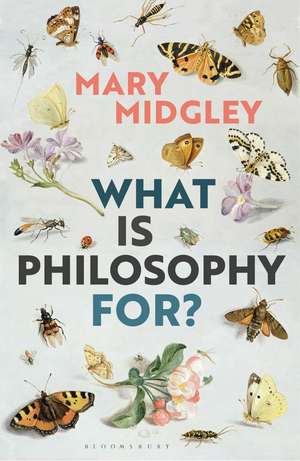
What Is Philosophy for?
Autor Mary Midgleyen Limba Engleză Paperback – 20 sep 2018
Suntem de părere că What Is Philosophy for? reprezintă un punct de cotitură în bibliografia regretatei Mary Midgley, fiind ultima sa lucrare publicată înainte de stingerea din viață. Această ediție nu este doar o recapitulare, ci o sinteză viguroasă a temelor sale favorite, adresând confuziile intelectuale actuale. Subliniem modul în care autoarea chestionează dacă filozofia mai este relevantă într-o eră dominată de progrese tehnologice și științifice masive, poziționând disciplina nu ca pe un studiu tehnic izolat, ci ca pe un instrument vital pentru viața personală.
Cartea completează perspectiva oferită de Wisdom, Information and Wonder, adăugând o critică actualizată la adresa „cultului impersonalității” și a scientismului contemporan, pe care Midgley îl numește „noul sedativ”. În timp ce lucrări anterioare precum Science as Salvation explorau ambițiile spirituale din jurul științei, acest volum final se concentrează pe „mindlessness” și pe riscul de a reduce experiența umană la simple date materiale, temă recurentă și în Are You an Illusion?.
Structura volumului este riguros organizată în patru părți, pornind de la căutarea unor repere intelectuale (unde analizează paradoxurile lui Rousseau și conceptele de libertate la Mill) și culminând cu o examinare a singularității și a cosmosului. Progresia capitolelor indică o tranziție de la fundamentele metodologice către dilemele etice ridicate de inteligența artificială și materialismul puritan. Recomandăm acest volum pentru claritatea cu care demonstrează că filozofia rămâne necesară pentru a integra complexitatea lumii într-o viziune unitară.
Preț: 162.91 lei
Preț vechi: 175.56 lei
-7%
Carte disponibilă
Livrare economică 16-30 noiembrie
Livrare express 30 octombrie-05 noiembrie pentru 37.54 lei
Specificații
ISBN-10: 1350051071
Pagini: 232
Dimensiuni: 126 x 196 x 20 mm
Greutate: 0.32 kg
Editura: Bloomsbury Publishing
Colecția Bloomsbury Academic
Locul publicării:London, United Kingdom
De ce să citești această carte
Recomandăm această carte oricărui cititor preocupat de locul umanității într-o lume dominată de tehnologie. Mary Midgley oferă o pledoarie accesibilă pentru gândirea critică, demonstrând că filozofia nu este un exercițiu abstract, ci un instrument esențial pentru a înțelege sensul, valorile și limitele științei. Este o lectură fundamentală pentru cei care doresc să navigheze printre „miturile” moderne ale scientismului cu rigoare și claritate morală.
Despre autor
Mary Midgley (1919–2018) a fost lector senior de filozofie la Universitatea din Newcastle și una dintre cele mai importante voci ale filozofiei morale din secolul XX. Cunoscută pentru abordarea sa directă și critică la adresa reducționismului științific, ea a scris peste 250 de lucrări despre natura umană, etică și relația noastră cu lumea naturală. Printre volumele sale de referință se numără Beast and Man și Wickedness. Cariera sa extraordinară s-a încheiat cu What Is Philosophy for?, publicată cu doar o lună înainte de moartea sa, la vârsta de 99 de ani.
Descriere
"Engaging and accessible, this vigorous swansong exemplifies many of Midgley's virtues, and revisits many of her favourite themes." - The Tablet
In her last published work, Mary Midgley addresses provocative questions, interrogating the various forms of our current intellectual anxieties and confusions and how we might deal with them. In doing so, she provides a robust, yet not uncritical, defence of philosophy and the life of the mind.
This defence is expertly placed in the context of contemporary debates about science, religion, and philosophy. It asks whether, in light of rampant scientific and technological developments, we still need philosophy to help us think about the big questions of meaning, knowledge, and value.
Cuprins
Chapter 1. Directions
Chapter 2. Do Ideas Get Out Of Date?
Chapter 3. What is Research?
Chapter 4. Clashes of Method
Chapter 5. What is Matter?
Chapter 6. Quantum Queries
Chapter 7. What is Progress?
Chapter 8. Perspectives and Paradoxes: Rousseau And His Intellectual Explosives
Chapter 9. Mill And The Different Kinds Of Freedom
Chapter 10. Making Sense Of Toleration
PART 2. Tempting Visions of Science
Chapter 11. The Force of World-Pictures
Chapter 12. The Past Does Not Die
Chapter 13. Scientism; The New Sedative
PART 3. Mindlessness and Machine Worship
Chapter 14. The Power-Struggle
Chapter 15. Missing Persons
Chapter 16. Oracles
PART 4. Singularities and the Cosmos
Chapter 17. What Kind of Singularity?
Chapter 18. Can Intelligence be Measured?
Chapter 19. What is Materialism?
Chapter 20. The Cult of Impersonality
Chapter 21. Matter and Reality
Chapter 22. The Mystique of Scientism
Chapter 23. The Strange World-Picture
Conclusion: One World but Many Window
Recenzii
Her final answer to the question "What is philosophy for?" is that its aim is not at all like that of the sciences. Scientists are specialists who study parts of the world, but philosophy concerns everybody. It tries to bring together aspects of life that have previously been unconnected in order to make a more coherent world-picture, which is not a private luxury but something essential for human life.
[This] is a book that not only illuminates the dangers and shortfalls of contemporary unrestrained faith in scientific and technological supremacy, it also accentuates the integrating qualities of philosophy which are necessary to achieve a more exhaustive view of the world and its complexities.