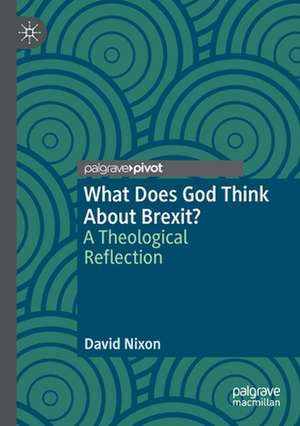
What Does God Think About Brexit?
Autor David Nixonen Limba Engleză Paperback – 28 dec 2020
Preț: 365.63 lei
Puncte Express: 548
Carte tipărită la comandă
Livrare economică 06-20 iunie
Specificații
ISBN-13: 9783030339449
ISBN-10: 3030339440
Pagini: 140
Ilustrații: XI, 127 p.
Dimensiuni: 148 x 210 x 8 mm
Greutate: 0.19 kg
Ediția:1st ed. 2019
Editura: Springer
Locul publicării:Cham, Switzerland
ISBN-10: 3030339440
Pagini: 140
Ilustrații: XI, 127 p.
Dimensiuni: 148 x 210 x 8 mm
Greutate: 0.19 kg
Ediția:1st ed. 2019
Editura: Springer
Locul publicării:Cham, Switzerland
Cuprins
1. Introduction: Personal Overview.- 2. Thinking Theologically: A Framework for Brexit.- 3. Community and Identity.- 4. Marriage and Divorce.- 5. Anxiety and Uncertainty.- 6. Nation and World.- 7. Reconciliation, Healing and Forgiveness.- 8. Conclusions: How Theology can Reframe the Imagination.
Notă biografică
Revd Dr. David Nixon is an Anglican priest who has worked in parishes, university chaplaincy, and theological education. He is currently Rector of St. Thomas Exeter, in the County of Devon, UK and an Honorary Research Fellow at the University of Exeter. His research interests have focused on marginalization and vulnerability, including a theology of homelessness. He has published numerous scholarly articles in theological and educational journals about sexualities, urban deprivation, and ministerial priesthood.
Textul de pe ultima copertă
This book is a theological reflection about the process and event of Brexit: Britain’s departure from the European Union. Within a framework of liberation and postmodern theology, it examines Brexit against a history of the EU, with themes of community, identity, marriage, and divorce. It considers the emotional reactions which have been generated, and places Brexit in the context of contemporary populism and the politics of the United States. The book concludes with a call for reconciliation via new imaginaries of solidarity and inclusion.
Caracteristici
Examines some of the historical, cultural, and sociological motifes that underlie the decision of the UK to leave the EU Examines the historical, cultural, and sociological motifs which underlie this decision and its aftermath from the perspective of Christian theological and biblical scholarship Argues for the value of theology in providing an alternative conceptual overview at a time when current thinking seems to be stalled into oppositional and unproductive grooves