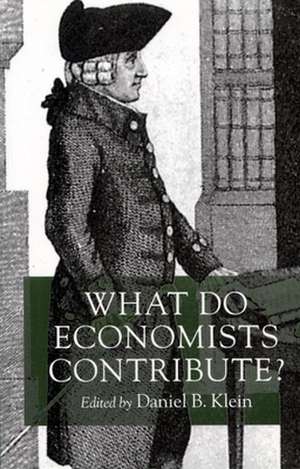
What Do Economists Contribute?
Autor Daniel B. Kleinen Limba Engleză Hardback – 1999
Daniel Klein has here gathered essays of 9 great economists of this century Friedrich Hayek, Ronald Coase, Thomas Schelling, Gordon Tullock, Israel Kirzner, Frank Graham, William Hutt, Clarence Philbrook, and D. McCloskey addressing the existential issue for economists: "How do we contribute to human betterment?"
The authors express their esteem for economic research firmly rooted in public issues and that contributes to public discourse. Some suggest that the academic focus on technical refinement not only diverts economists from efforts at public edification, but might even mislead economists in their own understanding of economic affairs."
Preț: 603.22 lei
Preț vechi: 783.39 lei
-23%
Puncte Express: 905
Carte tipărită la comandă
Livrare economică 08-22 iunie
Specificații
ISBN-13: 9780814747223
ISBN-10: 0814747221
Pagini: 174
Dimensiuni: 152 x 229 x 14 mm
Greutate: 0.4 kg
Ediția:New.
Editura: NYU Press - IPS
ISBN-10: 0814747221
Pagini: 174
Dimensiuni: 152 x 229 x 14 mm
Greutate: 0.4 kg
Ediția:New.
Editura: NYU Press - IPS
V-ar putea interesa
-
 Knowledge and Coordination: A Liberal InterpretationDaniel B. KleinPreț: 252.27 lei
 -
 -37%Preț: 1087.92 lei1718.72 lei
 -
 -31%Preț: 335.58 lei486.67 lei
 -
 Knowledge and Coordination: A Liberal InterpretationDaniel Klein-11%Preț: 490.68 lei551.31 lei
 -
 Rethinking the Keynesian Revolution: Keynes, Hayek, and the Wicksell ConnectionTyler Beck Goodspeed-11%Preț: 497.30 lei558.76 lei
 -
 Corporate Social Responsibility and Corporate GovernanceLorenzo Sacconi-15%Preț: 633.37 lei745.13 lei
 -
 Performance Information in the Public SectorKenneth A Loparo-15%Preț: 671.17 lei789.62 lei
 -
 Preț: 306.84 lei
 -
 Marxian EconomicsJohn EatwellPreț: 455.29 lei
 -
 Keynes HayekNicholas WapshottPreț: 105.66 lei
 -
 The Responsible AdministratorTerry L Cooper-8%Preț: 454.11 lei493.61 lei
 -
 The Darwin EconomyRobert H. FrankPreț: 88.23 lei
 -
 Making Capitalism Fit for SocietyColin CrouchPreț: 179.98 lei
 -
 -28%Preț: 63.70 lei88.58 lei
 -
 Moore, J: Pigeon Guided MissilesPaul NeroPreț: 92.76 lei
 -
 EconomixMichael Goodwin-9%Preț: 110.69 lei121.99 lei
 -
 An Economic Theory of Greed, Love, Groups, and NetworksPaul FrijtersPreț: 342.46 lei
 -
 Ethics Challenge 3eCarol W Lewis-8%Preț: 436.13 lei474.06 lei
 -
 Complexity and InstitutionsM. AokiPreț: 372.63 lei
 -
 G.L.S. ShackleP. Earl-15%Preț: 619.35 lei728.64 lei
 -
 The Theory of Political EconomyW. JevonsPreț: 443.33 lei
 -
 Border Security & Illegal Immigration EnforcementRichard M Taylor-30%Preț: 916.57 lei1315.62 lei
 -
 -29%Preț: 246.96 lei346.84 lei
Cuprins
Editor's Introduction Bibliography Biographies of Contributors On the Role of Values in the Work of Economists; F.D.Graham Economists and Public Policy; R.Coase On the Decline of Authority of Economists; W.H.Hutt 'Realism' in Policy Espousal; C.Philbrook How to Do Well While Doing Good!; G.Gordon The Common Weal and Economic Stories; D.N.McCloskey What Do Economists Know?; T.C.Schelling Economists and the Correction of Error; I.M.Kirzner On Being an Economist; F.A.Hayek
Recenzii
Pre-publication endorsements of hardcover
'The title of this book raises a provocative question that should make all economists think. What is our raison d'etre? Only a few economists have specifically addressed the issue. Several of the more challenging efforts are included here.' - James M. Buchanan, Professor of Economics, George Mason University
'Do economists have much influence on government policy, particularly over, say, 5 or 10 years? Probably not. Is that because they don't try hard enough or is it because politicians care more about the next election than about the opinion of economists? In this splendid collection, some published as long ago as the 1930s, nine great economists consider these questions. The editor's illuminating introduction sorts out the area of agreement and disagreement between them.' - Mark Blaug, Visiting Professor of Economics, University of Exeter
Reviews of Hardback
'[The book] contains outstanding essays from nine great economists of this century....the result is lively, informative, engaging discourse ....[The book] is highly recommended reading for lay readers as well as students of economics, and has a great deal of substansive value for even experienced, practicing economists.' - Reviewer's Bookwatch
'In What Do Economists Contribute? the writers try to explain just how economists contribute to the betterment of mankind. Although the title implies that the book is directed to students and intelligent laymen who would otherwise not know the answer, the book is aimed just as much at professional economists themselves. All three groups, especially undergraduates contemplating study in economics, will be fascinated and perhaps troubled by what they read.' - Philip R.Murray, Ideas on Liberty
'The title of this book raises a provocative question that should make all economists think. What is our raison d'etre? Only a few economists have specifically addressed the issue. Several of the more challenging efforts are included here.' - James M. Buchanan, Professor of Economics, George Mason University
'Do economists have much influence on government policy, particularly over, say, 5 or 10 years? Probably not. Is that because they don't try hard enough or is it because politicians care more about the next election than about the opinion of economists? In this splendid collection, some published as long ago as the 1930s, nine great economists consider these questions. The editor's illuminating introduction sorts out the area of agreement and disagreement between them.' - Mark Blaug, Visiting Professor of Economics, University of Exeter
Reviews of Hardback
'[The book] contains outstanding essays from nine great economists of this century....the result is lively, informative, engaging discourse ....[The book] is highly recommended reading for lay readers as well as students of economics, and has a great deal of substansive value for even experienced, practicing economists.' - Reviewer's Bookwatch
'In What Do Economists Contribute? the writers try to explain just how economists contribute to the betterment of mankind. Although the title implies that the book is directed to students and intelligent laymen who would otherwise not know the answer, the book is aimed just as much at professional economists themselves. All three groups, especially undergraduates contemplating study in economics, will be fascinated and perhaps troubled by what they read.' - Philip R.Murray, Ideas on Liberty
Notă biografică
RONALD H. COASE Nobel Prize in Economic Science, 1991FRANK D. GRAHAM (1890-1949) Professor of Economics at Princeton University until his death in 1949FRIEDRICH A. HAYEK (1899-1992) Nobel Prize in Economic Science, 1974. Professor at LSE, 1931-49. Author of The Road to SerfdomWILLIAM H. HUTT (b.1899) Professor of Economics at Capetown University and Texas, A & M. Author of Economists and the PublicISRAEL M. KIRZNER (b.1930) Professor of Economics at New York University since 1957DEIRDRE N. MCCLOSKEY (b.1942) Professor of Economics and of History at the University of IowaCLARENCE PHILBROOK (1909-78) was Professor of Economics at the University of North Carolina (1947-1975)THOMAS C. SCHELLING (b.1921) Professor of Economics at the University of Maryland and previously at HarvardGORDON TULLOCK Professor of Economics at the University of Arizona; editor of Public Choice for 25 years