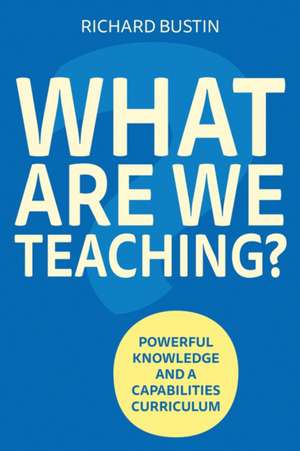
What are we Teaching?
Autor Richard Bustinen Limba Engleză Paperback – 24 oct 2024
În volumul What Are We Teaching?, remarcăm o deschidere interdisciplinară necesară, care pune în dialog pedagogia, geografia școlară și filosofia politică a capabilităților. Această abordare permite o reevaluare a modului în care selecția conținuturilor educaționale influențează dezvoltarea personală a elevului. Putem afirma că lucrarea reprezintă o evoluție a temelor explorate de Richard Bustin în Geography Education's Potential and the Capability Approach, unde acesta a introdus conceptele lui Amartya Sen și Martha Nussbaum în gândirea curriculară. Dacă în lucrarea anterioară accentul cădea pe potențialul specific al geografiei, noul volum extinde analiza asupra întregului spectru de discipline școlare. Observăm că autorul extinde cadrul propus de Subject Learning in the Primary Curriculum de Jill Bourne cu date noi din contextul actual al reformelor curriculare din Anglia, depășind simpla descriere a standardelor naționale. În timp ce Science de Vanessa Kind se concentra pe dismputernicirea noilor profesori în fața expertizei de subiect, What Are We Teaching? oferă un instrumentar pentru dialogul strategic. Găsim în această carte o structură care facilitează conversația dintre liderii de departament și managerii școlari, similară cu abordarea din Huh: Curriculum conversations between subject and senior leaders, dar cu un fundament teoretic mai pronunțat pe valoarea intrinsecă a cunoașterii. Stilul este unul analitic, orientat spre practică, oferind argumente solide pentru profesorii care doresc să justifice relevanța materiei lor dincolo de examene.
Preț: 120.41 lei
Carte disponibilă
Livrare economică 26 octombrie-09 noiembrie
Livrare express 10-16 octombrie pentru 29.95 lei
Specificații
ISBN-10: 1785837184
Pagini: 224
Dimensiuni: 157 x 234 x 16 mm
Greutate: 0.43 kg
Editura: Crown House Publishing
V-ar putea interesa
-
 Preț: 285.67 lei
 -
 Learning to Teach in the Primary SchoolTeresa CreminPreț: 393.82 lei
 -
 -14%Preț: 126.14 lei146.15 lei
 -
 The A-Z of Student WellbeingJamie O'Dowd-14%Preț: 119.04 lei137.74 lei
 -
 -13%Preț: 120.32 lei138.45 lei
 -
 Primary Reading SimplifiedChristopher SuchPreț: 172.48 lei
 -
 How Do We Learn?Hector Ruiz MartinPreț: 133.90 lei
 -
 Readings for Reflective Teaching in SchoolsProfessor Andrew Pollard-17%Preț: 246.32 lei297.32 lei
 -
 The Secret of LiteracyDavid DidauPreț: 140.34 lei
 -
 Because of You, This is MeJaz Ampaw-FarrPreț: 120.10 lei
 -
 Reclaiming the CurriculumBill LaarPreț: 142.20 lei
 -
 Powerful GeographyMark EnserPreț: 141.33 lei
 -
 How to Lead it: Primary ScienceJon Hutchinson-37%Preț: 96.65 lei153.54 lei
 -
 How to Lead it: Primary EnglishTricia Moss-36%Preț: 98.12 lei154.42 lei
 -
 How to Lead it: Primary HistoryAlex Pethick-38%Preț: 95.33 lei152.76 lei
 -
 Exam NationSammy Wright-19%Preț: 126.68 lei156.25 lei
 -
 -14%Preț: 106.28 lei123.96 lei
 -
 Secondary History in ActionCatherine Priggs-14%Preț: 118.87 lei137.64 lei
 -
 Secondary Maths in ActionEmma McCrea-14%Preț: 119.04 lei137.74 lei
 -
 Philosophy of EducationLaura D'OlimpioPreț: 401.44 lei
De ce să citești această carte
Această carte este esențială pentru managerii școlari și coordonatorii de materie care vor să înțeleagă fundamentul etic și intelectual al curriculumului. Cititorul câștigă o perspectivă clară asupra modului în care alegerea subiectelor predate poate stimula libertatea de gândire a elevilor. Este un ghid practic pentru a transforma planificarea școlară dintr-o bifare de standarde într-un demers educativ cu sens.
Descriere scurtă
Written by Richard Bustin, What are we Teaching? Powerful knowledge and a capabilities curriculum offers a fresh perspective on curriculum design, arguing that subjects are key to enabling young people to develop the powerful knowledge needed to flourish in a complex modern world. Moving ideas beyond the 'traditional vs progressive' debates that have dominated education discourse, Richard Bustin challenges the overarching emphasis on exam performance at the expense of the broader benefits of subject knowledge and capabilities such as critical and creative thinking.
What are we Teaching? explores curriculum debates in relation to the current school climate, considering factors such as knowledge-led education, teaching to the test, and the challenge of teacher retention and recruitment issues. It includes new research involving teachers in real schools engaging with powerful knowledge, and it prompts teachers to evaluate their responsibilities as 'curriculum makers'. The book invites teachers to consider why their subject specialism is important as part of a whole school curriculum vision, and a provides language with which to articulate that.
Part One introduces the key theories on which the book is based, including different ways of making sense of knowledge, skills and values in the curriculum, powerful knowledge and educational capabilities. What are we Teaching?is research-based, using voices of real teachers who engaged with the question 'what makes your subject powerful knowledge for young people', and Part Two, which focuses on different subject areas, examines these testimonies. The final part offers advice on building a powerful knowledge and capabilities rich curriculum in schools. Each chapter includes a set of reflective questions which can be used as part of ITE training or staff CPD.
Essential reading for teachers, senior and subject leaders and curriculum coordinators.
; Discusses the importance of having a subject-based curriculum in schools and explores the responsibility that teachers, through their subject specialisms, have to help ensure this is achieved.;Richard Bustin's book is a much-needed addition to the academic discussion on the meaning and role of subjects in school education. Much has previously been written about the concept of powerful knowledge and its potential to highlight the importance of specialised knowledge in education: scholars in several discipline-based subject groups - for example, in geography and history - have studied it, but most of this work has been done in the context of these individual subjects. In this book, Richard looks at different subjects and gives voice to teachers themselves. In the theoretical part of the book, he makes a clear introduction to the concepts of powerful knowledge and the capability approach to help teachers explore what kind of contribution their subjects can have for their students. Even though the book is mainly targeted at readers in the UK, it also works well for the international audience interested in the role of subject-based education. I highly recommend this book to all teachers, teacher educators and student teachers.
Sirpa Tani
;This is a remarkable book and the timing of it is impeccable. The 2024 Labour Government is strongly committed to social justice and is looking to restore the promise of education. This book should inform that work. It is well informed, showing up some of the snake oil solutions of recent years, and through its conceptual framing provides a way to avoid the familiar swing of the educational pendulum. And Richard Bustin makes no bones about it: we need to trust teachers and support them properly in the 'knowledge work' which I fervently believe underpins great teaching at all levels.It is not a 'practical' handbook, but it is written mainly