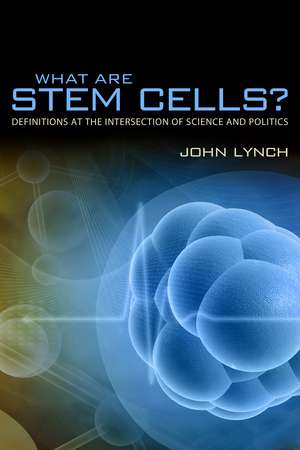
What Are Stem Cells?: Definitions at the Intersection of Science and Politics: Rhetoric, Culture, and Social Critique
Autor John Alexander Lynchen Limba Engleză Hardback – 30 sep 2011
In recent years political, religious, and scientific communities have engaged in an ethical debate regarding the development of and research on embryonic stem cells. Does the manipulation of embryonic stem cells destroy human life? Or do limitations imposed on stem cell research harm patients who might otherwise benefit?
John Lynch’s What Are Stem Cells? identifies the moral stalemate between the rights of the embryo and the rights of the patient and uses it as the framework for a larger discussion about the role of definitions as a key rhetorical strategy in the debate. In the case of stem cells, the controversy arises from the manner in which stem cells are defined--in particular, whether they are defined with an appeal to their original source or to their future application. Definitions such as these, Lynch argues, are far more than convenient expository references; they determine the realities of any given social discourse.
Lynch addresses definitions conceptually--their stability in the face of continual technological innovation, their versatility at the crossroads of scientific and public forums, and their translations and retranslations through politics. Most importantly, his work recognizes definitions as central to issues, not only within the topic of stem cell research, but also in all argumentation.
Din seria Rhetoric, Culture, and Social Critique
-
 Preț: 226.04 lei
 -
 Preț: 234.64 lei
 -
 Preț: 226.04 lei
 -
 Preț: 231.15 lei
 -
 Preț: 238.89 lei
 -
 Preț: 223.09 lei
 -
 Preț: 337.03 lei
 -
 Preț: 370.33 lei
 -
 Preț: 144.80 lei
 -
 Preț: 156.89 lei
 -
 Preț: 224.33 lei
 -
 Preț: 203.27 lei
 -
 Preț: 202.74 lei
 -
 Preț: 240.47 lei
 -
 Preț: 159.48 lei
 -
 Preț: 224.38 lei
 -
 Preț: 224.74 lei
 -
 Preț: 192.11 lei
 -
 Preț: 224.74 lei
 -
 Preț: 200.90 lei
 -
 Preț: 158.19 lei
 -
 Preț: 371.63 lei
 -
 Preț: 271.45 lei
 -
 Preț: 337.03 lei
 -
 Preț: 258.08 lei
 - nou
 Preț: 601.05 lei
 -
 Preț: 190.81 lei
 -
 Preț: 272.07 lei
 -
 Preț: 337.70 lei
 -
 Preț: 260.03 lei
 -
 Preț: 223.44 lei
 -
 Preț: 369.34 lei
 -
 Preț: 158.81 lei
 -
 Preț: 190.45 lei
 -
 Preț: 192.11 lei
 -
 Preț: 191.74 lei
 - 9%
 Preț: 662.43 lei
 -
 Preț: 158.50 lei
Preț: 271.14 lei
Nou
Puncte Express: 407
Preț estimativ în valută:
47.98€ • 56.26$ • 42.14£
47.98€ • 56.26$ • 42.14£
Carte indisponibilă temporar
Doresc să fiu notificat când acest titlu va fi disponibil:
Se trimite...
Preluare comenzi: 021 569.72.76
Specificații
ISBN-13: 9780817317485
ISBN-10: 0817317481
Pagini: 192
Dimensiuni: 152 x 229 x 23 mm
Greutate: 0.4 kg
Ediția:First Edition
Editura: University Of Alabama Press
Colecția University Alabama Press
Seria Rhetoric, Culture, and Social Critique
ISBN-10: 0817317481
Pagini: 192
Dimensiuni: 152 x 229 x 23 mm
Greutate: 0.4 kg
Ediția:First Edition
Editura: University Of Alabama Press
Colecția University Alabama Press
Seria Rhetoric, Culture, and Social Critique
Notă biografică
John Lynch is an assistant professor of communication at the University of Cincinnati.
Cuprins
Acknowledgments vii
1. Science-Based Controversies and Idioms of Public Argument 1
2. Timely and Powerful: Defining Stem Cells through Appeals to Application 16
3. Abortion and the Embryo: Right-to-Life Arguments as a Source for Rhetorical Invention 44
4. Blastocysts, Spare Embryos, and Embryo Adoption: Redefining the Beginnings of Human Life 73
5. Power, Potency, and Plasticity: Hierarchies of Stem Cells and Their Inherent Ambiguities 90
6. Stalemate and the Idioms of Science-Based Controversy: George W. Bush’s Manichean Idiom and Barack Obama’s Return to a Scientistic Idiom 118
7. Scientistic and Manichean Idioms of Public Argument 146
Notes 155
Works Cited 161
Index 181
1. Science-Based Controversies and Idioms of Public Argument 1
2. Timely and Powerful: Defining Stem Cells through Appeals to Application 16
3. Abortion and the Embryo: Right-to-Life Arguments as a Source for Rhetorical Invention 44
4. Blastocysts, Spare Embryos, and Embryo Adoption: Redefining the Beginnings of Human Life 73
5. Power, Potency, and Plasticity: Hierarchies of Stem Cells and Their Inherent Ambiguities 90
6. Stalemate and the Idioms of Science-Based Controversy: George W. Bush’s Manichean Idiom and Barack Obama’s Return to a Scientistic Idiom 118
7. Scientistic and Manichean Idioms of Public Argument 146
Notes 155
Works Cited 161
Index 181
Recenzii
“Lynch addresses a topic of considerable social importance and encourages academic thought about it. The issue of definition is a very good one, interesting to rhetoric scholars, and highly pertinent to this public issue. It would be of interest to those who study rhetoric, culture, and ethics.” --John Lyne, a professor of communication at the University of Pittsburgh, has written numerous articles and book chapters on the rhetoric of science and bioethics that have appeared in Argumentation and Advocacy, Rhetoric of Public Affairs, and the Quarterly Journal of Speech
"Although bioethical issues surrounding stem cell research during the Bush and Obama administrations form a backdrop, Lynch (communication, Univ. of Cincinnati) is more concerned here with how language is used than with ethical positions. He presents definitions not so much as reflections of reality, but more as malleable tools for shaping public debate and policy. He introduces the idea of "scientistic idioms" to describe how various proponents and opponents of stem cell research incorporate the language of science to bolster their positions. Ironically, critics of stem cell research often use scientific idioms to challenge and undermine the authority of stem cell researchers. Lynch also frames his analysis in terms of a 'Manichean idiom' that presents stem cell research in terms of struggles between good and evil. For proponents of stem cell research, the Manichean idiom may take the form of scientific progress versus benighted religious or political agendas. Opponents may use the same idiom to contrast overreaching science with protection of human values. Lynch's analysis is useful for understanding not only debates over stem cell research, but also contentious issues such as teaching evolution in schools--a topic briefly addressed in the conclusion. Part of the 'Rhetoric, Culture, and Social Critique' series. Summing Up: Recommended. Upper-division undergraduates through professionals."
—CHOICE
—CHOICE
Descriere
In recent years political, religious, and scientific communities have waged an ethical debate regarding the development and research of embryonic stem cells. On the one hand, does the manipulation of embryonic stem cells destroy human life? On the other hand, do limitations imposed on stem cell research harm the patients who might otherwise benefit?