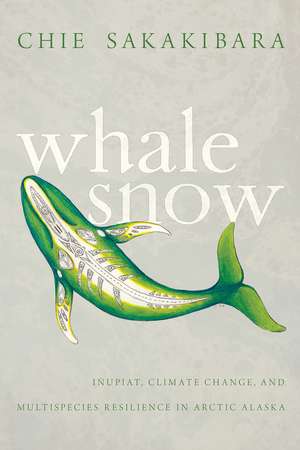
Whale Snow: Iñupiat, Climate Change, and Multispecies Resilience in Arctic Alaska: First Peoples: New Directions in Indigenous Studies
Autor Chie Sakakibaraen Paperback – 5 oct 2020
As a mythical creature, the whale has been responsible for many transformations in the world. It is an enchanting being that humans have long felt a connection to. In the contemporary environmental imagination, whales are charismatic megafauna feeding our environmentalism and aspirations for a better and more sustainable future.
Using multispecies ethnography, Whale Snow explores how everyday the relatedness of the Iñupiat of Arctic Alaska and the bowhead whale forms and transforms “the human” through their encounters with modernity. Whale Snow shows how the people live in the world that intersects with other beings, how these connections came into being, and, most importantly, how such intimate and intense relations help humans survive the social challenges incurred by climate change. In this time of ecological transition, exploring multispecies relatedness is crucial as it keeps social capacities to adapt relational, elastic, and resilient.
In the Arctic, climate, culture, and human resilience are connected through bowhead whaling. In Whale Snow we see how climate change disrupts this ancient practice and, in the process, affects a vital expression of Indigenous sovereignty. Ultimately, though, this book offers a story of hope grounded in multispecies resilience.
Using multispecies ethnography, Whale Snow explores how everyday the relatedness of the Iñupiat of Arctic Alaska and the bowhead whale forms and transforms “the human” through their encounters with modernity. Whale Snow shows how the people live in the world that intersects with other beings, how these connections came into being, and, most importantly, how such intimate and intense relations help humans survive the social challenges incurred by climate change. In this time of ecological transition, exploring multispecies relatedness is crucial as it keeps social capacities to adapt relational, elastic, and resilient.
In the Arctic, climate, culture, and human resilience are connected through bowhead whaling. In Whale Snow we see how climate change disrupts this ancient practice and, in the process, affects a vital expression of Indigenous sovereignty. Ultimately, though, this book offers a story of hope grounded in multispecies resilience.
Din seria First Peoples: New Directions in Indigenous Studies
-
 Preț: 214.93 lei
 -
 Preț: 117.44 lei
 -
 Preț: 106.39 lei
 -
 Preț: 109.17 lei
 -
 Preț: 192.57 lei
 -
 Preț: 215.85 lei
 -
 Preț: 201.56 lei
 -
 Preț: 212.08 lei
 -
 Preț: 185.17 lei
 -
 Preț: 193.17 lei
 -
 Preț: 277.03 lei
 -
 Preț: 221.51 lei
 -
 Preț: 281.91 lei
 -
 Preț: 204.46 lei
 -
 Preț: 243.12 lei
 - 29%
 Preț: 404.95 lei
 - 30%
 Preț: 440.10 lei
 - 30%
 Preț: 368.08 lei
 - 20%
 Preț: 379.52 lei
 -
 Preț: 128.78 lei
 - 25%
 Preț: 193.13 lei
 -
 Preț: 241.45 lei
 -
 Preț: 195.43 lei
 - 29%
 Preț: 404.42 lei
 - 14%
 Preț: 139.99 lei
 - 29%
 Preț: 131.45 lei
 - 30%
 Preț: 129.97 lei
Preț: 242.50 lei
Puncte Express: 364
Carte disponibilă
Livrare economică 23 iulie-06 august
Livrare express 09-15 iulie pentru 33.38 lei
Livrare prin curier în România Termenul estimat este afișat lângă disponibilitate.
Transport gratuit de la 400.00 lei Plată online sau ramburs, în funcție de opțiunile comenzii.
Retur gratuit în 14 zile Comandă securizată și suport în română.
Specificații
ISBN-13: 9780816529612
ISBN-10: 0816529612
Pagini: 304
Ilustrații: 42 b&w illustrations, 1 table
Dimensiuni: 152 x 229 x 20 mm
Greutate: 0.48 kg
Ediția:First Edition
Editura: University of Arizona Press
Colecția University of Arizona Press
Seria First Peoples: New Directions in Indigenous Studies
ISBN-10: 0816529612
Pagini: 304
Ilustrații: 42 b&w illustrations, 1 table
Dimensiuni: 152 x 229 x 20 mm
Greutate: 0.48 kg
Ediția:First Edition
Editura: University of Arizona Press
Colecția University of Arizona Press
Seria First Peoples: New Directions in Indigenous Studies
Notă biografică
Chie Sakakibara is an assistant professor of environmental studies at Oberlin College. Sakakibara was trained in cultural geography, art history, and Indigenous studies. Her work explores human dimensions of global environmental change among Indigenous peoples.
Cuprins
Preface
Acknowledgments
Introduction: The Whale Makes Us Human
1. Into the Whaling Cycle
2. Our Siḷa Is Changing
3. The New Harpoon
4. Our Home Is Drowning
5. No Whale, No Music
Epilogue
Abbreviations
Iñupiatun Glossary
Notes
Bibliography
Index
Acknowledgments
Introduction: The Whale Makes Us Human
1. Into the Whaling Cycle
2. Our Siḷa Is Changing
3. The New Harpoon
4. Our Home Is Drowning
5. No Whale, No Music
Epilogue
Abbreviations
Iñupiatun Glossary
Notes
Bibliography
Index
Recenzii
“The Japanese epistemology begins and ends with sonkei (respect); likewise, with the Iñupiat, with the word quksin. Chie Sakakibara begins her research journey with two Iñupiat communities and establishes avanmun (reciprocity) and is adopted by the Iñupiat. Her Iñupiat relations share their uqaaqtuat (personal stories) about their intimate relationship with aġviq (the bowhead whale).”—Sean Asiqłuq Topkok, University of Alaska
“When invited ‘not to disappear’ after her initial time in Utqiaġvik, Chie Sakakibara accepted with energy, insight, and compassion. The result, as she shares with us in Whale Snow, is a remarkable and personal engagement with the Iñupiat of northern Alaska. Her book is a powerful testimony to Indigenous ways of being in the world, to the values that sustain a society in the midst of environmental, economic, and political turmoil.”—Henry P. Huntington, Arctic Science Director at Ocean Conservancy
"The book’s introduction asks, 'what would an ethnography which is not solely about the human but simultaneously focuses on "other-than-human" ways of life look like?' With its foundation of rigorous field-based scholarship, deep theoretical insights, and openness to both human and other-than-human perspectives, I think such an ethnography would look a lot like Chie Sakakibara’s Whale Snow."—Russell Fielding, Geographical Review
“When invited ‘not to disappear’ after her initial time in Utqiaġvik, Chie Sakakibara accepted with energy, insight, and compassion. The result, as she shares with us in Whale Snow, is a remarkable and personal engagement with the Iñupiat of northern Alaska. Her book is a powerful testimony to Indigenous ways of being in the world, to the values that sustain a society in the midst of environmental, economic, and political turmoil.”—Henry P. Huntington, Arctic Science Director at Ocean Conservancy
"The book’s introduction asks, 'what would an ethnography which is not solely about the human but simultaneously focuses on "other-than-human" ways of life look like?' With its foundation of rigorous field-based scholarship, deep theoretical insights, and openness to both human and other-than-human perspectives, I think such an ethnography would look a lot like Chie Sakakibara’s Whale Snow."—Russell Fielding, Geographical Review
Descriere
Chie Sakakibara shows how knots of connection came into being between humans and nonhuman others and how such intimate and intense relations will help humans survive the Anthropocene. Whale Snow offers an important and thought-provoking look at global climate change as it manifests in the everyday life of the Iñupiat in Arctic Alaska.