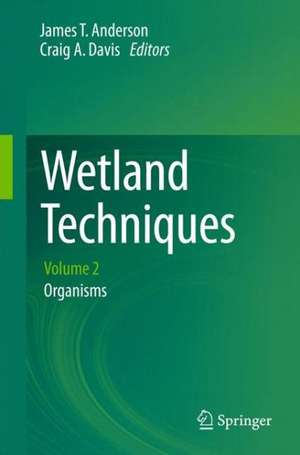
Wetland Techniques
Editat de James T. Anderson, Craig A. Davisen Limba Engleză Paperback – 22 oct 2013
To date there has been no practical, comprehensive techniques book centered on wetlands, and written for wetland researchers, students, and managers. This techniques book aims to fill that gap. It is designed to provide an overview of the various methods that have been used or developed by researchers and practitioners to study, monitor, manage, or create wetlands. Including many methods usually found only in the peer-reviewed or gray literature, this 3-volume set fills a major niche for all professionals dealing with wetlands.
Preț: 648.46 lei
Preț vechi: 762.89 lei
-15%
Puncte Express: 973
Carte tipărită la comandă
Livrare economică 18 noiembrie-02 decembrie
Livrare prin curier în România Termenul estimat este afișat lângă disponibilitate.
Transport gratuit pentru acest produs Plată online sau ramburs, în funcție de opțiunile comenzii.
Retur gratuit în 14 zile Comandă securizată și suport în română.
Specificații
ISBN-13: 9789400769304
ISBN-10: 940076930X
Pagini: 344
Ilustrații: XII, 332 p. 59 illus., 34 illus. in color.
Dimensiuni: 155 x 235 x 18 mm
Greutate: 0.59 kg
Ediția:2013
Editura: Springer
Locul publicării:Dordrecht, Netherlands
ISBN-10: 940076930X
Pagini: 344
Ilustrații: XII, 332 p. 59 illus., 34 illus. in color.
Dimensiuni: 155 x 235 x 18 mm
Greutate: 0.59 kg
Ediția:2013
Editura: Springer
Locul publicării:Dordrecht, Netherlands
Public țintă
ResearchCuprins
Preface.- Acknowledgements.- 1. Methods for Sampling and Analyzing Wetland Algae; Steven N. Francoeur et al.- 2. Methods for Sampling and Analyzing Wetland Soil Bacterial Community; Aixin Hou and Henry Williams.- 3. Methods for Sampling and Analyzing Wetland Fungi; Steven L. Stephenson et al.- 4. Methods for Sampling and Analyzing Wetland Protoza (Protists); Marianne Borneff-Lipp and Matthias Duerr.- 5. Sampling and Processing Aquatic and Terrestrial Invertebrates in Wetlands; James T. Anderson et al.- 6. Wetland Fish Monitoring and Assessment; Michael D. Kaller et al.- 7. Wetland Wildlife Monitoring and Assessment; Matthew J. Gray et al.- Index.
Recenzii
From the reviews:
“The Second Volume of Wetland Techniques is devoted to the study of a wide range of organisms- from microbes to mammals. … The classroom and laboratory exercises at the end of each chapter are an important and useful aspect … . a very useful contribution which attempts to bring together the research methods from many disciplines that are required to investigate the wetlands, and thereby fill an important gap in wetland literature.” (Brij Gopal, International Journal of Ecology and Environmental Sciences, Vol. 40 (2), 2014)
“The Second Volume of Wetland Techniques is devoted to the study of a wide range of organisms- from microbes to mammals. … The classroom and laboratory exercises at the end of each chapter are an important and useful aspect … . a very useful contribution which attempts to bring together the research methods from many disciplines that are required to investigate the wetlands, and thereby fill an important gap in wetland literature.” (Brij Gopal, International Journal of Ecology and Environmental Sciences, Vol. 40 (2), 2014)
Textul de pe ultima copertă
Wetlands serve many important functions and provide numerous ecological services such as clean water, wildlife habitat, nutrient reduction, and flood control. Wetland science is a relatively young discipline but is a rapidly growing field due to an enhanced understanding of the importance of wetlands and the numerous laws and policies that have been developed to protect these areas. This growth is demonstrated by the creation and growth of the Society of Wetland Scientists which was formed in 1980 and now has a membership of 3,500 people. It is also illustrated by the existence of 2 journals (Wetlands and Wetlands Ecology and Management) devoted entirely to wetlands.
To date there has been no practical, comprehensive techniques book centered on wetlands, and written for wetland researchers, students, and managers. This techniques book aims to fill that gap. It is designed to provide an overview of the various methods that have been used or developed by researchers and practitioners to study, monitor, manage, or create wetlands. Including many methods usually found only in the peer-reviewed or gray literature, this 3-volume set fills a major niche and for all professionals dealing with wetlands.
To date there has been no practical, comprehensive techniques book centered on wetlands, and written for wetland researchers, students, and managers. This techniques book aims to fill that gap. It is designed to provide an overview of the various methods that have been used or developed by researchers and practitioners to study, monitor, manage, or create wetlands. Including many methods usually found only in the peer-reviewed or gray literature, this 3-volume set fills a major niche and for all professionals dealing with wetlands.
Caracteristici
Only comprehensive book on the topic of wetland research and management techniques Chapters are authored by leading scientists in the field of wetlands Examples of classroom and field activities are provided to jump start non-specialists teaching specific topics