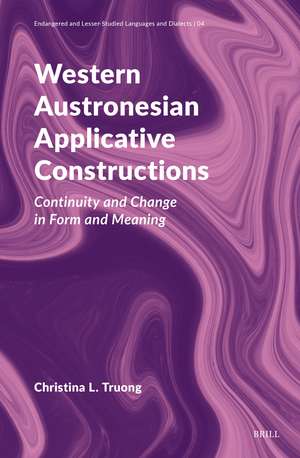
Western Austronesian Applicative Constructions: Continuity and Change in Form and Meaning: Endangered and Lesser-Studied Languages and Dialects, cartea 4
Autor Christina L. Truongen Limba Engleză Hardback – 21 aug 2025


Preț: 602.22 lei
Preț vechi: 708.49 lei
-15%
Puncte Express: 903
Carte disponibilă
Livrare economică 13-24 noiembrie
Livrare prin curier în România Termenul estimat este afișat lângă disponibilitate.
Transport gratuit pentru acest produs Plată online sau ramburs, în funcție de opțiunile comenzii.
Retur gratuit în 14 zile Comandă securizată și suport în română.
Specificații
ISBN-13: 9789004737129
ISBN-10: 900473712X
Pagini: 380
Dimensiuni: 155 x 235 x 22 mm
Greutate: 0.76 kg
Editura: Brill
Colecția Brill
Seria Endangered and Lesser-Studied Languages and Dialects
ISBN-10: 900473712X
Pagini: 380
Dimensiuni: 155 x 235 x 22 mm
Greutate: 0.76 kg
Editura: Brill
Colecția Brill
Seria Endangered and Lesser-Studied Languages and Dialects
V-ar putea interesa
-
 The Integration of Language and Society: A Cross-Linguistic TypologyAlexandra Y. Aikhenvald-31%Preț: 844.88 lei1216.34 lei
 -
 -32%Preț: 666.08 lei978.27 lei
 -
 Verb-Verb Complexes in Asian LanguagesTaro Kageyama-33%Preț: 1003.57 lei1491.09 lei
 -
 The Oxford Guide to the Malayo-Polynesian Languages of Southeast AsiaAlexander Adelaar-30%Preț: 1056.43 lei1511.05 lei
 -
 Commands: A Cross-Linguistic TypologyAlexandra Y. AikhenvaldPreț: 290.89 lei
 -
 A Guide to Gender and ClassifiersAlexandra Y. Aikhenvald-32%Preț: 831.26 lei1221.04 lei
 -
 Clause Chaining in the Languages of the WorldHannah S. Sarvasy-32%Preț: 1394.54 lei2047.53 lei
 -
 Locative Predications in Chadic Languages: Implications for Semantic AnalysisZygmunt Frajzyngier-32%Preț: 697.24 lei1025.50 lei
 -
 Alignment and Subjecthood in LatinClaudia Fabrizio-32%Preț: 658.65 lei968.04 lei
 -
 A New Grammar of DyirbalR. M. W. Dixon-15%Preț: 300.73 lei352.36 lei
 -
 The Atlas and Survey of Pidgin and Creole Languages: Super Set: Four-volume PackSusanne Maria Michaelis-23%Preț: 5780.71 lei7507.42 lei
 -
 -33%Preț: 999.81 lei1485.98 lei
 -
 Preț: 382.00 leiRecomandat
 -
 Cultural Tasks for Digital Language LearningDr Müge Satar-32%Preț: 633.60 lei929.96 lei
 -
 -22%Preț: 184.48 lei235.21 lei
 -
 AlgospeakAdam AleksicPreț: 122.02 leiRecomandat
 -
 Adferfau - Disentangling the Welsh adverbD. Geraint LewisPreț: 64.92 lei
 -
 The evolution of the derivational verbal system in ArabicVera TsukanovaPreț: 487.25 lei
 -
 Using Tonal Data to Recover Japanese Language HistoryElisabeth M. de Boer-9%Preț: 683.30 lei750.88 lei
 -
 Peripheral Linguistic BrutalityJess KrukPreț: 206.04 lei
Notă biografică
Christina L. Truong, PhD (2024), University of Hawaiʻi at Mānoa, is a documentary linguist whose work has focused on the Austronesian languages of Asia and the Pacific. Her research explores linguistic diversity and typology, verbal constructions, and language change.
Cuprins
Acknowledgments
List of Figures and Maps
List of Tables
Abbreviations
1 Introduction
11 What are Applicatives?
12 Why Study Applicatives in Languages of West Nusantara?
13 Background and Sources of Data
14 Scope of the Study
15 Previous Research on Applicatives in West Nusantara Languages
16 Framework and Assumptions
17 Content and Structure
2 Case Study: Sundanese Applicatives
21 The Sundanese Language and Community
22 Basic Morphosyntax
23 Overview of Applicative Morphology
24 Locative-selecting Constructions Marked with ‑an
25 Theme- and Instrument-selecting Constructions Marked with ‑keun
26 Beneficiary-selecting Constructions Marked with pang‑ ‑keun
27 Beneficiary-selecting Constructions Marked with ‑keun
28 Other Applicative Constructions
29 Other AM-marked Constructions
210 Summary and Discussion
3 Towards a Typologically-grounded, Constructional Approach to Applicatives
31 What are Applicatives?
32 Problematic Constructions and Their Significance
33 Constructional Approaches as a Lens for West Nusantara Applicative Systems
34 On the Problem of Philippine-type Voice in a Study of Applicatives
35 On the Relationship between Serial Verb Constructions and Applicatives
36 West Nusantara Applicatives in Typological Perspective
4 The Distribution of Applicatives in West Nusantara Languages: A Bird’s Eye View
41 Establishing the Basic Distribution
42 Properties Considered in the Survey
43 Overview of Results and Multivariable Analysis
44 Detailed Results for Structural Properties
45 Location and Genetic Affiliation
46 Summary and Implications
5 Interpreting Distributional Patterns through Geographic Typology
51 Sumatra and the Barrier Islands
52 Java and Madura
53 The Lesser Sundas
54 Mainland Southeast Asia and Peninsular Malaysia
55 Borneo and the Southern Philippines
56 Sulawesi
57 Summary of Major Findings
6 Properties of Applicative Constructions and their Distribution in West Nusantara
61 Distribution of Function and Form
62 Properties of ACs and AMs Considered in the Survey
63 Forms Marking Pivot-selecting Constructions
64 Forms Marking Pivot-neutral Constructions
65 Polyfunctionality of West Nusantara Applicative Morphemes
66 Comparative and Other Degree Constructions
67 Syntactic Properties of Applicative Constructions
68 Summary of Findings and Implications
7 A Functional Typology of Applicative Constructions in Languages of West Nusantara
71 Introduction
72 Sampling of Languages
73 Basic Morphosyntax
74 Applicative Morphology
75 Beneficiaries and Recipients
76 Instruments and Themes
77 Goals and locations
78 Circumstantial and Comitative Roles
79 Other Applied Phrases
710 Aspect, Intensity and Other Semantic Effects
711 Causative AM-marked Constructions
712 Applicatives and Voice
713 Summary of Findings
8 Conclusion
Appendix 1: Language Sample for Typological Survey
Appendix 2: Questionnaires Used in the Typological Survey
Appendix 3: Database for Typological Survey
References
Index
List of Figures and Maps
List of Tables
Abbreviations
1 Introduction
11 What are Applicatives?
12 Why Study Applicatives in Languages of West Nusantara?
13 Background and Sources of Data
14 Scope of the Study
15 Previous Research on Applicatives in West Nusantara Languages
16 Framework and Assumptions
17 Content and Structure
2 Case Study: Sundanese Applicatives
21 The Sundanese Language and Community
22 Basic Morphosyntax
23 Overview of Applicative Morphology
24 Locative-selecting Constructions Marked with ‑an
25 Theme- and Instrument-selecting Constructions Marked with ‑keun
26 Beneficiary-selecting Constructions Marked with pang‑ ‑keun
27 Beneficiary-selecting Constructions Marked with ‑keun
28 Other Applicative Constructions
29 Other AM-marked Constructions
210 Summary and Discussion
3 Towards a Typologically-grounded, Constructional Approach to Applicatives
31 What are Applicatives?
32 Problematic Constructions and Their Significance
33 Constructional Approaches as a Lens for West Nusantara Applicative Systems
34 On the Problem of Philippine-type Voice in a Study of Applicatives
35 On the Relationship between Serial Verb Constructions and Applicatives
36 West Nusantara Applicatives in Typological Perspective
4 The Distribution of Applicatives in West Nusantara Languages: A Bird’s Eye View
41 Establishing the Basic Distribution
42 Properties Considered in the Survey
43 Overview of Results and Multivariable Analysis
44 Detailed Results for Structural Properties
45 Location and Genetic Affiliation
46 Summary and Implications
5 Interpreting Distributional Patterns through Geographic Typology
51 Sumatra and the Barrier Islands
52 Java and Madura
53 The Lesser Sundas
54 Mainland Southeast Asia and Peninsular Malaysia
55 Borneo and the Southern Philippines
56 Sulawesi
57 Summary of Major Findings
6 Properties of Applicative Constructions and their Distribution in West Nusantara
61 Distribution of Function and Form
62 Properties of ACs and AMs Considered in the Survey
63 Forms Marking Pivot-selecting Constructions
64 Forms Marking Pivot-neutral Constructions
65 Polyfunctionality of West Nusantara Applicative Morphemes
66 Comparative and Other Degree Constructions
67 Syntactic Properties of Applicative Constructions
68 Summary of Findings and Implications
7 A Functional Typology of Applicative Constructions in Languages of West Nusantara
71 Introduction
72 Sampling of Languages
73 Basic Morphosyntax
74 Applicative Morphology
75 Beneficiaries and Recipients
76 Instruments and Themes
77 Goals and locations
78 Circumstantial and Comitative Roles
79 Other Applied Phrases
710 Aspect, Intensity and Other Semantic Effects
711 Causative AM-marked Constructions
712 Applicatives and Voice
713 Summary of Findings
8 Conclusion
Appendix 1: Language Sample for Typological Survey
Appendix 2: Questionnaires Used in the Typological Survey
Appendix 3: Database for Typological Survey
References
Index