
Wells, H: Invisible man
en Paperback
Preț: 71.07 lei
Puncte Express: 107
Carte disponibilă
Livrare economică 09-23 noiembrie
Livrare express 23-29 octombrie pentru 22.92 lei
Livrare prin curier în România Termenul estimat este afișat lângă disponibilitate.
Transport gratuit de la 400.00 lei Plată online sau ramburs, în funcție de opțiunile comenzii.
Retur gratuit în 14 zile Comandă securizată și suport în română.
Specificații
V-ar putea interesa
-
 XISLAND OF DOCTOR_CLASSICS PBH. G. WellsPreț: 28.01 lei
 -
 Alchemist - The 25th AnniversaryPaulo CoelhoPreț: 61.39 lei
 -
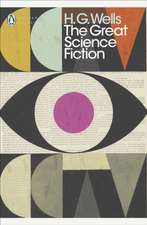 The Great Science FictionH. G. Wells-27%Preț: 80.67 lei110.30 lei
 -
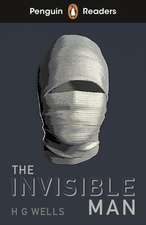 Preț: 49.59 lei
 -
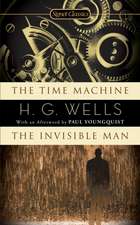 The Time Machine/The Invisible ManH. G. WellsPreț: 45.90 lei
 -
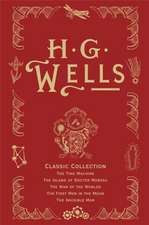 HG Wells Classic CollectionH. G. Wells-28%Preț: 142.19 lei198.26 lei
 -
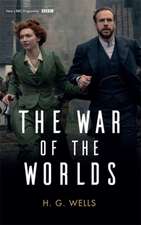 -27%Preț: 46.65 lei63.61 lei
 -
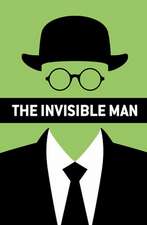 Rollercoasters: The Invisible ManH. G. Wells-28%Preț: 64.34 lei89.97 lei
 -
 The Nobody (New Edition)Jeff Lemire-24%Preț: 157.95 lei207.66 lei
 -
 The Invisible ManH. G. WellsPreț: 51.39 lei
 -
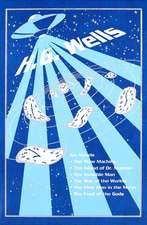 H. G. WellsH. G. Wells-13%Preț: 133.07 lei153.36 lei
 -
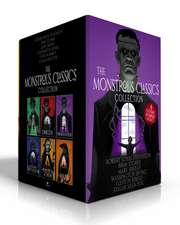 -18%Preț: 168.62 lei205.95 leiRecomandat
 -
 Preț: 50.57 lei
 -
 Preț: 70.86 lei
 -
 Preț: 42.27 lei
 -
 The Fantastic Tales of Fitz-James O'Brien: Fully Annotated EditionFitz-James O'BrienPreț: 64.87 lei
 -
 The Time MachineH. G. WellsPreț: 33.23 lei
 -
 Wells, H: Invisible Man/m. CDH. G. WellsPreț: 49.59 lei
 -
 The Man Who Was ThursdayG. K. ChestertonPreț: 38.95 lei
 -
 The Country of the Blind and Other StoryH. G. WellsPreț: 128.58 lei
Notă biografică
Herbert George Wells (21 September 1866 - 13 August 1946) was an English writer. He was prolific in many genres, writing dozens of novels, short stories, and works of social commentary, satire, biography, and autobiography, and even including two books on recreational war games. He is now best remembered for his science fiction novels and is often called a "father of science fiction", along with Jules Verne and Hugo Gernsback.[5][6][a] During his own lifetime, however, he was most prominent as a forward-looking, even prophetic social critic who devoted his literary talents to the development of a progressive vision on a global scale. A futurist, he wrote a number of utopian works and foresaw the advent of aircraft, tanks, space travel, nuclear weapons, satellite television and something resembling the World Wide Web.[7] His science fiction imagined time travel, alien invasion, invisibility, and biological engineering. Brian Aldiss referred to Wells as the "Shakespeare of science fiction".[8] Wells rendered his works convincing by instilling commonplace detail alongside a single extraordinary assumption - dubbed "Wells's law" - leading Joseph Conrad to hail him in 1898 as "O Realist of the Fantastic!".[9] His most notable science fiction works include The Time Machine (1895), The Island of Doctor Moreau (1896), The Invisible Man (1897), The War of the Worlds (1898) and the military science fiction The War in the Air (1907). Wells was nominated for the Nobel Prize in Literature four times.[10] Wells's earliest specialised training was in biology, and his thinking on ethical matters took place in a specifically and fundamentally Darwinian context.[11] He was also from an early date an outspoken socialist, often (but not always, as at the beginning of the First World War) sympathising with pacifist views. His later works became increasingly political and didactic, and he wrote little science fiction, while he sometimes indicated on official documents that his profession was that of journalist.[12] Novels such as Kipps and The History of Mr Polly, which describe lower-middle-class life, led to the suggestion that he was a worthy successor to Charles Dickens,[13]but Wells described a range of social strata and even attempted, in Tono-Bungay (1909), a diagnosis of English society as a whole. A diabetic, Wells co-founded the charity The Diabetic Association (known today as Diabetes UK) in 1934 Herbert George Wells was born at Atlas House, 162 High Street in Bromley, Kent,[15] on 21 September 1866.[4] Called "Bertie" in the family, he was the fourth and last child of Joseph Wells (a former domestic gardener, and at the time a shopkeeper and professional cricketer) and his wife, Sarah Neal (a former domestic servant). An inheritance had allowed the family to acquire a shop in which they sold china and sporting goods, although it failed to prosper: the stock was old and worn out, and the location was poor. Joseph Wells managed to earn a meagre income, but little of it came from the shop and he received an unsteady amount of money from playing professional cricket for the Kent county team.[16] Payment for skilled bowlers and batsmen came from voluntary donations afterwards, or from small payments from the clubs where matches were played.
Descriere
Descriere de la o altă ediție sau format:
On a windswept night, a mysterious stranger arrives in a small English village seeking seclusion and the peace to continue his academic pursuits. Yet a dawning recognition grows within him that scientific enlightenment has come at a horrific cost. H. G. Wells' suspense-filled The Invisible Man remains a science fiction classic famous not just for its element of individual hubris but also for its uncomfortable glimpse into mankind's dark nature. Additional titles by this publisher can be found at www.finisterrabooks.com.
On a windswept night, a mysterious stranger arrives in a small English village seeking seclusion and the peace to continue his academic pursuits. Yet a dawning recognition grows within him that scientific enlightenment has come at a horrific cost. H. G. Wells' suspense-filled The Invisible Man remains a science fiction classic famous not just for its element of individual hubris but also for its uncomfortable glimpse into mankind's dark nature. Additional titles by this publisher can be found at www.finisterrabooks.com.