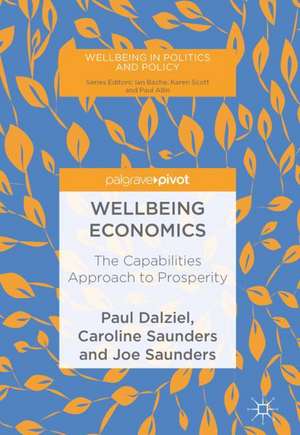
Wellbeing Economics
Autor Paul Dalziel, Caroline Saunders, Joe Saundersen Limba Engleză Hardback – 26 sep 2018
This open access book addresses that challenge. It sets out a wellbeing economics framework that directly addresses fundamental issues affecting wellbeing outcomes. Drawing inspiration from the capabilities approach of Nobel Prize winner Amartya Sen, the book demonstrates how persons can enhance prosperity through their own actions and through collaboration with others.
The book examines national public policy, but its analysis also focuses on choices made by individuals, households, families, civil society, local government and the global community. It therefore offers important insights for anyone concerned with improving personal wellbeing and community prosperity.
Preț: 223.38 lei
Puncte Express: 335
Carte tipărită la comandă
Livrare economică 17 noiembrie-01 decembrie
Livrare prin curier în România Termenul estimat este afișat lângă disponibilitate.
Transport gratuit de la 400.00 lei Plată online sau ramburs, în funcție de opțiunile comenzii.
Retur gratuit în 14 zile Comandă securizată și suport în română.
Specificații
ISBN-13: 9783319931937
ISBN-10: 3319931938
Pagini: 216
Ilustrații: XVII, 196 p. 23 illus.
Dimensiuni: 153 x 216 x 17 mm
Greutate: 0.4 kg
Ediția:1st ed. 2018
Editura: Springer
Locul publicării:Cham, Switzerland
ISBN-10: 3319931938
Pagini: 216
Ilustrații: XVII, 196 p. 23 illus.
Dimensiuni: 153 x 216 x 17 mm
Greutate: 0.4 kg
Ediția:1st ed. 2018
Editura: Springer
Locul publicării:Cham, Switzerland
V-ar putea interesa
-
 Neoliberale Staatsverständnisse im VergleichStefan Kolev-19%Preț: 487.33 lei601.64 lei
 -
 Preț: 318.08 lei
 -
 -15%Preț: 566.60 lei666.59 lei
 -
 Preț: 436.47 lei
 -
 -15%Preț: 617.08 lei725.97 lei
 -
 Advances in Decision Making Under Risk and UncertaintyMohammed Abdellaoui-15%Preț: 625.30 lei735.64 lei
 -
 Evolution of Non-Expected Utility PreferencesSven von WidekindPreț: 365.78 lei
 -
 Optimal Control of Nonlinear ProcessesDieter Grass-18%Preț: 1132.99 lei1381.69 lei
 -
 Predictably Rational?: In Search of Defenses for Rational Behavior in EconomicsRichard B. McKenzie-15%Preț: 508.94 lei598.75 lei
 -
 An Introduction to Allocation RulesJens Leth Hougaard-15%Preț: 615.52 lei724.14 lei
 -
 Fairness in Bargaining and MarketsChristian Korth-15%Preț: 694.76 lei817.36 lei
Cuprins
Chapter 1: From Economic Growth to Wellbeing Economics.- Chapter 2: Persons and Human Capital.- Chapter 3: Households, Families and Cultural Capital.- Chapter 4: Civil Society and Social Capital.- Chapter 5: Market Participation and Economic Capital.- Chapter 6: Local Government and Natural Capital.- Chapter 7: The Nation State and Knowledge Capital.- Chapter 8: The Global Community and Diplomatic Capital.- Chapter 9: The Wellbeing Economics Policy Framework.
Textul de pe ultima copertă
Economists have long sought to maximise economic growth, believing this to be their best contribution to improving human welfare. That approach is not sustainable in the face of ongoing issues such as global climate change, environmental damage, rising inequality and enduring poverty. Alternatives must be found.
This open access book addresses that challenge. It sets out a wellbeing economics framework that directly addresses fundamental issues affecting wellbeing outcomes. Drawing inspiration from the capabilities approach of Nobel Prize winner Amartya Sen, the book demonstrates how persons can enhance prosperity through their own actions and through collaboration with others.
The book examines national public policy, but its analysis also focuses on choices made by individuals, households, families, civil society, local government and the global community. It therefore offers important insights for anyone concerned with improving personal wellbeing and community prosperity.
Paul Dalziel is Professor of Economics and Deputy Director of the Agribusiness and Economics Research Unit at Lincoln University, New Zealand.
Caroline Saunders is Professor of Trade and Environmental Economics and Director of the Agribusiness and Economics Research Unit at Lincoln University, New Zealand. Joe Saunders is Assistant Professor in Post-Kantian Philosophy at the University of Durham, UK.
This open access book addresses that challenge. It sets out a wellbeing economics framework that directly addresses fundamental issues affecting wellbeing outcomes. Drawing inspiration from the capabilities approach of Nobel Prize winner Amartya Sen, the book demonstrates how persons can enhance prosperity through their own actions and through collaboration with others.
The book examines national public policy, but its analysis also focuses on choices made by individuals, households, families, civil society, local government and the global community. It therefore offers important insights for anyone concerned with improving personal wellbeing and community prosperity.
Paul Dalziel is Professor of Economics and Deputy Director of the Agribusiness and Economics Research Unit at Lincoln University, New Zealand.
Caroline Saunders is Professor of Trade and Environmental Economics and Director of the Agribusiness and Economics Research Unit at Lincoln University, New Zealand. Joe Saunders is Assistant Professor in Post-Kantian Philosophy at the University of Durham, UK.
Caracteristici
Offers an integrated account of how levels of activity and types of capital investment connect in a Wellbeing Economics framework for policy formulation and implementation Outlines different levels of action for wellbeing, so that central government policies can integrate what is already occurring as a result of individual, household, community, regional and market activities, while recognising that some problems require international collaboration Constructs a positive and rich paradigm for designing policies to raise personal and social wellbeing Is informed by, and provides clear references to, a wide economics literature and practical policy examples Accessible to non-specialist readers