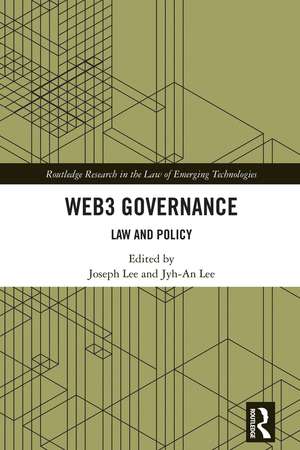
Web3 Governance: Law and Policy: Routledge Research in the Law of Emerging Technologies
Editat de Joseph Lee, Jyh-An Leeen Limba Engleză Paperback – 22 iun 2026
Artificial intelligence (AI) and data analytics have played a key role in the development of Web3, transforming the governance of existing digital platforms and enabling the formation of new platforms. Web3 is increasingly used for commercial and social interactions and is predicted to be the future of the internet. As a blockchain-based web, Web3 provides a platform for cryptocurrencies, non-fungible tokens (NFTs), decentralised autonomous organisations, and decentralised finance. Web3 users can read, write, and even own their own version of the web, which has transformed the space for commerce and social interaction, but brings inherent risks. This book identifies the principles in law and policy which can be used as the basis for the development of Web3 activities and their regulation with a focus on security, scalability, and sustainability. Though digital platforms and underlying technologies have reshaped our daily lives and business practices, they have also caused numerous legal problems. The book considers the interaction of data analytics with well-established fields of study such as financial law, tax law, intellectual property, data protection, private international law, and internet law.
Addressing the current knowledge gap in the legal literature on Web3, including blockchain, AI, and data governance in commercial and social activities, it develops new baseline frameworks which will form the foundation for new research into data governance, FinTech, and RegTech, as well as social and market infrastructure, and will be essential reading for scholars in law, business studies, economics, public administration, and regulation.
Din seria Routledge Research in the Law of Emerging Technologies
- 20%
 Preț: 362.55 lei
 -
 Preț: 379.86 lei
 -
 Preț: 405.33 lei
 - 15%
 Preț: 430.06 lei
 -
 Preț: 422.34 lei
 -
 Preț: 381.41 lei
 -
 Preț: 410.56 lei
 -
 Preț: 187.83 lei
 -
 Preț: 410.42 lei
 - 20%
 Preț: 354.07 lei
 -
 Preț: 414.64 lei
 -
 Preț: 429.73 lei
 -
 Preț: 474.05 lei
 -
 Preț: 472.36 lei
 - 17%
 Preț: 181.01 lei
 - 20%
 Preț: 1170.10 lei
 - 18%
 Preț: 1114.82 lei
 - 18%
 Preț: 1116.90 lei
 - 8%
 Preț: 425.71 lei
 - nou
 Preț: 1351.04 lei
 - 20%
 Preț: 552.34 lei
 - nou
 Preț: 1352.12 lei
 - nou
 Preț: 1130.31 lei
Preț: 468.95 lei
Puncte Express: 703
Carte tipărită la comandă
Livrare economică 02-16 decembrie
Livrare prin curier în România Termenul estimat este afișat lângă disponibilitate.
Transport gratuit pentru acest produs Plată online sau ramburs, în funcție de opțiunile comenzii.
Retur gratuit în 14 zile Comandă securizată și suport în română.
Specificații
ISBN-13: 9781032618968
ISBN-10: 1032618965
Pagini: 252
Dimensiuni: 156 x 234 mm
Greutate: 0.36 kg
Ediția:1
Editura: Taylor & Francis
Colecția Routledge
Seria Routledge Research in the Law of Emerging Technologies
Locul publicării:Oxford, United Kingdom
ISBN-10: 1032618965
Pagini: 252
Dimensiuni: 156 x 234 mm
Greutate: 0.36 kg
Ediția:1
Editura: Taylor & Francis
Colecția Routledge
Seria Routledge Research in the Law of Emerging Technologies
Locul publicării:Oxford, United Kingdom
Public țintă
PostgraduateCuprins
Roadmap to Legal Implications of Web3: An Introduction
Part A: Property and Contract
1. Deciphering the Legal Enigma of NFTs
2. Taxation of Cryptoassets and Web 3.0
3. The Sense and Nonsense of Smart Contracts
Part B: Reorganising Organisations
4. Law and Regulation for Decentralised Autonomous Organisations (DAOs)
5. Resource Dependency Theory and Cybersecurity Regulation
Part C: Data Governance
6. Data Law in China
7. Copyright Law and the Use of Big Data for Computer Vision
Part D: Disputes and Liabilities in the Platform Economy
8. What’s the Gig? Tort Liability of Platforms for Physical User-to-User Harm
9. Envisioning the Future of Online Dispute Resolution from the Case of China
Part E: International Law Perspectives
10. Navigating the Cryptosphere: Jurisdictional Uncertainty in Emerging Cross-Border Cryptocurrency Disputes
11. Rethinking Jurisdiction of Online Defamation
12. Grounding a Right to Internet Access in the Right to an Adequate Standard of Living
Part A: Property and Contract
1. Deciphering the Legal Enigma of NFTs
2. Taxation of Cryptoassets and Web 3.0
3. The Sense and Nonsense of Smart Contracts
Part B: Reorganising Organisations
4. Law and Regulation for Decentralised Autonomous Organisations (DAOs)
5. Resource Dependency Theory and Cybersecurity Regulation
Part C: Data Governance
6. Data Law in China
7. Copyright Law and the Use of Big Data for Computer Vision
Part D: Disputes and Liabilities in the Platform Economy
8. What’s the Gig? Tort Liability of Platforms for Physical User-to-User Harm
9. Envisioning the Future of Online Dispute Resolution from the Case of China
Part E: International Law Perspectives
10. Navigating the Cryptosphere: Jurisdictional Uncertainty in Emerging Cross-Border Cryptocurrency Disputes
11. Rethinking Jurisdiction of Online Defamation
12. Grounding a Right to Internet Access in the Right to an Adequate Standard of Living
Recenzii
In this admirable collection, contributors probe the governance challenges and opportunities that are presented by the transition from Web2 to Web3, offering readers important insights about not only the governance of Web3 artefacts—NFTs, smart contracts, DAOs, and the like—but also about the interface between, on the one side, law and policy and, on the other, the latest online technologies that support decentralisation, co-production, and user-centricity.
Roger Brownsword, Professor of Law at King’s College London and Bournemouth University
This remarkably informative and insightful volume offers lawyers and policymakers a thorough roadmap into the possible futures in which we will likely find ourselves in the age of Web3. As the learned contributors demonstrate, the existing knowledge in the field remains highly relevant for understanding and responding to novel issues. The sources of creativity and innovation, however, are nowadays increasingly more diversified and widely distributed across actors and places in the world.
Xin Dai, Associate Professor and Vice Dean, Peking University Law School
Web3 law and policy has evolved as quickly and diversely as the technological environment it seeks to govern. Featuring examples from multiple jurisdictions, this timely and comprehensive volume tackles a wide range of topics that are important to understanding this new environment. Whether you are into crypto assets, cybersecurity, data regulation, the platform economy, online disputes or jurisdictional questions, this book will provide a one-stop reference for the changing legal landscape surrounding Web 3.0. Highly recommended!
Peter K. Yu, University Distinguished Professor, Texas A&M University
Roger Brownsword, Professor of Law at King’s College London and Bournemouth University
This remarkably informative and insightful volume offers lawyers and policymakers a thorough roadmap into the possible futures in which we will likely find ourselves in the age of Web3. As the learned contributors demonstrate, the existing knowledge in the field remains highly relevant for understanding and responding to novel issues. The sources of creativity and innovation, however, are nowadays increasingly more diversified and widely distributed across actors and places in the world.
Xin Dai, Associate Professor and Vice Dean, Peking University Law School
Web3 law and policy has evolved as quickly and diversely as the technological environment it seeks to govern. Featuring examples from multiple jurisdictions, this timely and comprehensive volume tackles a wide range of topics that are important to understanding this new environment. Whether you are into crypto assets, cybersecurity, data regulation, the platform economy, online disputes or jurisdictional questions, this book will provide a one-stop reference for the changing legal landscape surrounding Web 3.0. Highly recommended!
Peter K. Yu, University Distinguished Professor, Texas A&M University
Notă biografică
Joseph Lee is a reader in corporate and financial law at the University of Manchester School of Law. He is founding programme director of Manchester Online LLM Master of Laws in International Commercial and Technology Law. He is author of the book Crypto-Finance, Law and Regulation: Governing an Emerging Ecosystem and editor of the book Data Governance in AI, FinTech and RegTech. He is a member of the LawTech Advisory Council of the Astana International Financial Centre and of the Manchester LawTech Initiative. Dr Lee has been principal investigator of research projects funded by the UKRI, British Academy, and British Council. He has held a number of visiting positions, including at KU Leuven and Tokyo University. He is also an attorney-at-law of New York State.
Jyh-An Lee is a Professor and the Executive Director of the Centre for Legal Innovation and Digital Society at the Chinese University of Hong Kong Faculty of Law. He has been featured on ABC News, BBC News, Bloomberg News, Financial Times, and Fortune as an expert on intellectual property and internet law. His works have been cited by the US Court of Appeals for the Fifth Circuit, the UK High Court of Justice, and the European Union (in a WTO dispute-settlement case).
Jyh-An Lee is a Professor and the Executive Director of the Centre for Legal Innovation and Digital Society at the Chinese University of Hong Kong Faculty of Law. He has been featured on ABC News, BBC News, Bloomberg News, Financial Times, and Fortune as an expert on intellectual property and internet law. His works have been cited by the US Court of Appeals for the Fifth Circuit, the UK High Court of Justice, and the European Union (in a WTO dispute-settlement case).
Descriere
Focusing on four key aspects of Web3, the book explores metaverses, data governance, public and private law interfaces, and access to justice, presenting new research on the impact of data analytics on transactions within law. It will be essential reading for scholars in law, business studies, economics, public administration and regulation.