
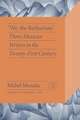
"We, the Barbarians": Three Mexican Writers in the Twenty-First Century: Critical Mexican Studies
Autor Mabel Moraña Traducere de Stephanie Kirken Limba Engleză Hardback – 20 mai 2024
Characterized by the fragmentation of civil society and the decomposition of the myths that accompanied the consolidation of the modern nation, Mexican visual and literary arts have explored a myriad of representational avenues to approach the phenomena of violence, institutional decay, and political instability. The critical and theoretical approaches in “We, the Barbarians” explore a variety of alternative symbolic representations of topics such as nationalism, community, and affect in times impacted by systemic violence, precariousness, and radical inequality. Moraña perceives the negotiations between regional/local imaginaries and global scenarios characterized by the devaluation and resignification of life, both at individual and collective levels. Though it uses three authors as its focus, this book seeks to more broadly theorize the question of the relationship between literature and the social in the twenty-first century.
| Toate formatele și edițiile | Preț | Express |
|---|---|---|
| Paperback (1) | 288.96 lei 3-5 săpt. | +29.07 lei 7-11 zile |
| Vanderbilt University Press – 20 mai 2024 | 288.96 lei 3-5 săpt. | +29.07 lei 7-11 zile |
| Hardback (1) | 844.47 lei 38-44 zile | |
| Vanderbilt University Press – 20 mai 2024 | 844.47 lei 38-44 zile |




Preț: 844.47 lei
Preț vechi: 1096.70 lei
-23% Nou
Puncte Express: 1267
Preț estimativ în valută:
149.43€ • 175.23$ • 131.23£
149.43€ • 175.23$ • 131.23£
Carte tipărită la comandă
Livrare economică 06-12 februarie 26
Preluare comenzi: 021 569.72.76
Specificații
ISBN-13: 9780826506702
ISBN-10: 0826506704
Pagini: 408
Dimensiuni: 152 x 229 x 25 mm
Greutate: 0.72 kg
Editura: Vanderbilt University Press
Colecția Vanderbilt University Press
Seria Critical Mexican Studies
ISBN-10: 0826506704
Pagini: 408
Dimensiuni: 152 x 229 x 25 mm
Greutate: 0.72 kg
Editura: Vanderbilt University Press
Colecția Vanderbilt University Press
Seria Critical Mexican Studies
Recenzii
“What is most interesting here is Moraña’s cross-reading of her writers, the originality of the approach, and the great lengths she goes to interpret the linguistic, political, and cultural importance of Herrera, Melchor, and Luiselli, three young writers that are in the center of the revival of Mexican literature translated into English.”
—Pedro Ángel Palou, author of Mestizo Failure(s): Race, Film, and Literature in Twentieth-Century Mexico
—Pedro Ángel Palou, author of Mestizo Failure(s): Race, Film, and Literature in Twentieth-Century Mexico
Notă biografică
Mabel Moraña is a professor of Spanish at Washington University in St. Louis.
Stephanie Kirk is a translator and professor of Hispanic studies at Washington University in St. Louis, working on Latin American literature and translation studies.
Stephanie Kirk is a translator and professor of Hispanic studies at Washington University in St. Louis, working on Latin American literature and translation studies.
Cuprins
Introduction
Chapter 1 | Yuri Herrera: A Distilled and Elliptical Art
Children’s Stories: Preparing Readers
Talud and Other Stories: Telling the Tale
Diez planetas: The Science of Fiction
Testimonial Virtuosity in El Incendio de la mina El Bordo
Microcosms
Human Bodies versus Legal Bodies
Trabajos del Reino: First as Tragedy, then as Farce
Tragedy, Myth, Fable, and Farce
Axes and Paradigms
What’s in a Name?
The Word, a Glimmer
The Corrido as Social Text
Courtly Theater: Dialogic Scenes
Seales que Precederán al Fin del Mundo: A Voyage into Silence
Journey as Paradigm
Word, Language, Time, Writing: Symbolic Displacements
Becomings
Tradition/Modernity and the Function of Myth
“We, the Barbarians”: From Enunciated to Enunciation
La Transmigración de los Cuerpos: “Symbolic Exchange and Death”
Mediation and Mandate
El Alfaqueque and “The Accursed Share”
Social Space and the Place of Death
Body as Commodity
Community/Immunity
Chapter 2 | Fernanda Melchor: Necro-Aesthetics and the “Truth of the Body”
(Thankfully) This Is Not Miami
Chronicle, Border Narrative, and the Villa Rica of la Vera Cruz
Regional Identities: Heterogeneity and Consistency
Lights, Fire, and Shadows
“Youth, Divine Treasure” in Falsa Liebre
The Devastation of Society
Mapping Subjectivity
Perversion, Excess, and Gender
Temporada de Huracanes or the Whirlwind of Language
The Problem with Truth
The Black Hole of a Bruja
Patriarchy and Witchcraft
Between Private and Public Life: Secrets and Gossip
(Anti)Modernity and Community in La Matosa
Chapter 3 | Valeria Luiselli: The Unbearable Lightness of Being
Displacements, Dispositifs, and Gestures
Papeles Falsos: The Exoskeleton and the Seeing Eye
The Map and the Hole
Liminality and Name Dropping
Los Ingrávidos: Owen and I (or Vice Versa?)
The Metaphysics of Presence and the Absence of the Self
Mobility and Fixity
Fabricating the Model: Translation and Simulacrum
The Irritating Historia de mis Dientes
Collectionism and the Aura of the Object
The Auction House as Negotiation of Meaning
Los Niños Perdidos (Un Ensayo en Cuarenta Preguntas)
The Migrant’s Via Crucis and the Theater of Belonging
Microhistory and Literature
Lost Children Archive
Word and Silence; Body and Specter
Experience, Archive, and Narration
Border Semiotics and Autofiction
Luiselli’s Use of Children
Elegiac Discourse
Notes
Chapter 1 | Yuri Herrera: A Distilled and Elliptical Art
Children’s Stories: Preparing Readers
Talud and Other Stories: Telling the Tale
Diez planetas: The Science of Fiction
Testimonial Virtuosity in El Incendio de la mina El Bordo
Microcosms
Human Bodies versus Legal Bodies
Trabajos del Reino: First as Tragedy, then as Farce
Tragedy, Myth, Fable, and Farce
Axes and Paradigms
What’s in a Name?
The Word, a Glimmer
The Corrido as Social Text
Courtly Theater: Dialogic Scenes
Seales que Precederán al Fin del Mundo: A Voyage into Silence
Journey as Paradigm
Word, Language, Time, Writing: Symbolic Displacements
Becomings
Tradition/Modernity and the Function of Myth
“We, the Barbarians”: From Enunciated to Enunciation
La Transmigración de los Cuerpos: “Symbolic Exchange and Death”
Mediation and Mandate
El Alfaqueque and “The Accursed Share”
Social Space and the Place of Death
Body as Commodity
Community/Immunity
Chapter 2 | Fernanda Melchor: Necro-Aesthetics and the “Truth of the Body”
(Thankfully) This Is Not Miami
Chronicle, Border Narrative, and the Villa Rica of la Vera Cruz
Regional Identities: Heterogeneity and Consistency
Lights, Fire, and Shadows
“Youth, Divine Treasure” in Falsa Liebre
The Devastation of Society
Mapping Subjectivity
Perversion, Excess, and Gender
Temporada de Huracanes or the Whirlwind of Language
The Problem with Truth
The Black Hole of a Bruja
Patriarchy and Witchcraft
Between Private and Public Life: Secrets and Gossip
(Anti)Modernity and Community in La Matosa
Chapter 3 | Valeria Luiselli: The Unbearable Lightness of Being
Displacements, Dispositifs, and Gestures
Papeles Falsos: The Exoskeleton and the Seeing Eye
The Map and the Hole
Liminality and Name Dropping
Los Ingrávidos: Owen and I (or Vice Versa?)
The Metaphysics of Presence and the Absence of the Self
Mobility and Fixity
Fabricating the Model: Translation and Simulacrum
The Irritating Historia de mis Dientes
Collectionism and the Aura of the Object
The Auction House as Negotiation of Meaning
Los Niños Perdidos (Un Ensayo en Cuarenta Preguntas)
The Migrant’s Via Crucis and the Theater of Belonging
Microhistory and Literature
Lost Children Archive
Word and Silence; Body and Specter
Experience, Archive, and Narration
Border Semiotics and Autofiction
Luiselli’s Use of Children
Elegiac Discourse
Notes
Descriere
Representations of Mexican collective imaginaries in the face of social and political fragmentation since the final decades of the twentieth century