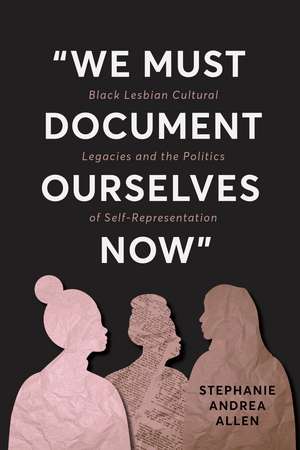
“We Must Document Ourselves Now”: Black Lesbian Cultural Legacies and the Politics of Self-Representation: Digital Media, Feminist Resistance
Autor Stephanie Andrea Allenen Limba Engleză Paperback – 9 iul 2026
A long-overdue analysis of how Black lesbians have asserted their lived experience through creative practice, pushing back against heteropatriarchal systems that deny them visibility.
“We Must Document Ourselves Now” examines the essential but oft-ignored importance of Black lesbian literature and film in queer literary and film histories, arguing that Black lesbian cultural texts reflect creators’ lived experiences and resist the heteropatriarchal systems that deny Black lesbians visibility in popular culture. Stephanie Andrea Allen contends that these texts have three goals: to lay bare the experiences of Black lesbians in a raced, gendered, classed, and homophobic society; to challenge the notion that claiming Black lesbian identity is marginal or forbidden; and to take care of Black lesbians by bearing witness to their experiences through creative practice.
Insisting that Black feminist creative practice is an integral form of self and community care, Allen weaves analysis of cultural output spanning key sociocultural moments from 1974 to 2020 with interviews with Black lesbian cultural workers. “We Must Document Ourselves Now” examines the Black Arts / Black Power movement, the “boom” in lesbian and gay publishing, the so-called golden era of Black film, and twenty-first-century visual media to demonstrate how representations of Black lesbians, or lack thereof, were vital to constructing a cultural canon that focused on illuminating Black lesbian experiences in the United States.
“We Must Document Ourselves Now” examines the essential but oft-ignored importance of Black lesbian literature and film in queer literary and film histories, arguing that Black lesbian cultural texts reflect creators’ lived experiences and resist the heteropatriarchal systems that deny Black lesbians visibility in popular culture. Stephanie Andrea Allen contends that these texts have three goals: to lay bare the experiences of Black lesbians in a raced, gendered, classed, and homophobic society; to challenge the notion that claiming Black lesbian identity is marginal or forbidden; and to take care of Black lesbians by bearing witness to their experiences through creative practice.
Insisting that Black feminist creative practice is an integral form of self and community care, Allen weaves analysis of cultural output spanning key sociocultural moments from 1974 to 2020 with interviews with Black lesbian cultural workers. “We Must Document Ourselves Now” examines the Black Arts / Black Power movement, the “boom” in lesbian and gay publishing, the so-called golden era of Black film, and twenty-first-century visual media to demonstrate how representations of Black lesbians, or lack thereof, were vital to constructing a cultural canon that focused on illuminating Black lesbian experiences in the United States.


Preț: 242.05 lei
Puncte Express: 363
Carte tipărită la comandă
Livrare economică 05-19 decembrie
Livrare prin curier în România Termenul estimat este afișat lângă disponibilitate.
Transport gratuit de la 400.00 lei Plată online sau ramburs, în funcție de opțiunile comenzii.
Retur gratuit în 14 zile Comandă securizată și suport în română.
Specificații
ISBN-13: 9780814259863
ISBN-10: 0814259863
Pagini: 176
Dimensiuni: 152 x 229 x 13 mm
Greutate: 0.25 kg
Editura: Ohio State University Press
Colecția Ohio State University Press
Seria Digital Media, Feminist Resistance
ISBN-10: 0814259863
Pagini: 176
Dimensiuni: 152 x 229 x 13 mm
Greutate: 0.25 kg
Editura: Ohio State University Press
Colecția Ohio State University Press
Seria Digital Media, Feminist Resistance
Recenzii
“Allen offers a galvanizing exploration of Black lesbian creatives, which exists between conventional scholarship and a more personal hybrid of theory and narrative. “We Must Document Ourselves Now” takes seriously its titular imperative drawn from Barbara and Beverly Smith’s 1978 admonition, challenging the systemic devaluation and misrepresentations of Black lesbians and their cultural legacies.” —Jaime Cantrell, coeditor of Out of the Closet, Into the Archives: Researching Sexual Histories
Notă biografică
Stephanie Andrea Allen is Assistant Professor of Gender Studies at Indiana University. Her research centers Black lesbian cultural histories and Black feminisms through various expressions, including literature, film, and other print and visual media.
Extras
“We Must Document Ourselves Now” examines the essential but oft-ignored importance of Black lesbian literature and film in queer literary and film histories. Tracing the evolution of Black lesbian writing from the first novel with a Black lesbian protagonist in 1974, I argue that Black lesbian literature, film, and other visual media reflect the material realities of Black lesbian lived experiences and respond to and resist the heteropatriarchal systems that contribute to the invisibility of Black lesbians in popular and literary culture. Moreover, while Black feminist care work may take a variety of forms, this project insists that Black feminist creative practice is an integral form of self and community care. That is, Black lesbian creative and cultural work creates space for Black lesbians to explore their shared and discrete experiences through their creation of and engagement with others around said work. Using what I call a Black lesbian feminist criticism, I weave textual analysis of various cultural texts alongside semi-structured interviews with self-identified Black lesbian cultural workers, analyzing works spanning key socio-cultural moments from 1974 to 2020. Similar to Candice M. Jenkins, I believe that “works of fiction are both products of and responses to a given sociohistorical and political moment, and that it is possible to learn something useful about our ‘reality’ through rigorous examination of the stories that are told about it.” Thus, I purposefully engage the scholarship written in or near each period I interrogate (with a few exceptions), aiming to create a historiography of Black lesbian writing and thinking spanning from the publication of the first Black lesbian novel in 1974 to the advent of Black lesbian Web series in the 2000s. I examine the Black Arts / Black Power movement, the “boom” in lesbian and gay publishing, the so-called Golden Era of Black film, and twenty-first-century visual media, namely Web series, to demonstrate how representations of Black lesbians, or the lack thereof, were vital to fomenting what I am calling a Black lesbian cultural canon: storytelling and media-making by self-identified Black lesbians that focused on illuminating Black lesbian experiences in the United States. “We Must Document Ourselves Now” takes seriously the role of Black lesbian representation, particularly literature and visual media, and contends that Black lesbian cultural texts have three main goals: (1) to lay bare the experiences of Black lesbians in a raced, gendered, classed, and homophobic society; (2) to challenge the notion that the claiming of a Black lesbian identity is marginal or forbidden; and (3) to take good care of Black lesbians by bearing witness to their discrete and shared experiences through creative practice.
As I will show, Black lesbian writers and filmmakers have amassed a corpus of work to rival that of any other historically excluded group in the United States, but save a token few, it has largely been ignored in literary, scholarly, and public discourses around Black literature and culture, sexuality, and sexual identity. Indeed, while white lesbian feminist Bonnie Zimmerman (1981) was trying to ascribe lesbianness to texts and writers who did not necessarily identify as lesbian, Pat Parker had been writing, performing, and publishing her poetry for years, and Kitchen Table Women of Color Press had recently published Home Girls: A Black Feminist Anthology (1983), a compilation of essential creative and theoretical writing by Black lesbian cultural workers. At the time, these writers were seeking to counteract the position of the Black lesbian as marginal and forbidden, as it was being represented by white women writers, Black Nationalists, and some segments of the Black community. More recently, the privileging of queer theoretical analyses in discussions about sexuality in literary and scholarly discourses erased or blurred difference or identity in favor of theories that deconstructed it, and did not consider the material reality of how race, gender, class, and sexual identity impacts Black lesbian lives.
As I will show, Black lesbian writers and filmmakers have amassed a corpus of work to rival that of any other historically excluded group in the United States, but save a token few, it has largely been ignored in literary, scholarly, and public discourses around Black literature and culture, sexuality, and sexual identity. Indeed, while white lesbian feminist Bonnie Zimmerman (1981) was trying to ascribe lesbianness to texts and writers who did not necessarily identify as lesbian, Pat Parker had been writing, performing, and publishing her poetry for years, and Kitchen Table Women of Color Press had recently published Home Girls: A Black Feminist Anthology (1983), a compilation of essential creative and theoretical writing by Black lesbian cultural workers. At the time, these writers were seeking to counteract the position of the Black lesbian as marginal and forbidden, as it was being represented by white women writers, Black Nationalists, and some segments of the Black community. More recently, the privileging of queer theoretical analyses in discussions about sexuality in literary and scholarly discourses erased or blurred difference or identity in favor of theories that deconstructed it, and did not consider the material reality of how race, gender, class, and sexual identity impacts Black lesbian lives.
Cuprins
Contents
Preface
Introduction A “Non-Entity in Imagination as well as Reality”: Looking for Black Lesbians
Chapter 1 “Writin’ Is Fightin’”: Black Lesbian Literary Beginnings
Chapter 2 The Right to Represent: Black Lesbians, White Lesbian Studies, and Truth-Telling from the Margins
Chapter 3 After the Boom, or Feminism Killed the Lesbian Bookseller
Chapter 4 She Be Dykin’: Black Lesbian Film and the Limits of Self-Representation
Chapter 5 Alexander King Films and OpenTV: A Mini Case Study
Conclusion The Precarity of Black Lesbian and Queer Publishing and Visual Media-Making
Acknowledgments
Bibliography
Index
Preface
Introduction A “Non-Entity in Imagination as well as Reality”: Looking for Black Lesbians
Chapter 1 “Writin’ Is Fightin’”: Black Lesbian Literary Beginnings
Chapter 2 The Right to Represent: Black Lesbians, White Lesbian Studies, and Truth-Telling from the Margins
Chapter 3 After the Boom, or Feminism Killed the Lesbian Bookseller
Chapter 4 She Be Dykin’: Black Lesbian Film and the Limits of Self-Representation
Chapter 5 Alexander King Films and OpenTV: A Mini Case Study
Conclusion The Precarity of Black Lesbian and Queer Publishing and Visual Media-Making
Acknowledgments
Bibliography
Index
Descriere
Centers cultural output by and about Black lesbians, examining feminist creative practice as a form of self and community care that hinges on visibility as resistance to heteropatriarchal systems.