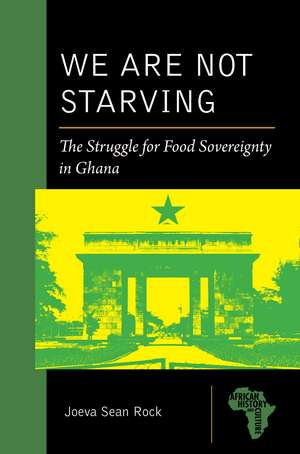
We Are Not Starving: The Struggle for Food Sovereignty in Ghana: African History and Culture
Autor Joeva Sean Rocken Limba Engleză Paperback – sep 2022


Preț: 381.09 lei
Nou
Puncte Express: 572
Preț estimativ în valută:
67.44€ • 79.08$ • 59.22£
67.44€ • 79.08$ • 59.22£
Carte disponibilă
Livrare economică 22 ianuarie-05 februarie
Livrare express 08-14 ianuarie pentru 27.43 lei
Preluare comenzi: 021 569.72.76
Specificații
ISBN-13: 9781611864328
ISBN-10: 1611864321
Pagini: 234
Ilustrații: 1
Dimensiuni: 152 x 229 x 30 mm
Greutate: 0.29 kg
Ediția:First Edition
Editura: Michigan State University Press
Colecția Michigan State University Press
Seria African History and Culture
ISBN-10: 1611864321
Pagini: 234
Ilustrații: 1
Dimensiuni: 152 x 229 x 30 mm
Greutate: 0.29 kg
Ediția:First Edition
Editura: Michigan State University Press
Colecția Michigan State University Press
Seria African History and Culture
Notă biografică
JOEVA SEAN ROCK is an assistant professor in anthropology at Stony Brook University. She is the 2024 recipient of the Margaret Mead Award, jointly awarded by the American Anthropological Association and Society for Applied Anthropology. She is the 2019 winner of the Boahen-Wilks Outstanding Scholarly Article Prize from the Ghana Studies Association.
Cuprins
Contents
List of Abbreviations
Acknowledgments
Introduction
Chapter 1. Agricultural Development and So-Called NGOs
Chapter 2. From Peasantry to Prosperity
Chapter 3. Our Stomachs Are Being Colonized
Chapter 4. The Patents Are Out There
Chapter 5. (Im)Possibilities
Epilogue
Notes
Bibliography
Index
Recenzii
“In this well researched, yet very approachable text, Joeva Sean Rock sheds light on the controversies surrounding the introduction of GMO crops in Ghana and the vital role that civil society and the food sovereignty movement are playing in raising critical questions about this corporate and donordriven agenda.”
—WILLIAM G. MOSELEY, steering committee member of the High Level Panel of Experts on Food Security and Nutrition
—WILLIAM G. MOSELEY, steering committee member of the High Level Panel of Experts on Food Security and Nutrition
Descriere
This critical text is a timely ethnography of how global powers, local resistance, and capital flows are shaping contemporary African foodways. Ghana was one of the first countries targeted by a group of US donors and agribusiness corporations that funded an ambitious plan to develop genetically modified (GM) crops for African farmers. Today, in spite of impressive efforts and investments by proponents, only two GM crops remain in the pipeline. Why, after years of preparation, millions of dollars of funding, and multiple policy reforms, did these megaprojects effectively come to a halt? One of the first ethnographies to take on the question of GM crops in the African context, We Are Not Starving blends archival analysis, interviews, and participant observation with Ghanaian scientists, farmers, activists, and officials. Ultimately the text aims to illuminate why GM crops have animated the country and to highlight how their introduction has opened an opportunity to air grievances about the systematic de-valuing and exploitation of African land, labor, and knowledge that have been centuries in the making.