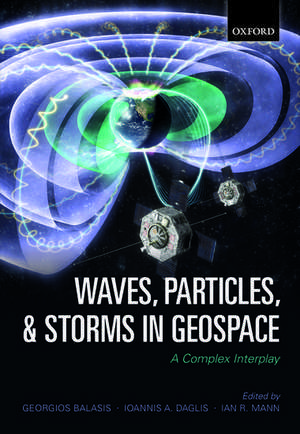
Waves, Particles, and Storms in Geospace: A Complex Interplay
Editat de Georgios Balasis, Ioannis A. Daglis, Ian R. Mannen Limba Engleză Hardback – 24 noi 2016
Preț: 711.75 lei
Preț vechi: 1007.90 lei
-29%
Puncte Express: 1068
Carte tipărită la comandă
Livrare economică 10-15 decembrie
Livrare prin curier în România Termenul estimat este afișat lângă disponibilitate.
Transport gratuit pentru acest produs Plată online sau ramburs, în funcție de opțiunile comenzii.
Retur gratuit în 14 zile Comandă securizată și suport în română.
Specificații
ISBN-13: 9780198705246
ISBN-10: 0198705247
Pagini: 468
Ilustrații: 157
Dimensiuni: 176 x 248 x 30 mm
Greutate: 1.07 kg
Editura: OUP OXFORD
Colecția OUP Oxford
Locul publicării:Oxford, United Kingdom
ISBN-10: 0198705247
Pagini: 468
Ilustrații: 157
Dimensiuni: 176 x 248 x 30 mm
Greutate: 1.07 kg
Editura: OUP OXFORD
Colecția OUP Oxford
Locul publicării:Oxford, United Kingdom
V-ar putea interesa
-
 Waves and StonesGraham HarmanPreț: 230.87 lei
 -
 The Next Decade of Discovery in Solar and Space PhysicsCommittee on a Decadal Survey for Solar and Space Physics 2024-2033-14%Preț: 592.76 lei689.25 lei
 -
 SatellitesKate PeridotPreț: 127.21 lei
 -
 Remote Sensing and Image InterpretationThomas Lillesand-18%Preț: 1378.98 lei1681.68 lei
 -
 The Space of the WorldNick CouldryPreț: 157.50 lei
 -
 -32%Preț: 90.70 lei134.00 leiRecomandat
 -
 SnoSverker SörlinPreț: 124.75 lei
 -
 -26%Preț: 1723.91 lei2344.01 lei
 -
 Handbook on Solar Wind: Effects, Dynamics & InteractionsHans E Johannson-26%Preț: 1473.94 lei2003.91 lei
 -
 When It's StormyNoah LeatherlandPreț: 49.41 lei
 -
 Facing InfinityJonas EnanderPreț: 108.84 lei
 -
 Weather ScienceBrian CleggPreț: 77.11 lei
 -
 Cut-out Curiosities Space, Science & Technology: A Collage BookMaximillian Malone-18%Preț: 126.31 lei153.75 lei
 -
 Problems of Geocosmos-2022Andrei Kosterov-18%Preț: 1449.35 lei1767.50 lei
 -
 Charged Particle Beam PhysicsSarvesh Kumar-23%Preț: 625.24 lei812.00 lei
 -
 The Dynamic MagnetosphereWilliam Liu-15%Preț: 687.69 lei809.05 lei
 -
 Solar-Terrestrial Environmental PredictionKanya Kusano-15%Preț: 721.86 lei849.24 lei
Recenzii
Virtually all discussions in this advanced reference book are academic but subjects of practical concern and interest such as the consequences of space weather, solar wind, geomagnetic storms and substorms... are incorporated in many of the chapters.
This book is essentially for those who wish to conduct serious research on the Van Allen belts and related phenomena and do not know where to start... Recommended.
This book is essentially for those who wish to conduct serious research on the Van Allen belts and related phenomena and do not know where to start... Recommended.
Notă biografică
Georgios Balasis is a senior researcher of the Institute for Astronomy, Astrophysics, Space Applications and Remote Sensing (IAASARS) at the National Observatory of Athens (NOA), Greece. He received a BSc in Physics from the of University of Athens (Greece), followed by an MSc in Geophysics from the University of Edinburgh (UK), an MSc in Condensed Matter Physics and a PhD in Applied Electromagnetism both from the University of Athens. From 2002 to 2006 he was the specialist for global electromagnetic induction in the CHAMP satellite team at GeoForschungsZentrum Potsdam (Germany). Dr. Balasis continues to be involved in magnetic satellite missions, in particular as member of the Validation Team of the Swarm satellite mission of the European Space Agency (ESA) and principal investigator of the Swarm Mission Science Exploration. His primary interest lies in Space Physics, with a focus on the dynamics of the magnetosphere and space weather forecasting.Ioannis A. Daglis is a professor in the Department of Physics at the National and Kapodistrian University of Athens, Greece. Before his appointment at the University of Athens, he was the Director of the Institute for Space Applications and Remote Sensing for six years (2006-2012) and the Director of the Institute for Astronomy, Astrophysics, Space Applications and Remote Sensing for one year (2012-2013). His scientific expertise pertains to solar system astrophysics and space applications. Prof. Daglis graduated from the Physics Department of the Aristotle University of Thessaloniki. He worked on his PhD in Space Plasma Electrodynamics at the Max Planck Institute for Solar System Research (Germany) and the Johns Hopkins University Applied Physics Laboratory (USA) under the supervision of the late Prof. Sir W. Ian Axford.Ian R. Mann is a professor in the Department of Physics at the University of Alberta, Canada, and was a Canada Research Chair in Space Physics from 2003-13. His research specialises in the study of the impacts of the sun on near-Earth space, including being an expert in the study of ultra-low frequency plasma waves and their impacts on energetic particle dynamics, including on the radiation belts, ring current, as well as and energy transport in the coupled geospace system and in relation to the generation of the aurora. He obtained his PhD in Applied Mathematics from the University of St. Andrews U.K., following receipt of a degree in Physics with Astrophysics from the University of Birmingham, U.K. He worked as a post-doctoral researcher at the University of London, U.K., and the University of Alberta, Canada, and was awarded a UK NSERC Post-Doctoral Fellowship. He worked as a Lecturer at the University of York, U.K. from before joining the faculty at the University of Alberta, Canada.