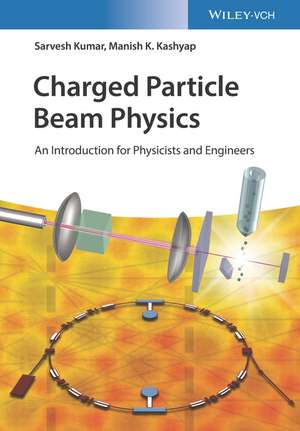
Charged Particle Beam Physics
Autor Sarvesh Kumar, Manish K. Kashyapen Limba Engleză Hardback – 24 sep 2025
În cadrul programelor de studii avansate în fizică și inginerie, studiul acceleratoarelor de particule necesită o înțelegere riguroasă a dinamicii fasciculelor. Charged Particle Beam Physics se încadrează în curriculumul de nivel masteral și doctoral, oferind o introducere practică în fundamentele teoretice și implementarea tehnică a componentelor optice. Găsim în această lucrare o abordare structurată care facilitează tranziția de la conceptele de bază ale electrodinamicii la modelarea complexă a sistemelor de transport al fasciculelor. Descoperim aici o analiză detaliată a câmpurilor electrostatice, magnetostatice și de radiofrecvență, autorii Sarvesh Kumar și Manish K. Kashyap punând un accent deosebit pe designul surselor de ioni și pe sistemele de diagnostic. Cartea extinde cadrul propus de Particle Accelerator Physics de Helmut Wiedemann prin integrarea directă a metodelor de calcul moderne, precum metoda matricei de transfer, și prin utilizarea unor instrumente de simulare numerică open-source, cum sunt TRANSPORT și TRACE3d. Față de abordările pur teoretice, volumul de față prioritizează aplicabilitatea în domenii conexe, de la biologia radiațiilor la fizica plasmei. Textul este calibrat pentru a servi atât ca suport de curs, cât și ca manual de referință pentru profesioniștii din laboratoarele de cercetare. Cele 200 de ilustrații și problemele rezolvate de la finalul capitolelor transformă conceptele abstracte în modele vizuale și matematice aplicabile. Publicată de Wiley-VCH GmbH, ediția în limba engleză reușește să sintetizeze decenii de evoluție în tehnologia acceleratoarelor într-un format accesibil și actualizat.
Preț: 625.24 lei
Preț vechi: 812.00 lei
-23%
Carte disponibilă
Livrare economică 07-13 noiembrie
Livrare express 28 octombrie-03 noiembrie pentru 64.71 lei
Specificații
ISBN-10: 3527414045
Pagini: 420
Ilustrații: 200 schwarz-weiße Abbildungen
Dimensiuni: 175 x 247 x 19 mm
Greutate: 0.7 kg
Ediția:1
Editura: Wiley-VCH GmbH
Locul publicării:Weinheim, Germany
V-ar putea interesa
-
 Seven Brief Lessons on Physics. Anniversary EditionCarlo RovelliPreț: 92.41 lei
 -
 Mathematical PhysicsDonald H. MenzelPreț: 110.74 lei
 -
 Physics I For DummiesSteven HolznerPreț: 167.32 lei
 -
 Fundamentals of Electron Emission PhysicsKevin L. University of Maryland) Jensen-23%Preț: 685.51 lei890.28 lei
 -
 Thermodynamics For DummiesMichael PaukenPreț: 166.32 lei
 -
 The Physics Book: From the Big Bang to Quantum ResurrectionClifford Pickover A-30%Preț: 149.98 lei215.25 lei
 -
 Introducing Particle PhysicsTom WhyntiePreț: 63.96 lei
 -
 Navigating: Quantum PhysicsGemma LavenderPreț: 94.44 lei
 -
 BeamsVolker ZiemannPreț: 125.85 lei
 -
 Understanding the Physics of Particle AcceleratorsFrançois MéotPreț: 459.03 lei
 -
 A Concise Introduction to Polymer PhysicsReinhard Hentschke-11%Preț: 428.27 lei481.21 lei
 -
 Space Charge Physics for Particle AcceleratorsIngo Hofmann-15%Preț: 604.94 lei711.69 lei
 -
 Introduction to Elementary ParticlesDavid Griffiths-11%Preț: 490.46 lei551.08 lei
 -
 Nuclear Reactor Physics 3eWM Stacey-14%Preț: 1117.20 lei1299.08 lei
 -
 Field Simulation for Accelerator MagnetsStephan Russenschuck-23%Preț: 2277.91 lei2958.32 lei
 -
 -11%Preț: 545.78 lei613.23 lei
 -
 Introductory Nuclear PhysicsSamuel S. M. Wong-9%Preț: 1008.50 lei1108.25 lei
 -
 -23%Preț: 596.33 lei776.93 lei
De ce să citești această carte
Această carte este esențială pentru studenții și inginerii care doresc să stăpânească designul componentelor de optică a fasciculelor. Cititorul câștigă acces la metode de simulare numerică open-source și la soluții practice pentru probleme reale de inginerie a acceleratoarelor. Este recomandată celor care au nevoie de o punte între teoria fizicii particulelor și implementarea tehnică a sistemelor de transport al fasciculelor în cercetarea modernă.
Descriere
Notă biografică
Dr. Sarvesh Kumar is an experimental plasma and accelerator physicist with nearly two decades of experience at the IUAC, New Delhi, India. He contributed to significant national and international projects such as the Large Hadron Collider project. He is presently working as Associate Professor in the Department of Physics & Astrophysics, University of Delhi, India. His main area of interests are plasma wakefield acceleration, plasma instabilities, particle accelerator designs, beam optics and beam-plasma interaction.
Dr. Manish K. Kashyap is a Professor at the School of Physical Sciences, Jawaharlal Nehru University (JNU), India. His areas of interest are condensed matter physics, plasma physics and accelerator physics. His work integrates theoretical modeling with experimental perspectives to enhance beam quality and stability in ion accelerators. He has published around 110 research papers in international journals and conference proceedings.
Cuprins
Foreword x
Preface xi
About the Authors xiv
Acknowledgments xvi
Acronyms xvii
About the Companion Website xix
1 Introduction to Charged Particle Beams 1
1.1 History of Particle Accelerators and the Chronological Milestones 6
1.2 Maxwell's Equations 9
1.3 Electrostatic Accelerators 11
1.4 Cyclotrons 18
1.5 Synchrotrons 21
1.6 Synchrocyclotron 23
1.7 Betatron 25
1.8 Particle Colliders 26
1.9 FFAG Accelerators 28
1.10 Wakefield Accelerators 30
1.11 Radiation Physics 36
1.12 Beam Conceptual Visualization 39
1.13 Numerical Problems 40
2 Ion Sources 43
2.1 ECR Ion Sources 44
2.2 SNICS Ion Source 52
2.3 Duoplasmatron 54
2.4 Electron Beam Ion Source 55
2.5 Penning Ion Sources 57
2.6 Laser Ion Sources 59
2.7 Vacuum Arc Ion Source 61
2.8 Numerical Problems 61
3 Beam Optics 63
3.1 Phase Space and Liouville's Theorem 64
3.2 Emittance and Acceptance 66
3.3 Brightness 68
3.4 Luminosity 69
3.5 Matrix Formalism 71
3.6 Equation of Motion in a Co-moving Coordinate System 76
3.7 Hill's Equation and Twiss Parameters Formalism 79
3.8 Horizontal and Vertical Root M ean S quare Beam Sizes in Accelerators 84
3.9 Betatron Phase Advance and Tune 86
3.10 Chromaticity 89
3.11 RMS Emittance 91
3.12 Space Charge Effects on Ion Beam 93
3.13 Numerical Problems 96
4 Motion in Magnetostatic Devices 99
4.1 Magnetostatic Devices 99
4.2 Ampere's Law for Magnet Design 101
4.3 Equation of Motion in a Co-moving Coordinate System 101
4.4 Drift 104
4.5 Dipole Magnets 106
4.6 Design of Dipole Magnets 110
4.7 Quadrupole Magnets 116
4.8 Beam Rotation Matrix 120
4.9 Solenoid Magnets 120
4.9 .2 Design of Solenoid Magnets 126
4.10 Sextupole Magnets 128
4.11 Magnetostatic Steerer/Deflector 130
4.12 Wien Filter 132
4.13 Achromatic Magnets 134
4.14 Septum and Kicker Magnets 136
4.15 Glaser Lens 137
4.16 Undulators 141
4.17 Wigglers 145
4.18 Numerical Problems 148
5 Electrostatic Devices 151
5.1 Motion of a Charged Particle in an Electric Field 151
5.2 Electrostatic Dipole 152
5.3 Electrostatic Quadrupole 155
5.4 Electrostatic Thin Lens and Einzel Lens 158
5.5 Electrostatic Steerer/Deflector 165
5.6 Electrostatic Accelerating Tube 165
5.7 Electrostatic Septum 169
5.8 Numerical Problems 170
6 Radio Frequency Devices 171
6.1 Longitudinal Beam Dynamics 172
6.2 Pillbox Cavity 175
6.3 Traveling Wave Structures 175
6.4 Standing Wave Structures 176
6.5 Phase Stability in LINACs 181
6.6 Radial Impulse and Deflection in an RF Gap 186
6.7 RF Chopper 188
6.8 RF Buncher 189
6.9 RF Acceleration 190
6.10 Quarter-wave and Half-wave Resonators 193
6.11 Radio Frequency Quadrupole 195
6.12 Drift Tube LINACS 197
6.13 Numerical Problems 199
7 Beam Diagnostics 201
7.1 Faraday Cups 203
7.2 Beam Profile Monitor 204
7.3 Beam Position Monitors 204
7.4 Beam Current Transformers 207
7.5 Capacitive Pick-up Probes 208
7.6 Fast Faraday Cups 209
7.7 Phase Detector Cavity 212
7.8 Transverse Beam Emittance by Quadrupole Magnet Scan 214
7.9 Longitudinal Beam Emittance by Buncher Scan 215
7.10 Energy Spread Measurements 217
7.11 Ion Bunch Width Using Detectors 217
7.12 Numerical Problems 219
8 Vacuum Devices 221
8.1 Basics of Vacuum Technology 222
8.2 Vacuum Accessories and Subcomponents 231
8.3 Vacuum Pumps 234
8.4 Vacuum Gauges 238
8.5 Helium Leak Detector: Mathematical Principles 241
8.6 Numerical Problems 243
Appendix A: Field-induced Breakdown in Accelerator Technologies 245
Appendix B: Panofsky--Wenzel Theorem in Accelerator Physics 249
Appendix C: Child--Langmuir Law and Richardson's Law 253
Appendix D: Larmor's Formula and Its Importance in Accelerator Physics 255
Appendix E: Stefan--Boltzmann Law and Its Applications in Particle Accelerators 257
Bibliography 259
Index 263