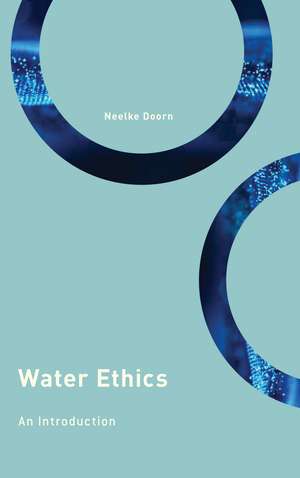
Water Ethics: An Introduction: Philosophy, Technology and Society
Autor Neelke Doornen Limba Engleză Hardback – 25 oct 2019
These and other questions to be linked to ongoing discussion in other disciplines within philosophy, such as environmental ethics, climate ethics, the ethics of technology and climate justice, making this text important across a wide range of courses for upper undergraduate and graduate students.






Preț: 730.58 lei
Preț vechi: 1096.36 lei
-33%
Puncte Express: 1096
Carte tipărită la comandă
Livrare economică 30 noiembrie-14 decembrie
Livrare prin curier în România Termenul estimat este afișat lângă disponibilitate.
Transport gratuit pentru acest produs Plată online sau ramburs, în funcție de opțiunile comenzii.
Retur gratuit în 14 zile Comandă securizată și suport în română.
Specificații
ISBN-13: 9781786609502
ISBN-10: 1786609509
Pagini: 272
Ilustrații: 1 b/w illustration; 13 tables; 22 textboxes
Dimensiuni: 159 x 233 x 24 mm
Greutate: 0.63 kg
Editura: Bloomsbury Publishing
Colecția Rowman & Littlefield
Seria Philosophy, Technology and Society
Locul publicării:New York, United States
ISBN-10: 1786609509
Pagini: 272
Ilustrații: 1 b/w illustration; 13 tables; 22 textboxes
Dimensiuni: 159 x 233 x 24 mm
Greutate: 0.63 kg
Editura: Bloomsbury Publishing
Colecția Rowman & Littlefield
Seria Philosophy, Technology and Society
Locul publicării:New York, United States
Cuprins
List of Text boxes / List of Tables / Acknowledgments / 1. The nature of the world's water challenges / 2. Water and its different uses / 3. Water and justice / 4. Water and economic valuation / 5. Water and rights / 6. Water and responsibilities / 7. Water and engineering / 8. Inserting ethics into water governance / Glossary / References / Index
Recenzii
Often books fall distinctly into one category or another: general readership or scholarly research. This needed introductory book, however, is successful at satisfying at least three categories: general readership, self-directed course textbook, and scholarly research/reference publication. It embodies the well-known structural features of a textbook: chapter summaries indicating what the reader should learn, summary conclusions or takeaways for each chapter, boxed text outlining issues of particular importance, a glossary of terms, and extensive notes and references for further reading. The last two satisfy requirements of a research text for scholars. Doorn (Delft Univ. of Technology) employs a writing style that minimizes technical language, rendering the text accessible to general readers and introductory students. The author's extensive background in civil engineering, philosophy, and law shows clearly as she argues diverse controversial ideas related to water uses. Among these are distributive/procedural justice, economic issues, human rights, and communitarian and intergenerational responsibility. While introducing ethical issues of water engineering design and implementation, Doorn maintains a genuine openness, empowering readers' informed disagreement. The concluding chapter identifies strategic decision-making challenges related to water management/governance from bottom-up and top-down governance approaches, well integrated with critical considerations brought forward from earlier chapters. Summing Up: Highly recommended. All readers.
This book addresses the challenges for governing water posed by increasing scarcity, the risks of flooding due to climate change, and by water pollution. Within this context the author explores how to value and distribute a resource that has multiple and competing uses and does not respect our borders. She then skilfully addresses the complex issues of justice that arise.
In this highly accessible book, Neelke Doorn introduces the complexity and role of ethics in water governance. It's a great resource both for students and professionals.
In this lucid book, Neelke Doorn explains why and how questions of justice need to become more explicit in water governance. In a clear way, the book identifies possible ways to articulate and discuss the ethical considerations that shape where and to whom water flows. I recommend it to anyone interested in a comprehensive, interdisciplinary introduction to contemporary water problems.
Water governance is replete with ethical challenges, whether in the way that humans address increasing demands upon scarce freshwater resources, pollution threats, or hazards from flooding, all of which are intensifying with anthropogenic environmental change. Doorn's book is timely and accessible, offering the first comprehensive ethical treatment of this essential and unique resource.
This book addresses the challenges for governing water posed by increasing scarcity, the risks of flooding due to climate change, and by water pollution. Within this context the author explores how to value and distribute a resource that has multiple and competing uses and does not respect our borders. She then skilfully addresses the complex issues of justice that arise.
In this highly accessible book, Neelke Doorn introduces the complexity and role of ethics in water governance. It's a great resource both for students and professionals.
In this lucid book, Neelke Doorn explains why and how questions of justice need to become more explicit in water governance. In a clear way, the book identifies possible ways to articulate and discuss the ethical considerations that shape where and to whom water flows. I recommend it to anyone interested in a comprehensive, interdisciplinary introduction to contemporary water problems.
Water governance is replete with ethical challenges, whether in the way that humans address increasing demands upon scarce freshwater resources, pollution threats, or hazards from flooding, all of which are intensifying with anthropogenic environmental change. Doorn's book is timely and accessible, offering the first comprehensive ethical treatment of this essential and unique resource.