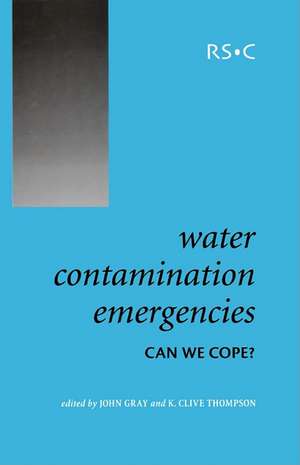
Water Contamination Emergencies
Editat de John Gray, K Clive Thompsonen Limba Engleză Hardback – 22 apr 2004
Preț: 804.31 lei
Preț vechi: 935.24 lei
-14%
Puncte Express: 1206
Carte tipărită la comandă
Livrare economică 03-17 decembrie
Livrare prin curier în România Termenul estimat este afișat lângă disponibilitate.
Transport gratuit pentru acest produs Plată online sau ramburs, în funcție de opțiunile comenzii.
Retur gratuit în 14 zile Comandă securizată și suport în română.
Specificații
ISBN-13: 9780854046287
ISBN-10: 0854046283
Pagini: 184
Ilustrații: Illustrations, maps
Dimensiuni: 166 x 241 x 17 mm
Greutate: 0.43 kg
Editura: RSC Publishing
ISBN-10: 0854046283
Pagini: 184
Ilustrații: Illustrations, maps
Dimensiuni: 166 x 241 x 17 mm
Greutate: 0.43 kg
Editura: RSC Publishing
V-ar putea interesa
-
 Managing Water ResourcesUnknown-40%Preț: 372.04 lei620.28 lei
 -
 Hayek on LibertyJohn Gray-15%Preț: 426.07 lei501.26 lei
 -
 A Companion to Media AuthorshipJonathan GrayPreț: 442.63 lei
 -
 -18%Preț: 1110.98 lei1354.84 lei
 -
 Ciliary MovementJ. GrayPreț: 345.42 lei
 -
 Preț: 387.46 lei
 -
 -15%Preț: 506.38 lei595.74 lei
 -
 Water Science and Technology: An IntroductionNicholas Gray-15%Preț: 714.02 lei840.03 lei
 -
 -18%Preț: 916.02 lei1117.09 lei
 -
 Water Conservation: Practices, Challenges & Future ImplicationsMonzur A Imteaz-27%Preț: 1218.70 lei1660.32 lei
 -
 -27%Preț: 999.12 lei1362.16 lei
 -
 Groundwater: Hydrogeochemistry, Environmental Impacts & Management PracticesSegun Michael Adelana-27%Preț: 1328.96 lei1811.91 lei
 -
 -27%Preț: 1023.42 lei1395.71 lei
 -
 -27%Preț: 1023.60 lei1395.83 lei
 -
 Indian Irrigation Projects: Maintenance & Sustainability IssuesChristopher Flores-27%Preț: 1023.31 lei1395.63 lei
 -
 -18%Preț: 905.87 lei1104.72 lei
Cuprins
The city of Milwaukee cryptosporidium outbreak: What really happened and how vulnerable are we?; The WEM incident; The Hungerford Fish Mortality; The Foot and Mouth disease outbreak 2001; Burnscrooks diesel incident; Problems, perceptions and perfection - The role of the drinking water inspectorate in water quality incidents and emergencies; Dealing with company, public and media perception; Water related chemical incidents and their toxicological management; Water and public health; Environment agency analysis overview on contamination monitoring; Contamination monitoring: Screening VS targeted analysis; Field laboratory analysis for detection of unknown deliberately released contaminants; Microbiological analysis: How soon can we have the results?; Rapid toxkit microbiotests for water contamination emergencies; Overview of handling emergencies: Some cautionary tales; Radiological issues; Communications; Testing the system - Exercise is good for you!!; Can we cope?; Summary of workshop outputs; Subject Index.
Descriere
A welcome review of lessons learnt in the past and an identification of ways in which to improve response in the future.
Notă biografică
John Gray spent 22 years working in UK Water Companies on all aspects of water treatment, supply and analysis. This was followed by 13 years as a regulator before retirement in 2007 from his position as Deputy Chief Inspector (Operations) with the Drinking Water Inspectorate. He has been involved in improving the safety and security of drinking water supplies and has established links with other Government Departments, academia and research organizations involved in "homeland defence" issues both in the UK and internationally. He was closely involved in the development of the specialized analytical capability for the water industry. Actively involved with the Royal Society of Chemistry, John Gray was for six years a member of the Applications Committee followed by seven years with the Ethical Practices Committee. He chaired of the organizing committee of the three Water Contamination Emergencies conferences. Professor Thompson has 37 years experience in the management of environmental laboratories including those at Severn Trent and Yorkshire Water. He is currently Chief Scientist of ALcontrol UK, one of the largest contract water, soil, air and food analysis organizations in Europe. Since its inception in 1995, he has chaired the UK Water Laboratory Mutual Aid Group and been closely involved with the three associated sub-groups on emergency organic and radioactivity analysis and the LEAP emergency incident proficiency scheme. He was Secretary of the organizing committee of the three Water Contamination Emergencies conferences.
Textul de pe ultima copertă
In the current international situation, the ability to deal effectively with water contamination emergencies is of rapidly increasing importance. The third in a series of conference proceedings, this book brings together contributions from leading scientists and experts in industry and academia. It offers an international perspective and develops the themes of the previous volumes entitled Water Contamination Emergencies: Can we cope? and Water Contamination Emergencies: Enhancing our response. The full range of potential chemical, microbiological and radiological contamination scenarios are addressed from the perspective of medical and health professionals, water companies and regulators, environmental protection professionals, risk and business continuity managers, emergency planners, local authorities, service and support providers, detection and equipment suppliers, disaster recovery specialists, water security experts, water distribution modellers and laboratories involved in round the clock emergency response. Emphasis is placed on the considerable effort required to prepare for and respond to an emergency. It is not sufficient for Individuals to simply identify their own responsibilities, they must also take action to establish effective and efficient working relationships with the other parties involved. In other words, they must take "Collective Responsibility." In summary, this book will provide readers with an up-to-date view of current strategies and the collaboration essential for an appropriate and timely response to water contamination emergencies.