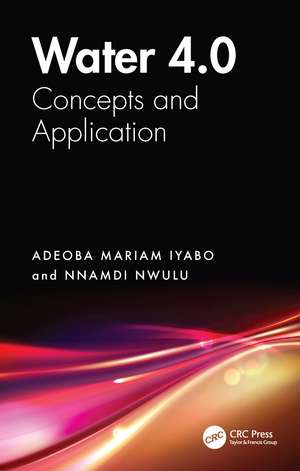
Water 4.0: Concepts and Application
Autor Adeoba Mariam Iyabo, Nnamdi Nwuluen Limba Engleză Hardback – oct 2026
Features:
- Examines the application of the Fourth Industrial Revolution to water systems operation.
- Applies the concept of intelligent computing through the exploration of Big Data and modelling to water supply network management.
- Discusses the application of automation in Water Supply Network Management with practical examples.
- Explores the use of automatic and electronic devices to monitor and control water loss.
- Reviews the historical development of technology from the First to the Fourth Industrial Revolution.
Preț: 819.20 lei
Preț vechi: 999.03 lei
-18% Nou
Puncte Express: 1229
Carte tipărită la comandă
Livrare economică 01-15 decembrie
Livrare prin curier în România Termenul estimat este afișat lângă disponibilitate.
Transport gratuit pentru acest produs Plată online sau ramburs, în funcție de opțiunile comenzii.
Retur gratuit în 14 zile Comandă securizată și suport în română.
Specificații
ISBN-13: 9781041031567
ISBN-10: 1041031564
Pagini: 236
Ilustrații: 50
Dimensiuni: 156 x 234 mm
Greutate: 0.51 kg
Ediția:1
Editura: CRC Press
Colecția CRC Press
ISBN-10: 1041031564
Pagini: 236
Ilustrații: 50
Dimensiuni: 156 x 234 mm
Greutate: 0.51 kg
Ediția:1
Editura: CRC Press
Colecția CRC Press
V-ar putea interesa
-
 The Oxford Encyclopedia of Water Resources Management and PolicyDale Whittington-32%Preț: 3823.89 lei5627.11 lei
 -
 Preț: 109.36 lei
 -
 -20%Preț: 1437.53 lei1796.91 lei
 -
 Systematic Security: A CISO’s PlaybookTimur Qader-20%Preț: 367.98 lei459.97 leiRecomandat
 -
 The Big ThirstCharles FishmanPreț: 116.59 lei
 -
 Cybernetic Circulation ComplexNick Dyer-WithefordPreț: 129.05 lei
 -
 New Technologies, Development and Application IVIsak Karabegović-20%Preț: 1872.46 lei2340.57 lei
 -
 Cyber-Physical SystemsAlla G. Kravets-18%Preț: 1153.16 lei1406.29 lei
 -
 -18%Preț: 1448.15 lei1766.03 lei
 -
 -18%Preț: 996.30 lei1215.01 lei
 -
 Digital TransformationBirgit Vogel-Heuser-20%Preț: 419.84 lei524.80 lei
 -
 Julia WatsonJulia WatsonPreț: 341.59 lei
 -
 Intelligent Water Monitoring IoT SystemAna Cristina Faria RibeiroPreț: 426.48 lei
 -
 Recent Trends and Best Practices in Industry 4.0Abhinav Sharma-20%Preț: 773.71 lei967.14 lei
 -
 Data-Driven Cyber Physical SystemsFangyu Li-18%Preț: 1044.71 lei1274.04 lei
 -
 Water InformaticsSupreeti Kamilya-18%Preț: 1153.38 lei1406.56 lei
 -
 -20%Preț: 1648.37 lei2060.47 lei
 -
 Industry 4.0 and Advanced Manufacturing, Volume 2Amaresh Chakrabarti-18%Preț: 1444.32 lei1761.37 lei
 -
 Industry 4.0 and Advanced Manufacturing, Volume 1Amaresh Chakrabarti-18%Preț: 1446.03 lei1763.45 lei
 -
 Digital TransformationAvadhesh Kumar-20%Preț: 1095.19 lei1368.99 lei
Public țintă
Academic and PostgraduateNotă biografică
Adeoba Mariam Iyabo is an accomplished researcher and academic, holding a Ph.D. in Zoology from the University of Johannesburg and an M.Sc. and a B.Sc. (Honours) from the University of Agriculture, Abeokuta, Nigeria. She is currently a senior research associate at the University of Johannesburg’s Centre for Cyber‑Physical Food, Energy and Water Systems. In addition, she serves as a lecturer in Water Resources Management at the Pan African University for Life and Earth Science Institute, University of Ibadan, Nigeria, as well as a research fellow with the Biomechanics Research Group at the University of South Africa. Drawing on her multidisciplinary background, her research spans environmental management, freshwater biodiversity conservation, renewable energy systems, and sustainable water resources management, with a particular focus on integrating artificial intelligence into sustainability initiatives and exploring the interconnections within the Food‑Energy‑Water nexus. She contributes actively to the scientific community as an editor of the Marine and Environment journal and as a reviewer for multiple scholarly publications. She has also mentored numerous postgraduate students across different universities in Nigeria and South Africa. Beyond her academic roles, she co‑founded the Conserve Africa Initiative, a nonprofit organisation dedicated to environmental preservation and community empowerment, reflecting her commitment to public engagement and sustainable development. Her work has earned recognition through prestigious honours, including a Canadian Science Publishing Award for one of the top ten papers of 2019, as well as research grants and merit awards from the University of Johannesburg, underscoring her impact in the field.
Nnamdi Nwulu is a Professor of Electrical Engineering and the Director of the Centre for Cyber‑Physical Food, Energy and Water Systems at the University of Johannesburg. His research interests have focused on applying digital technologies, mathematical optimisation techniques, and machine learning algorithms in food, energy, and water systems. This research focus has produced five books and over 70 indexed journal publications, winning him the 2021 NRF Research Excellence Award for Early Career/Emerging Researchers in the Engineering/Technology Category. He was also a 2020/2021 TW Kambule‑NSTF‑South 32 Award finalist in the Emerging Researcher category and won the 2020 UJ Vice Chancellor’s Most Promising Young Researcher Award. He is a member of the South African Young Academy of Science. He is a professional engineer registered with the Engineering Council of South Africa), a senior member of the Institute of Electrical and Electronics Engineers, a senior member of the South African Institute of Electrical Engineers, and a Y‑rated researcher by the National Research Foundation of South Africa. He is the Editor‑in‑Chief of the Journal of Digital Food Energy and Water Systems and Associate Editor of the IET Renewable Power Generation and the African Journal of Science, Technology, Innovation and Development.
Nnamdi Nwulu is a Professor of Electrical Engineering and the Director of the Centre for Cyber‑Physical Food, Energy and Water Systems at the University of Johannesburg. His research interests have focused on applying digital technologies, mathematical optimisation techniques, and machine learning algorithms in food, energy, and water systems. This research focus has produced five books and over 70 indexed journal publications, winning him the 2021 NRF Research Excellence Award for Early Career/Emerging Researchers in the Engineering/Technology Category. He was also a 2020/2021 TW Kambule‑NSTF‑South 32 Award finalist in the Emerging Researcher category and won the 2020 UJ Vice Chancellor’s Most Promising Young Researcher Award. He is a member of the South African Young Academy of Science. He is a professional engineer registered with the Engineering Council of South Africa), a senior member of the Institute of Electrical and Electronics Engineers, a senior member of the South African Institute of Electrical Engineers, and a Y‑rated researcher by the National Research Foundation of South Africa. He is the Editor‑in‑Chief of the Journal of Digital Food Energy and Water Systems and Associate Editor of the IET Renewable Power Generation and the African Journal of Science, Technology, Innovation and Development.
Cuprins
Chapter 1 Introduction to the Water Supply System; 1.1 Introduction; 1.2 Water Resource, Climate Change, and Water Scarcity; 1.3 Water Supply System Operation; 1.4 Key Problems in Water Supply System Management; 1.5 Water Supply Network Management Application Domain; 1.6 The Need for Industry 4.0 in the Water Supply Network Management; 1.7 Chapter Summary and Conclusion; Chapter 2 Introduction to Industry 4.0; 2.1 Introduction; 2.2 History and Evolution of the Industrial Revolutions; 2.3 Industry 4.0 Features; 2.4 Functions and Benefits of Industry 4.0; 2.5 Applications of Industry 4.0 in Engineering; 2.6 Blending Industry 4.0 in the Water System Operations (Water 4.0); 2.7 Chapter Summary and Conclusion; Chapter 3 Water 4.0: Perspective and Concepts; 3.1 Introduction; 3.2 Water 4.0: Perspective and Concepts; 3.3 Key Features of Water 4.0; 3.4 Chapter Summary and Conclusion; Chapter 4 IoT in the Water Supply Network Management; 4.1 Introduction; 4.2 IoT Component and Architecture; 4.3 Applications of IoT to Water Supply Network Management; 4.4 Challenges and Progress; 4.5 Chapter Summary and Conclusion; Chapter 5 CPS in the Water Supply Network Management; 5.1 Introduction; 5.2 CPS Components and Architecture; 5.3 Functional Attributes of the CPS; 5.3.1 Control; 5.3.2 Communication; 5.3.3 Computation; 5.4 Application of CPS to Water Supply Network Management; 5.5 Challenges and Progress; 5.6 Chapter Summary and Conclusion; Chapter 6 Intelligent Computing in Water Supply Network Management; 6.1 Introduction; 6.2 Computational methods; 6.3 Water Supply Network Data Management; 6.5 Chapter Summary and Conclusion; Chapter 7 Automation in the Water Supply Network Management; 7.1 Introduction; 7.2 Real‑Time Control; 7.3 Advanced Control System Technologies; 7.4 Sensor Integration; 7.4.1 Benefits of Sensor Integration; 7.4.2 Sensor Fusion Techniques; 7.5 Applications of Advanced Control Systems Technology to Water Systems; 7.6 Application of Intelligent Computing and Automation to Hydroelectricity; 7.7 Sensor Integration Application in Water Systems; 7.8 Application of Automation to Water Corporations; 7.9 Challenges and Progress; 7.10 Summary and Conclusion; Chapter 8 Wastewater Treatment in Water 4.0; 8.1 Introduction to Smart Wastewater Management; 8.2 Wastewater Treatment Processes and Their Evolution; 8.3 Integration of Smart Technology in Wastewater Management: IoT, Sensors, and Real‑Time Monitoring; 8.4 Technologies and Innovations in Wastewater Treatment; 8.5 Automated and AI‑Driven Control Systems for Process Optimisation; 8.6 Innovations in Treatment Technologies: Membrane Bioreactors, Advanced Oxidation, and Nutrient Recovery; 8.7 Case Studies Showcasing Efficient Wastewater Treatment Solutions; 8.8 Water Reuse Strategies for Agriculture, Industry, and Municipal Use; 8.9 Nutrient and Energy Recovery from Wastewater; 8.10 Environmental and Regulatory Considerations for Safe Reuse Practices; 8.11 Chapter Summary and Conclusion; Chapter 9 Transition to Water 5.0; 9.1 Introduction to Water 5.0 and the Autonomous Future Water Management Systems; 9.2 Potential Impacts of Water 5.0 on Society, Environment, and Economics; 9.3 Deep Learning and Autonomous Decision‑Making Capabilities in Water Systems; 9.4 Key Enabling Technologies: Advanced AI, Robotics, and Autonomous Infrastructure; 9.5 AI‑Driven Resource Optimisation and Autonomous Leak Detection; 9.6 Case Studies on Experimental Water 5.0 Applications; 9.7 Solar, Wind, and Other Renewable Energy Sources Power Water Systems; 9.8 Energy‑Efficient Desalination and Water Treatment; 9.9 The Role of Water 5.0 in Sustainable, Climate‑Resilient; 9.10 Chapter Summary; Chapter 10 Cybersecurity and Risk Management in Water Systems; 10.1 Introduction to Cybersecurity and Risk Management in Water Systems; 10.2 Developing End‑to‑End Cybersecurity Policies for Water Utilities; 10.3 The Application of Some Critical Technologies: Encryption, Firewalls, Multi‑Factor Authentication, and Network Segmentation; 10.4 The Role of AI in Proactive Cybersecurity Monitoring and Response; 10.5 Global Cybersecurity Standards and Regulations for Water Systems; 10.6 Best Practices for Compliance and Secure Data Management; 10.7 The Importance of Multi‑Stakeholder Collaboration in Cybersecurity; 10.8 Frameworks for Rapid Response and Incident Recovery in the Event of Cyberattacks; 10.9 Cyber Resilience Strategies and Recovery Planning for Water Infrastructure; 10.10 Chapter Summary and Conclusion; Chapter 11 Water 4.0: Opportunities and Challenges; 11.1 Introduction; 11.2 Opportunities of Water 4.0; 11.3 Challenges of Water 4.0; 11.4 Progress and Future Directions; 11.5 Chapter Summary and Conclusion; Chapter 12 Concluding Remarks; 12.1 Summary of This Book; 12.2 Conclusion
Descriere
The book guides readers through the key issues within water supply systems, and how it has seen several technological advancements over the years. It examines the application of the Fourth Industrial Revolution to water systems operation with the advent of big data and computational information.