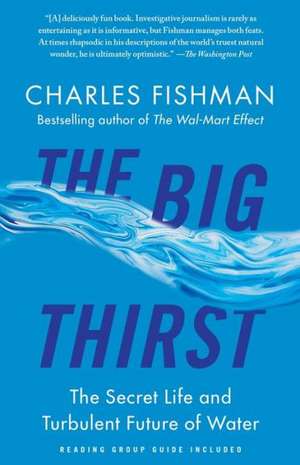
The Big Thirst
Autor Charles Fishmanen Limba Engleză Paperback – 14 feb 2012
În această ediție a lucrării The Big Thirst, Charles Fishman analizează sfârșitul unei epoci de aur în care apa a fost considerată o resursă abundentă, sigură și gratuită. Considerăm că forța acestui volum rezidă în capacitatea autorului de a demonta miturile despre epuizarea apei, explicând că problema nu este lipsa resursei în sine — care este reciclabilă la infinit — ci modul defectuos în care o gestionăm. Fishman ne poartă într-o călătorie fascinantă, de la lunile înghețate ale lui Saturn până la cazinourile din Las Vegas și fabricile IBM, demonstrând că apa poate fi purificată până la un nivel care devine toxic pentru organism, dar și că civilizațiile pot colapsa din cauza lipsei unei „conștiințe a apei”. Analiza sa completează perspectiva oferită de Last Call at the Oasis, adăugând o dimensiune optimistă axată pe inovație și management inteligent, acolo unde alte lucrări se concentrează strict pe criza iminentă. Dacă Last Call at the Oasis pune accent pe valoarea de piață a apei potabile, Fishman explorează soluțiile tehnologice care pot preveni catastrofele observate recent în California sau Australia. Reținem abordarea sa jurnalistică riguroasă, specifică unui laureat al premiului Gerald Loeb, care transformă un subiect tehnic într-o narațiune vibrantă despre supraviețuire și creativitate. Volumul se înscrie în linia preocupărilor autorului pentru sistemele complexe care ne guvernează viața, similar modului în care The Wal-Mart Effect a disecat mecanismele comerțului global, oferind aici o radiografie la fel de detaliată a infrastructurii invizibile a apei.
Preț: 116.59 lei
Carte disponibilă
Livrare economică 02-16 noiembrie
Specificații
ISBN-10: 1439102082
Pagini: 416
Dimensiuni: 141 x 220 x 35 mm
Greutate: 0.36 kg
Editura: Free Press
Locul publicării:New York, NY, United States
V-ar putea interesa
-
 -17%Preț: 36.51 lei43.99 lei
 -
 Preț: 109.36 lei
 -
 Preț: 180.40 lei
 -
 Mirage: Florida and the Vanishing Water of the Eastern U.S.Cynthia BarnettPreț: 118.26 lei
 -
 -20%Preț: 118.84 lei148.04 lei
 -
 Watery Planet: How a water crisis is impacting our worldAnna Claybourne-35%Preț: 53.71 lei83.21 lei
 -
 WaterAnna Skowronska-28%Preț: 73.89 lei102.74 lei
 -
 All the Water on EarthRochelle Strauss-19%Preț: 109.98 lei135.14 lei
 -
 The Last DropTim Smedley-34%Preț: 57.66 lei86.74 lei
 -
 Chasing IcebergsMatthew H Birkhold-24%Preț: 114.94 lei150.75 lei
 -
 My First Book about WaterDuopress-16%Preț: 50.42 lei59.68 lei
 -
 -20%Preț: 86.01 lei107.07 lei
 -
 ThirstFilippo MengaPreț: 127.57 lei
 -
 AquaChiara BarziniPreț: 121.00 lei
 -
 The Water RemedyClare GogertyPreț: 108.51 lei
 -
 The Healing Nature of WaterCharlie Ryrie-27%Preț: 52.73 lei71.75 lei
 -
 Are We Running Out of Water?Isabel ThomasPreț: 125.33 lei
 -
 WaterCatherine BarrPreț: 71.76 lei
 -
 Julia WatsonJulia WatsonPreț: 341.59 lei
 -
 Theory of WaterLeanne Betasamosake SimpsonPreț: 112.05 lei
De ce să citești această carte
Recomandăm această carte oricărui cititor interesat de ecologie și economie care dorește să înțeleagă mizele reale ale managementului resurselor naturale. Charles Fishman oferă o perspectivă lucidă asupra modului în care tehnologia și schimbarea mentalității pot transforma o criză globală într-o oportunitate de reinventare. Este o lectură esențială pentru a înțelege de ce apa de la robinet, veche de miliarde de ani, este cel mai prețios bun al secolului XXI.
Despre autor
Charles Fishman este un jurnalist american de prestigiu, triplu câștigător al premiului Gerald Loeb pentru excelență în jurnalismul de afaceri. Este autorul bestsellerelor The Wal-Mart Effect și One Giant Leap, lucrări recunoscute pentru rigoarea cercetării și stilul narativ captivant. Colaborările sale, precum cea cu Brian Grazer pentru A Curious Mind, demonstrează interesul său constant pentru curiozitate și inovație. În The Big Thirst, Fishman își folosește experiența de investigator pentru a expune complexitatea relației umane cu cea mai vitală resursă a planetei.
Recenzii
"[A] lively and invaluable assessment of the current politics, economics, and culture of water. Lyrical in his descriptions of the beauty and wonder of water, Fishman is rigorous when explaining that the water we have now is all the water we will ever have."
"A wide-ranging look at that most precious of goods, water, and a world in which it is a subject of constant crisis...A timely warning."
Notă biografică
Descriere
Bringing readers on a lively and fascinating journey--from the wet moons of Saturn to the water-obsessed hotels of Las Vegas, where dolphins swim in the desert, and from a rice farm in the parched Australian outback to a high-tech IBM plant that makes an exotic breed of pure water found nowhere in nature--Fishman vividly shows that we've already left behind a century-long golden age when water was thoughtlessly abundant, free, and safe and entered a new era of high-stakes water. In 2008, Atlanta came within ninety days of running entirely out of clean water. California is in a desperate battle to hold off a water catastrophe. And in the last five years Australia nearly ran out of water--and had to scramble to reinvent the country's entire water system. But as dramatic as the challenges are, the deeper truth Fishman reveals is that there is no good reason for us to be overtaken by a global water crisis. We have more than enough water. We just don't think about it, or use it, smartly.
"The Big Thirst "brilliantly explores our strange and complex relationship to water. We delight in watching waves roll in from the ocean; we take great comfort from sliding into a hot bath; and we will pay a thousand times the price of tap water to drink our preferred brand of the bottled version. We love water--but at the moment, we don't appreciate it or respect it. Just as we've begun to reimagine our relationship to food, a change that is driving the growth of the organic and local food movements, we must also rethink how we approach and use water. The good news is that we can. As Fishman shows, a host of advances are under way, from the simplicity of harvesting rainwater to the brilliant innovations devised by companies such as IBM, GE, and Royal Caribbean that are making impressive breakthroughs in water productivity. Knowing what to do is not the problem. Ultimately, the hardest part is changing our water consciousness.
As Charles Fishman writes, "Many civilizations have been crippled or destroyed by an inability to understand water or manage it. We have a huge advantage over the generations of people who have come before us, because we can understand water and we can use it smartly." "The Big Thirst "will forever change the way we think about water, about our essential relationship to it, and about the creativity we can bring to ensuring that we'll always have plenty of it.