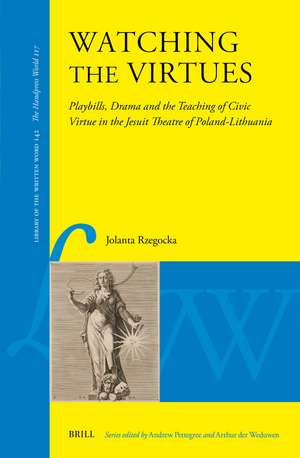
Watching the Virtues: Playbills, Drama and the Teaching of Civic Virtue in the Jesuit Theatre of Poland–Lithuania: Library of the Written Word / Library of the Written Word - The Handpress World, cartea 142
Autor Jolanta Rzegockaen Limba Engleză Hardback – 13 oct 2025
Ne-a atras atenția în Watching the Virtues modul în care Jolanta Rzegocka reconstruiește universul educațional și politic al Uniunii polono-lituaniene pornind de la un corpus impresionant de peste 800 de afișe de teatru. Departe de a fi simple anunțuri, aceste documente sunt analizate ca instrumente de condensare retorică prin care ordinul iezuit a modelat conștiința civică a tineretului catolic și nu numai, între anii 1564 și 1773. Găsim în această lucrare o demonstrație riguroasă a modului în care scena devenea un spațiu de mediere culturală, unde figurile monarhilor medievali sau ale conducătorilor antici erau transformate în modele de conduită etică pentru societatea vremii.
Structura cărții este organizată meticulos, începând cu aspectele tehnice ale producției de afișe în centre precum Vilnius sau Braniewo, și continuând cu o analiză tematică a dramei iezuite. Notăm cu interes capitolul dedicat prezenței dinastiei Jagiellonilor pe scenă și modul în care teatrul a servit drept punte pentru temele anglo-scoțiene, culminând cu prezentarea unei piese necunoscute anterior despre Thomas More. Această perspectivă asupra teatrului ca fenomen cultural de masă oferă o alternativă necesară la Neo-Latin Drama in Early Modern Europe de Jan Bloemendal pentru cursurile de istoria teatrului sau studii neo-latine, având avantajul unei focalizări specifice pe Europa Centrală și de Răsărit și pe impactul direct al materialelor tipărite asupra recepției publice.
În timp ce Foreign Intruders de Robert Aleksander Maryks explorează literatura anti-iezuită a epocii, volumul de față completează tabloul istoric arătând mecanismele interne de construcție a autorității și credinței prin spectacol. Este o resursă academică densă, care transformă efemeridele tipărite în dovezi ale unei strategii educaționale sofisticate.
Din seria Library of the Written Word / Library of the Written Word - The Handpress World
- 18%
 Preț: 1071.34 lei
 - 18%
 Preț: 719.37 lei
 - 18%
 Preț: 784.69 lei
 - 18%
 Preț: 709.62 lei
 - 18%
 Preț: 887.89 lei
 - 18%
 Preț: 799.57 lei
 - 18%
 Preț: 805.32 lei
 - 18%
 Preț: 1118.01 lei
 - 18%
 Preț: 674.96 lei
 - 18%
 Preț: 760.65 lei
 - 18%
 Preț: 1062.21 lei
 - 18%
 Preț: 929.41 lei
 - 18%
 Preț: 1287.29 lei
 - 18%
 Preț: 724.57 lei
 - 18%
 Preț: 782.44 lei
 - 18%
 Preț: 933.28 lei
 - 18%
 Preț: 777.04 lei
 - 18%
 Preț: 817.70 lei
 - 18%
 Preț: 788.72 lei
 - 18%
 Preț: 1037.16 lei
 - 18%
 Preț: 844.20 lei
 - 18%
 Preț: 823.72 lei
 - 18%
 Preț: 663.10 lei
 - 18%
 Preț: 678.79 lei
 - 18%
 Preț: 676.41 lei
 -
 Preț: 226.92 lei
 - nou
 Preț: 1188.06 lei
 - nou
 Preț: 684.04 lei
 - nou
 Preț: 611.73 lei
Preț: 1111.23 lei
Preț vechi: 1355.15 lei
-18%
Carte disponibilă
Livrare economică 13-24 noiembrie
Specificații
ISBN-10: 9004697268
Pagini: 588
Dimensiuni: 155 x 235 mm
Greutate: 1.16 kg
Editura: Brill
Colecția Brill
Seria Library of the Written Word / Library of the Written Word - The Handpress World
De ce să citești această carte
Această monografie este esențială pentru cercetătorii istoriei educației și a teatrului pre-modern. Cititorul câștigă o înțelegere profundă a modului în care teatrul iezuit a funcționat ca un laborator de formare a cetățeanului, folosind retorica și spectacolul pentru a preda virtuți politice. Este un studiu de referință pentru oricine analizează legăturile culturale dintre Insulele Britanice și Europa de Est în perioada modernă timpurie, oferind date inedite despre circulația ideilor prin rețelele religioase.
Despre autor
Jolanta Rzegocka este o cercetătoare specializată în istoria teatrului și a culturii din perioada modernă timpurie, cu un accent deosebit pe activitatea pedagogică și culturală a ordinului iezuit în spațiul polono-lituanian. Expertiza sa se concentrează pe analiza documentelor de arhivă și a materialelor tipărite efemere, precum afișele de teatru, pentru a descifra mecanismele de mediere culturală și educație civică. Prin această lucrare publicată la editura Brill, Rzegocka contribuie semnificativ la istoriografia europeană, aducând la lumină surse primare anterior neexplorate care redefinesc influența teatrului școlar asupra vieții publice.
Notă biografică
Descriere
Drawing from over 800 playbills, college playbooks, diaries as well as newly uncovered plays, Rzegocka paints a picture of a theatre deeply engaged with contemporary political and moral issues. She demonstrates how Jesuit theatre extended beyond educational institutions, influencing broader political discussions and public life, particularly regarding issues of authority, faith, and ethical behaviour. The study presents as a cultural phenomenon the diffusion through Jesuit theatre of Anglo-Scottish themes and narratives in Poland-Lithuania and discusses a hitherto unknown play about Thomas More (1765).
Cuprins
Acknowledgements
List of Figures and Maps
Abbreviations
A Note on Usage
Key Dates
Introduction
Jesuit Theatre as a Form of Cultural Mediation
Virtues in Action
The Playbill
The Jesuit Art of Condensation
The Uses of Rhetoric
Polish-Lithuanian Jesuits and Their Interest in ‘Images of Great Men’
Printing the Playbills
Setting the Standard: the Braniewo Printing House
Jesuit Playbills from Vilnius
Playbills: Production, Distribution, Print Run, Costs
Part 1: Through the Looking Glass: the Commonwealth of Poland-Lithuania Viewed through a Jesuit Theatrical Lens
1 Enter the King: Monarchs as Role-Models and Bearers of Christian Virtues
1.1 Medieval Kings in Early Modern Jesuit Drama
1.2 Women in Jesuit Drama
1.3 Royal and Heroic Names in Jesuit Historiography and Drama
1.4 Monarchs as Role-Models in Jesuit Drama
1.5 Ancient Rulers as Bearers of Christian Virtues: the Case of Duke Mieszko
1.6 The Jagiellonians on the Jesuit Stage
1.7 Jesuit Readings of the Life of Saint Casimir Jagiellon
2 The Public Spirit of Jesuit Theatre: the Sejm, the Senate and the Chamber of Deputies on Stage
2.1 The Public Spirit of Jesuit Theatre
2.2 The Sejm, the Senate, and the Chamber of Deputies
2.3 The Senate and the Senators
3 Polish-Lithuanian Noblemen in Jesuit Drama
3.1 Politics on Stage
3.2 Enter the Szlachcic
3.3 Szlachta Ancestors: Champions of Virtue
4 Books and Prize Giving as a Celebration of Knowledge and Virtue
4.1 The Genius of the Noble Family in Jesuit Drama
4.2 The Family Coats of Arms on Stage
4.3 Heraldic Emblems
5 Legality, Law, and the Tribunal on the Jesuit Stage
5.1 Authority in Epitome: St. Stanislaus Play, Lublin 1638
5.2 Grandia monumenta, Lublin 1726
5.3 Conclusion
Part 2: Fact and Fiction: English and Scottish-Themed Plays in Polish-Lithuanian Jesuit Drama
6 The Earliest Jesuit Theatre in Poland-Lithuania: Themes and Contexts
6.1 From Local to Universal
6.2 The Earliest Jesuit Theatre in Poland-Lithuania: Themes and Contexts
6.3 Braniewo – the Mission in the North
6.4 Saving the Virtuous: Susanna Play in Braniewo 1569
6.5 Addressing the Waivering in Faith: the Evangelicus fluctuans Play in Braniewo in 1570
6.6 Chastity as Political Virtue: the Earliest English Link
7 English and Scottish Catholics in Poland-Lithuania: Geography and Stage
7.1 English and Scottish Catholics in Poland-Lithuania
7.2 English and Scottish History on Jesuit Stage
7.3 Campion in Kalisz
7.4 The Two Traditions of English Theatre in Poland-Lithuania
7.5 Poznań: Franciscus Valsingamius 1619
7.6 English History as Shrovetide Entertainment: the War of the Roses
7.7 St Alban Play Vicarius Christi (Warsaw, 1701)
7.8 Jesuit Theatre and the Scottish History
7.9 King Coenred of Mercia: Jesuits and the Echoes of Morality Plays
7.10 English History and the Rewards of Learning on the Jesuit Stage: Nieśwież (1724) and Mohylev (1732)
8 Thomas Pounde and Vandamorillus in the Eighteenth-Century Polish-Lithuanian Jesuit Theatre
8.1 Lusus in seria (Vilnius 1733)
8.2 Józef Katenbring, Próżność nad próżnościami (Vanitas vanitatum) (Nieśwież, 1755)
8.3 Jan Bielski, Vandamorillus, Kalisz 1747
9 Thomas More Plays from Poland-Lithuania
9.1 Messis immortalium trophaeorum Thomae Mori (Zamość, 1736)
9.2 Morus Angliae Cancellarius (Lviv, 1765)
Conclusions
Appendix 1: Jesuit Playbills Printed in Vilnius: a Chronology
Appendix 2: Anglo-Scottish Themes, Authors and Sources in the School Theatre of the Polish-Lithuanian Commonwealth [1597–1755]
Glossary
Gazetteer
Bibliography
Index