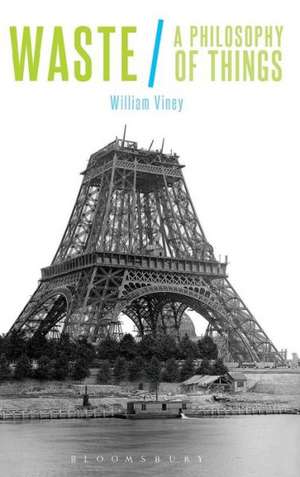
Waste: A Philosophy of Things
Autor William Vineyen Limba Engleză Hardback – 22 mai 2014
Preț: 849.38 lei
Preț vechi: 1193.42 lei
-29%
Puncte Express: 1274
Carte tipărită la comandă
Livrare economică 07-21 decembrie
Livrare prin curier în România Termenul estimat este afișat lângă disponibilitate.
Transport gratuit pentru acest produs Plată online sau ramburs, în funcție de opțiunile comenzii.
Retur gratuit în 14 zile Comandă securizată și suport în română.
Specificații
ISBN-13: 9781472527578
ISBN-10: 1472527577
Pagini: 240
Ilustrații: 24 illus
Dimensiuni: 160 x 238 x 20 mm
Greutate: 0.52 kg
Ediția:New.
Editura: Bloomsbury Publishing
Colecția Bloomsbury Academic
Locul publicării:London, United Kingdom
ISBN-10: 1472527577
Pagini: 240
Ilustrații: 24 illus
Dimensiuni: 160 x 238 x 20 mm
Greutate: 0.52 kg
Ediția:New.
Editura: Bloomsbury Publishing
Colecția Bloomsbury Academic
Locul publicării:London, United Kingdom
V-ar putea interesa
-
 The Aesthetic Mind: Philosophy and PsychologyElisabeth Schellekens-17%Preț: 370.70 lei443.96 lei
 -
 The Artful Universe ExpandedJohn Barrow-24%Preț: 164.77 lei218.08 lei
 -
 -30%Preț: 700.51 lei1001.19 lei
 -
 Art and Abstract ObjectsChristy Mag Uidhir-31%Preț: 572.59 lei827.76 lei
 -
 The Routledge Companion to Philosophy and FilmPaisley Livingston-15%Preț: 507.26 lei596.78 lei
 -
 The SublimeTimothy M. Costelloe-19%Preț: 246.02 lei304.35 lei
 -
 Environmental AestheticsMartin DrenthenPreț: 236.63 lei
 -
 Media and Formal CauseMarshall McLuhanPreț: 101.31 lei
 -
 -20%Preț: 192.56 lei239.95 lei
 -
 -21%Preț: 178.77 lei227.28 lei
 -
 The Politics of AestheticsGabriel Rockhill-24%Preț: 145.14 lei191.64 lei
 -
 AestheticsCharles TaliaferroPreț: 71.26 lei
Cuprins
Acknowledgements
List of Illustrations
1. Introduction
Part I: Collecting Waste
2. Narrating the Event of Waste
3. Archaeologies of Waste
Part II: Reading Waste
4. The Poetic Economies of T. S. Eliot
5. Reading Joycean Disjecta
Part III: Building Ruins
6. Ruins Past
7. Ruins of the Future
8. Conclusion
Notes
Bibliography
Index
List of Illustrations
1. Introduction
Part I: Collecting Waste
2. Narrating the Event of Waste
3. Archaeologies of Waste
Part II: Reading Waste
4. The Poetic Economies of T. S. Eliot
5. Reading Joycean Disjecta
Part III: Building Ruins
6. Ruins Past
7. Ruins of the Future
8. Conclusion
Notes
Bibliography
Index
Recenzii
This book will convince you that our most complex contemporary ideas about time are at work in the concept of waste. It draws its temporal concepts from many places, from art and literature, philosophy and cultural theory, narrative and the theory of narrative to think about the time of things - things we discard, things we used to use, things we collect, things that fall into ruin, and things that hold the future within them. It animates the theory of things and makes something beautiful out of waste.
If the primary achievement of recent civilization is to produce unprecedented heaps of garbage, what does this tell us about that civilization? In his pleasantly lucid prose style, Will Viney answers this question by providing an ontology, a sociology, and even an art criticism of waste, with special attention to the writings of T.S. Eliot and James Joyce and the visual art of Cornelia Parker and Mark Dion.
If the primary achievement of recent civilization is to produce unprecedented heaps of garbage, what does this tell us about that civilization? In his pleasantly lucid prose style, Will Viney answers this question by providing an ontology, a sociology, and even an art criticism of waste, with special attention to the writings of T.S. Eliot and James Joyce and the visual art of Cornelia Parker and Mark Dion.