Warming to Ecocide
Autor Alan J. Sangsteren Limba Engleză Paperback – 23 aug 2014
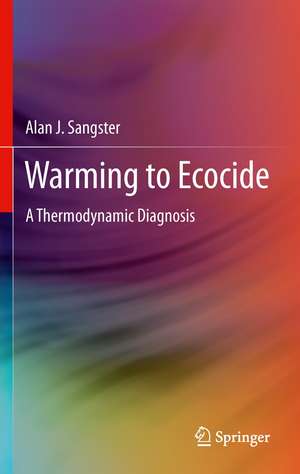
Warming to Ecocide begins by exploring the thermodynamic origins of climate change. It demonstrates that equilibrium thermodynamics can provide full explanations for the basic processes of life such as photosynthesis and metabolism, and that non-equilibrium thermodynamics is close to providing an explanation for how life started.
Armed with a solid appreciation of the power of thermodynamics, the second half of Warming to Ecocide discusses whether multinational corporations have convinced the public that climate change is insignificant and thereby neutered any all attempts by governments to espouse environmentally-friendly policies. It then goes on to offer strategies whereby mankind may avoid propelling the global average temperature above the pre-industrial level by more than 2°C, which scientists view as a threshold presaging catastrophic run-away processes.
Preț: 617.46 lei
Preț vechi: 726.42 lei
-15%
Puncte Express: 926
Carte tipărită la comandă
Livrare economică 20 noiembrie-04 decembrie
Livrare prin curier în România Termenul estimat este afișat lângă disponibilitate.
Transport gratuit pentru acest produs Plată online sau ramburs, în funcție de opțiunile comenzii.
Retur gratuit în 14 zile Comandă securizată și suport în română.
Specificații
ISBN-13: 9781447160205
ISBN-10: 1447160207
Pagini: 260
Ilustrații: XVII, 242 p.
Dimensiuni: 155 x 235 x 15 mm
Greutate: 0.4 kg
Ediția:2011
Editura: Springer
Locul publicării:London, United Kingdom
ISBN-10: 1447160207
Pagini: 260
Ilustrații: XVII, 242 p.
Dimensiuni: 155 x 235 x 15 mm
Greutate: 0.4 kg
Ediția:2011
Editura: Springer
Locul publicării:London, United Kingdom
V-ar putea interesa
-
 Latent Heat Transfer: An Introduction to FundamentalsG. S. H. Lock-21%Preț: 339.13 lei427.68 lei
 -
 Sustainable Energy Systems and ApplicationsIbrahim Dincer-15%Preț: 757.55 lei891.24 lei
 -
 Biological ThermodynamicsDonald T. Haynie-19%Preț: 557.28 lei687.99 lei
 -
 -19%Preț: 448.27 lei553.42 lei
 -
 -23%Preț: 476.43 lei618.75 lei
 -
 Introduction to Thermodynamics of Mechanical FatigueMichael M. Khonsari-18%Preț: 1604.53 lei1956.74 lei
 -
 Heat TransferPeter BöckhPreț: 472.08 lei
 -
 Transient Heat TransferDonatello AnnaratonePreț: 361.95 lei
 -
 Preț: 280.24 lei
Public țintă
ResearchCuprins
1. Equilibrium Thermodynamics.- 2. Equilibrium Thermodynamics and Life.- 3. Non-equilibrium Thermodynamics.- 4. Thermodynamics and Climate.- 5. Man’s Artificial Eco-system.- 6. Eco-blind Civilisation.- 7. Dismantling the Fossil Fuel Era.- 8. Sustainable Technologies.
Textul de pe ultima copertă
Despite scientific evidence that business-as-usual is unsustainable, there is a huge and widespread inertia to ‘greening’ the planet. Warming to Ecocide considers climate change from a thermodynamic perspective and asks whether market-driven organisations have carried us to the point of no return through the flawed economics of endless growth.
Warming to Ecocide begins by exploring the thermodynamic origins of climate change. It demonstrates that equilibrium thermodynamics can provide full explanations for the basic processes of life such as photosynthesis and metabolism, and that non-equilibrium thermodynamics is close to providing an explanation for how life started.
Armed with a solid appreciation of the power of thermodynamics, the second half of Warming to Ecocide discusses whether multinational corporations have convinced the public that climate change is insignificant and thereby neutered any all attempts by governments to espouse environmentally-friendly policies. It then goes on to offer strategies whereby mankind may avoid propelling the global average temperature above the pre-industrial level by more than 2°C, which scientists view as a threshold presaging catastrophic run-away processes.
Warming to Ecocide begins by exploring the thermodynamic origins of climate change. It demonstrates that equilibrium thermodynamics can provide full explanations for the basic processes of life such as photosynthesis and metabolism, and that non-equilibrium thermodynamics is close to providing an explanation for how life started.
Armed with a solid appreciation of the power of thermodynamics, the second half of Warming to Ecocide discusses whether multinational corporations have convinced the public that climate change is insignificant and thereby neutered any all attempts by governments to espouse environmentally-friendly policies. It then goes on to offer strategies whereby mankind may avoid propelling the global average temperature above the pre-industrial level by more than 2°C, which scientists view as a threshold presaging catastrophic run-away processes.
Caracteristici
Suggests a route to avoiding runaway climate change by reinstating the greenhouse thermostat to its full operational capacity Addresses mankind's contribution to climate change from a thermodynamic perspective Describes and illustrates the power of thermodynamics to furnish insights into the thermal behaviour of complex physical systems
Notă biografică
¿Alan J. Sangster received a B.Sc. in Electrical and Electronic Engineering in 1963, an M.Sc. in 1964, and a Ph.D. in 1967, all from the University of Aberdeen in Scotland. His research interests have been in the areas of microwave antennas, mm-wave sensing, electrostatically driven micromotors and microactuators, electromagnetic levitation, medical applications of microwaves, microwave propagation in geological strata, satellite communications at microwave frequencies, and the numerical solution of electromagnetic radiation and scattering problems. He is the author of over 230 papers on these topics. Professor Sangster spent four years with Ferranti plc, Edinburgh, Scotland, pursuing research into wide-band travelling wave tubes, and three years with Plessey Radar Ltd., Cowes, U.K., investigating and developing microwave devices and antennas for microwave landing systems and frequency scanned radar systems. Since 1972, he has been with the Heriot-Watt University, Edinburgh, where he became a full Professor of Electromagnetic Engineering in 1989. He retired in 2006, but continues to act in a professorial capacity as a consultant to industry on microwave antennas and microwave component design. He is a Chartered Electrical Engineer, a Fellow of the Institution of Engineering Technology (U.K.), and a Member of the Electromagnetics Academy (U.S.A.).