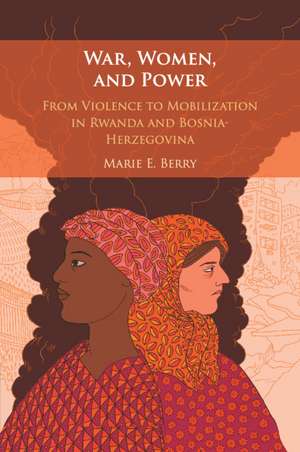
War, Women, and Power
Autor Marie E. Berryen Limba Engleză Paperback – 8 sep 2018
Considerăm că volumul War, Women, and Power reprezintă o contribuție esențială prin abordarea sa interdisciplinară, situându-se la intersecția dintre sociologia politică, studiile de gen și analiza conflictelor armate. Marie E. Berry investighează modul în care traumele colective din Rwanda și Bosnia-Herțegovina au servit, în mod paradoxal, drept catalizatori pentru o mobilizare politică fără precedent a femeilor, demontând imaginea acestora de simple victime pasive. Structura lucrării se sprijină pe o metodologie riguroasă, integrând peste 260 de interviuri care oferă o perspectivă intimă asupra transformărilor structurale post-conflict. Găsim în această carte o analiză nuanțată a modului în care distrugerea vechilor ierarhii patriarhale în timpul războiului a forțat femeile să ocupe spații economice și politice anterior inaccesibile. Stilul autoarei este precis și analitic, evitând generalizările și susținând fiecare ipoteză prin date demografice și cartografice clare. Această lucrare completează perspectiva oferită de Women, War, and Violence, adăugând o dimensiune empirică solidă prin studiile de caz specifice care explică mecanismele de putere, dincolo de simpla documentare a activismului. În contextul operei sale, volumul se corelează direct cu Healing and Peacebuilding after War, unde autoarea a explorat procesele de vindecare colectivă. Dacă în lucrarea anterioară accentul cădea pe reconstrucția socială, War, Women, and Power face un pas înainte, analizând cum aceste procese de recuperare sunt dublate de o luptă pentru reprezentare oficială și putere legislativă. Este o lectură densă, publicată de Cambridge University Press, care reușește să explice de ce câștigurile politice feminine sunt adesea fragile și supuse regresului în perioadele de stabilitate post-război.
Preț: 303.07 lei
Carte tipărită la comandă
Livrare economică 05-19 decembrie
Specificații
ISBN-10: 1108401511
Pagini: 298
Ilustrații: 10 b/w illus. 4 maps 3 tables
Dimensiuni: 152 x 229 x 18 mm
Greutate: 0.49 kg
Editura: Cambridge University Press
Locul publicării:New York, United States
De ce să citești această carte
Recomandăm această carte cercetătorilor și studenților interesați de dinamica puterii în societățile post-conflict. Cititorul va obține o înțelegere profundă a modului în care structurile de gen se reconfigurează sub presiunea crizelor majore. Este o resursă valoroasă pentru cei care lucrează în organizații internaționale și politici publice, oferind sugestii concrete pentru susținerea drepturilor femeilor în zonele afectate de violență.
Descriere scurtă
Cuprins
Recenzii
'This fascinating and important book examines the processes through which war facilitates women's grassroots mobilization through demographic, economic, and cultural transformations. It makes an original contribution to the study of gender and conflict. Moreover, it is well-written and nuanced, backed by strong evidence, drawing on a rich body of fieldwork in Rwanda and Bosnia.' Aili Mari Tripp, Wangari Maathai Professor of Political Science and Gender and Women's Studies, University of Wisconsin, Madison
'In this exceptional and often surprising book, Marie E. Berry shows how in disrupting power and gender relations, wars in Rwanda and Bosnia-Herzegovina created political and cultural openings that allowed women to mobilize in significant and surprising ways. An altogether extraordinary contribution to the literatures on war, contentious politics, and women's political participation.' Doug McAdam, Ray Lyman Wilbur Professor of Sociology, Stanford University, California
'Can something good come of war? Looking deeply into the processes involved in the 1990s civil wars of Rwanda and Bosnia-Herzegovina, Marie E. Berry faces up to an uncomfortable contradiction. A period of death and destruction may be transformative for women, bringing them increased opportunities and political mobilization, both in the community and in the postwar power structures. Stopping to explore, rather than brush aside, such contradiction when you meet it, as the wisest social analysts know, is highly productive. Berry's unflinching investigation teaches us a lot about patriarchal gender power-relations - which turn out to have as much resilience as do women when it comes to surviving war.' Cynthia Cockburn, Centre for the Study of Women and Gender, University of Warwick, and City University London
'Marie E. Berry's book is a passionately engaged, yet scientifically embedded account of how women came to be politically empowered - yet ultimately remained vulnerable - activists and political actors in two post-violence countries. Her paired comparison shows how political opportunities often arose in the midst of social disorganization, as women turned the search for survival into the creation of new roles and responsibilities. Her well-crafted narratives shine a new light on the relationships among gender, war, and political mobilization.' Sidney Tarrow, Author of Power in Movement
'A comparative study not only of the ways in which women responded to the wars in Rwanda and Bosnia, but also of what happened to the women and their visions for the future after the war officially ended.' International Affairs
'There is much to be praised about this book … While others have argued that women's political positions can change significantly for the better postwar, the meticulous engagement with the ways in which that happens and the limits to that transformation are worth reading … Its empirical work is very high quality, and it makes important theoretical contributions.' Perspectives on Politics
'Berry's book uniquely considers how war precipitates political engagement from the perspectives of women themselves. This is no small feat … If our current political situation is any indication, War, Women, and Power will prove insightful for a range of questions beyond Rwanda and Bosnia concerning women's activism and the violence that manifests in their lives when they challenge the status quo. It is a landmark book set to shape the conversation on gender, conflict, and mobilization for decades to come.' Elizabeth Borland, Mobilization
'Berry has not only given us an incredibly detailed examination of how structural forces have an impact on women's lives, but a book that is a shining example of how to combine field research and interviews with statistics to really grab a reader's attention … Simultaneously heartbreaking and uplifting, this work is a must-read for gender scholars and humanitarian players.' Lauren Cantillon, Wiener Library Blog (wienerlibrary.co.uk)
'… this book fills an important void in the broader scholarship on women and war by focusing on how episodes of mass violence intervene in - rather than simply reflect - the gendered power relations that undergird politics, prewar, during war, and postwar.' Kanisha D. Bond, American Journal of Sociology