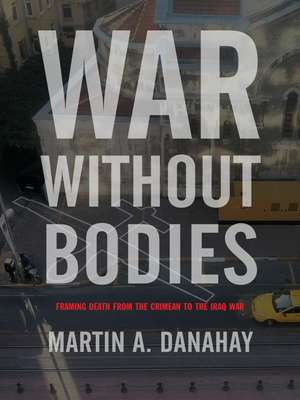
War without Bodies: Framing Death from the Crimean to the Iraq War: War Culture
Autor Martin Danahayen Limba Engleză Hardback – 18 mar 2022 – vârsta ani
Analyzing poetry, photographs, video and video games the book illustrates the ways in which war was framed in these different historical contexts. It examines the cultural assumptions that influenced the reception of images of war and discusses how death and damage to bodies was made acceptable to the public. War Without Bodies aims to heighten awareness of how acceptance of war is coded into texts and how active resistance to such hidden messages can help prevent future unnecessary wars.




Preț: 933.64 lei
Preț vechi: 1092.86 lei
-15%
Puncte Express: 1400
Preț estimativ în valută:
165.11€ • 195.77$ • 143.75£
165.11€ • 195.77$ • 143.75£
Carte indisponibilă temporar
Doresc să fiu notificat când acest titlu va fi disponibil:
Se trimite...
Specificații
ISBN-13: 9781978819207
ISBN-10: 197881920X
Pagini: 154
Ilustrații: 10 b&w images
Dimensiuni: 152 x 229 x 18 mm
Greutate: 0 kg
Editura: Rutgers University Press
Colecția Rutgers University Press
Seria War Culture
ISBN-10: 197881920X
Pagini: 154
Ilustrații: 10 b&w images
Dimensiuni: 152 x 229 x 18 mm
Greutate: 0 kg
Editura: Rutgers University Press
Colecția Rutgers University Press
Seria War Culture
Notă biografică
MARTIN A. DANAHAY is a professor of English at Brock University in Canada. He is the author of Gender at Work in Victorian Culture: Literature, Art and Masculinity and A Community of One: Masculine Autobiography and Autonomy in Nineteenth Century Britain.
Cuprins
Introduction: Two Photographs
Framing Death
War Culture
1. Sacrificial Bodies: Fenton, Tennyson and the Charge of the Light Brigade
Documenting the Crimean War: Fenton’s Photographs
Reliving the Charge of the Light Brigade
The Charge of the Light Brigade as Sacrifice
2. The Soldier’s Body and Sites of Mourning
Memorializing the Dead
The Charge of the Light Brigade and Psychological Trauma
Diagnosing Trauma
3. War Games
Fantasy Wars: Dungeons and Dragons
Virtual Warriors and Armchair Generals
The Pleasures of Conquest
4. Trauma and the Soldier’s Body
The Soldier’s Gendered Body
PTSD and Moral Injury
The Politics of PTSD
5. Sophie Ristelhueber: Landscape as Body
Fait and Drone Vision
Landscape and the Soldier’s Body
Reinserting the Civilian Body into the Frame
Conclusion: Future War without Bodies
Framing Death
War Culture
1. Sacrificial Bodies: Fenton, Tennyson and the Charge of the Light Brigade
Documenting the Crimean War: Fenton’s Photographs
Reliving the Charge of the Light Brigade
The Charge of the Light Brigade as Sacrifice
2. The Soldier’s Body and Sites of Mourning
Memorializing the Dead
The Charge of the Light Brigade and Psychological Trauma
Diagnosing Trauma
3. War Games
Fantasy Wars: Dungeons and Dragons
Virtual Warriors and Armchair Generals
The Pleasures of Conquest
4. Trauma and the Soldier’s Body
The Soldier’s Gendered Body
PTSD and Moral Injury
The Politics of PTSD
5. Sophie Ristelhueber: Landscape as Body
Fait and Drone Vision
Landscape and the Soldier’s Body
Reinserting the Civilian Body into the Frame
Conclusion: Future War without Bodies
Recenzii
"War Without Bodies contributes to an important and ongoing effort to understand—and to challenge— the myriad ways in which a culture of war has been historically normalized as a function of “new” technologies of representation. Martin Danahay illustrates how the illusion of a “war without bodies” complicates our capacity to engage the trauma of war by sanitizing its violence and undermining the very possibility of grieveable bodies, whether soldiers or civilians.
"You might not think to draw a line from Tennyson to Dungeons and Dragons, but that's the gift of this book. With great erudition, Danahay carefully folds historical epochs and disparate practices into one another, adding layers of richness to the old question of how war has figured the body."
Descriere
Thanks to the invention of photography and the telegraph descriptions and images of war have proliferated from the nineteenth century onward, yet wars continue to be fought. The way descriptions of war are framed blunts the impact of images of death and makes war an acceptable option by representing it as “war without bodies” therefore without casualties. Beginning with Crimean War, War Without Bodies traces the ways that death was framed in poetry, photography, video and video games up to and including the Iraq War.